
You finish a MYP maths task, you feel good, you even check the final answer twice.
Then the grade arrives and it lands like a small, confusing thud: not as high as you expected.
In MYP Mathematics, that feeling is common because marks are not only about being correct. They are about what kind of thinking your work proves you can do. Once you understand the four MYP criteria, the grading stops feeling random and starts feeling like a map you can actually follow.
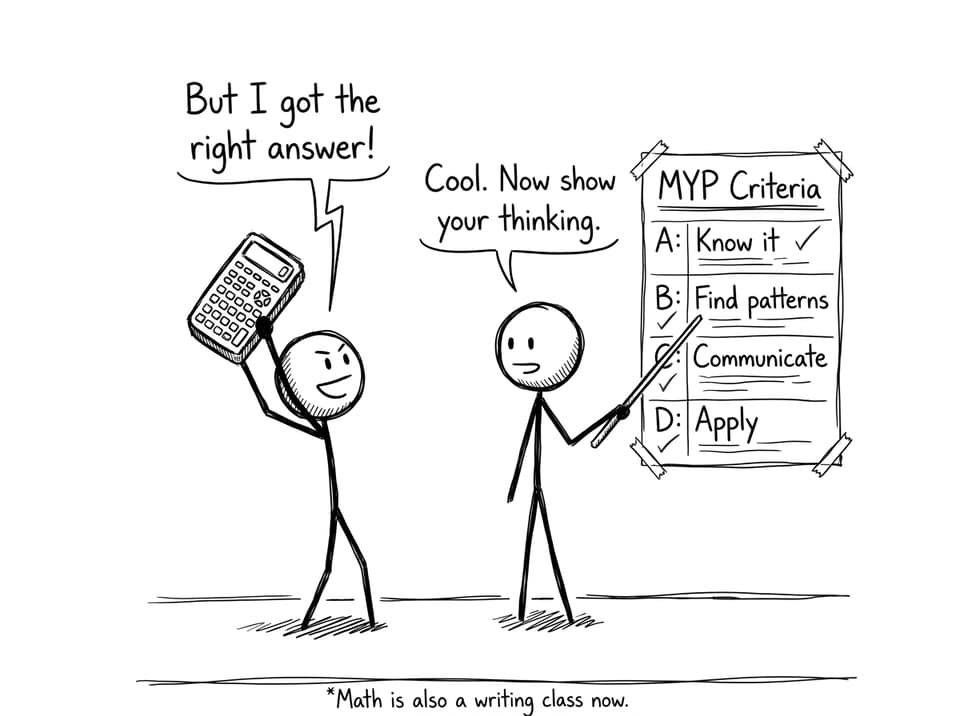
The MYP Math criteria in one simple checklist
When a teacher grades MYP work, they are basically asking four different questions:
-
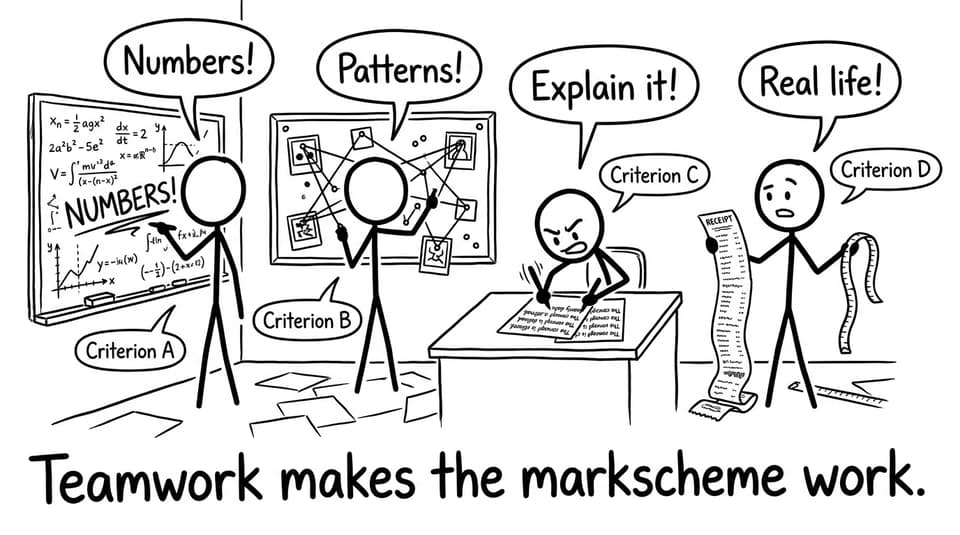
Criterion A (Knowing and understanding): Do you know the maths and can you use correct methods?
-
Criterion B (Investigating patterns): Can you notice patterns and justify general rules?
-
Criterion C (Communicating): Can you show clear working and use correct notation?
-
Criterion D (Applying mathematics in real-life contexts): Can you interpret a real situation and explain what your result means?
If you want a fast overview of the wider framework, start at the MYP hub on RevisionDojo. For targeted practice, the MYP Standard Mathematics resources page is the quickest launch point.
Criterion A: Knowing and understanding (the “math skills” part)
Criterion A is the one most students assume is the whole grade. It rewards solid mathematical knowledge: choosing a valid method, applying formulas correctly, and getting accurate results.
In MYP, high Criterion A work usually looks like this:
-
You pick an appropriate method (not a random one that happens to work).
-
You show enough working that your method is visible.
-
Your calculations are careful and consistent.
The quiet trap: if you only train Criterion A, you can still plateau. You can be “good at maths” and still lose marks elsewhere because MYP expects more than a final line.
A practical way to build Criterion A quickly is to practise topic sets and check your method step-by-step. RevisionDojo’s Questionbank feature helps you do exactly that in a repeatable loop.
Criterion B: Investigating patterns (thinking like a mathematician)
Criterion B is where students often feel like the rules changed. You are not just solving a question; you are exploring structure: sequences, relationships, trends, and generalisations.
In MYP Criterion B, top responses tend to:
-
Describe the pattern clearly (what changes, what stays constant).
-
Test multiple cases (not just one example).
-
Write a general rule and justify it logically.
It’s the difference between saying, “It increases by 3,” and proving why “term n = 3n + 2” fits, including a brief justification.
If you want a concrete example-heavy route, practising pattern topics like sequences helps a lot. Try a focused set like Sequences Questionbank practice and write one sentence of justification after each answer.
Criterion C: Communicating (the “make your marks visible” criterion)
Criterion C is not about fancy vocabulary. It is about making your thinking easy to follow. Many strong students lose MYP marks here simply because their logic is trapped in their head.
In MYP maths, strong Criterion C habits include:
-
Clear steps in a sensible order.
-
Correct notation (especially with algebra, units, and graphs).
-
Diagrams that are labelled, not just drawn.
-
Short explanations of decisions (why that method, why that step).
A useful self-check is: If someone copied my working, could they learn the method? If not, your Criterion C is probably leaking marks.
For deeper revision systems built around clarity and structure, this guide is worth reading: Best Study Techniques for MYP Mathematics.
Criterion D: Applying mathematics in real-life contexts (where marks disappear quietly)
Criterion D is often misunderstood. It is not “harder maths.” It is more about interpretation, modelling, and explaining what the mathematics means in context.
In MYP Criterion D, high-scoring answers typically:
-
Identify relevant information and constraints.
-
Choose a strategy that fits the situation (not just the topic you revised last night).
-
Interpret the result using words and units.
-
Comment on reasonableness (does the answer make sense?).
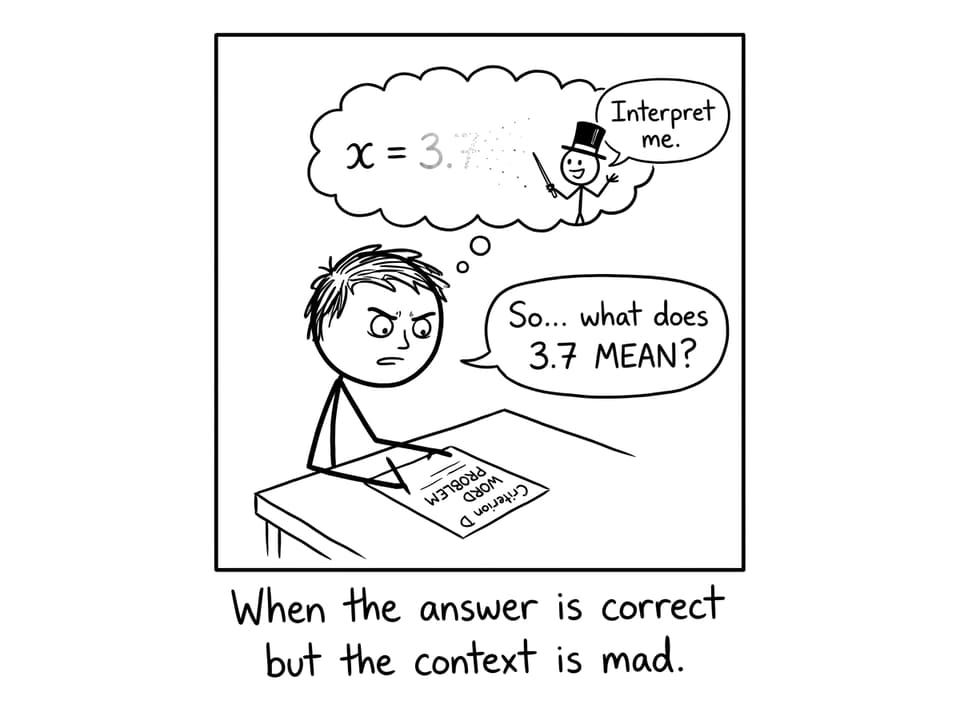
A classic mark-loss moment: you calculate perfectly, but you don’t connect the number back to the scenario. That missing sentence can be the difference between “math done” and “math applied.”
To build context confidence, practise modelling topics. A good place to start is Linear modelling, then switch immediately into question practice through the linked Questionbank sets.
Why you can feel “stuck” at a 5 or 6 in MYP Math
Most students pour time into Criterion A because it feels like traditional maths: practise, check answers, repeat.
But in MYP, that creates a predictable ceiling:
-
Patterns (Criterion B) get rushed.
-
Explanations (Criterion C) are too thin.
-
Context (Criterion D) is treated like decoration instead of the point.
If this sounds familiar, read Why Students Struggle With MYP Math (And How to Fix It). It explains the common bottlenecks in plain language.
A simple MYP revision routine that hits all four criteria
Try this 25-35 minute loop, three times per week:
-
5 min: skim one subtopic in Study Notes (aim for clarity, not completeness).
-
15 min: do a short set from the MYP Standard Mathematics resources Questionbank.
-
5 min: rewrite one solution focusing on Criterion C (clean steps + notation).
-
5 min: add one “interpretation sentence” focusing on Criterion D (units + meaning + reasonableness).
Over time, this trains you to earn marks across the full MYP rubric, not just the easiest corner of it.
If you want the larger picture of how assessment works, this article connects the dots well: How MYP Mathematics Is Assessed (and How to Revise).
Closing: make MYP grading feel fair by learning its logic
The MYP criteria are not there to trick you. They’re there to reward a fuller definition of “being good at maths”: knowing it, spotting structure, communicating clearly, and applying ideas to reality.
If you want your next MYP maths grade to feel earned (and repeatable), build your revision around the criteria, not just the answers. Start at the RevisionDojo MYP hub, then use the MYP Standard Mathematics resources to practise by skill with feedback that actually tells you what to fix next.