

In MYP Math, the most confusing moment is often this one: you finish the question, your final answer matches the mark scheme in your head, and yet the grade comes back… stubbornly average.
That mismatch can feel personal, like your effort isn’t translating.
But in the MYP, this is usually not a “you’re bad at maths” problem. It’s a “you’re playing the right game with the wrong rules” problem. MYP Mathematics rewards how you think, not just what number you land on. Once you study the way MYP is assessed, progress becomes surprisingly predictable.
A quick MYP Math checklist (use this before you revise)
If you’re stuck in MYP Math, run this quick diagnostic:
-
Can you name the four MYP criteria (A, B, C, D) and what each one rewards?
-
Do you show method and reasoning, even when the steps feel “obvious”?
-
Do you practise real-life context questions, not just clean textbook ones?
-
Do you review mistakes by criterion, not just by topic?
-
Do you do active practice more than passive revision?
If even two of these are “no,” your MYP grade can stall even when your maths skills are improving.
For a bigger picture of how the whole program fits together, start at the RevisionDojo MYP hub.
Why MYP Math feels unfair: the hidden switch from answers to evidence
Most students were trained by earlier systems to treat maths like a lock: find the right key, turn it, and you’re done.
MYP turns maths into something closer to a conversation. The marker can’t give credit for thinking they can’t see. And because MYP is criterion-based, you can be strong in one area (say, accurate calculations) and still lose a lot of marks elsewhere (communication or application).
If you haven’t already, read How MYP Mathematics Is Assessed (And How to Revise for It). It’s the single fastest way to understand what the MYP exam is really paying for.
MYP struggle #1: Only chasing the final answer
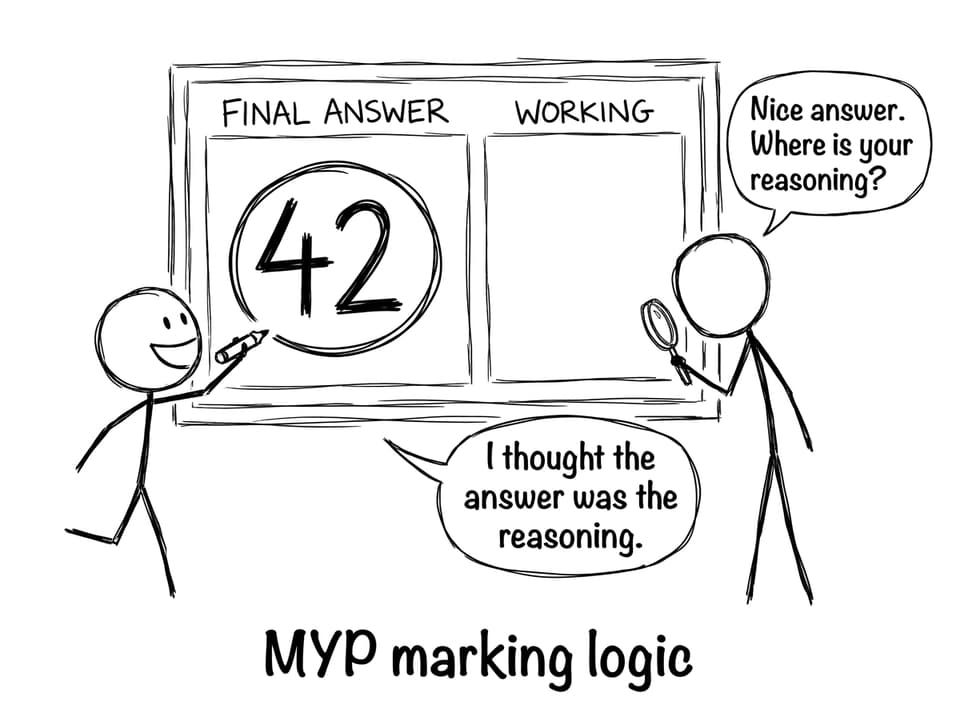
In MYP Math, the final answer is often the smallest part of what you’re being judged on.
Students lose marks when they:
-
write minimal working
-
skip justification (“why this method?”)
-
don’t interpret what the answer means
How to fix it in MYP
Practise adding one extra line after every solution:
-
Method line: “I used ___ because ___.”
-
Meaning line: “This value represents ___ in the context of the problem.”
RevisionDojo helps here because the Questionbank pushes you to practise under real marking expectations, and the workflow makes it easy to review solutions rather than just collect answers.
MYP struggle #2: Revising only Criterion A
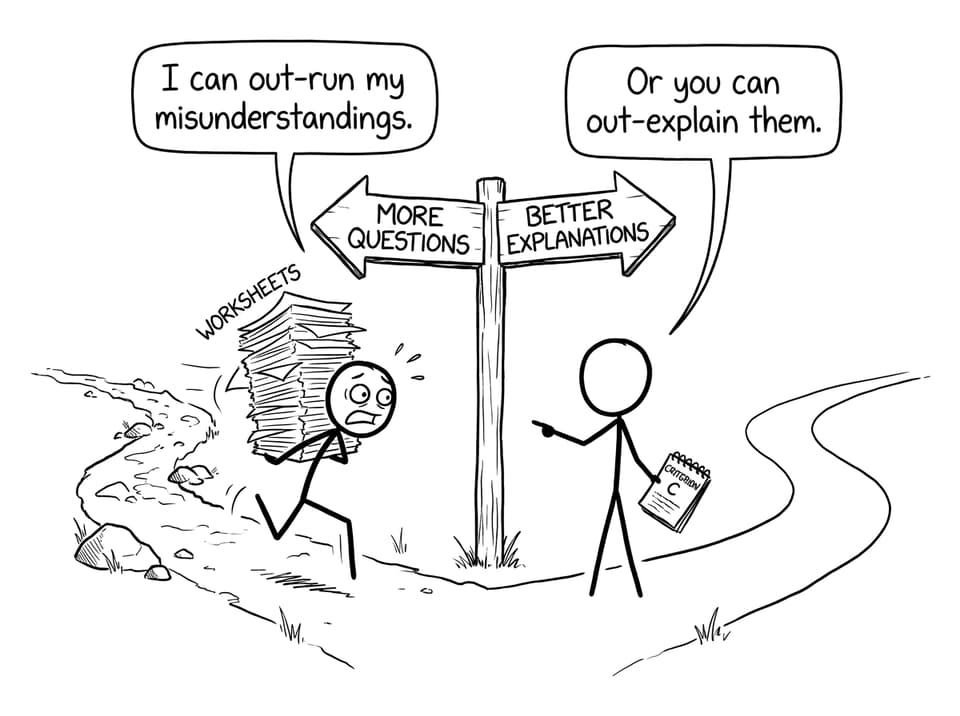
Criterion A (Knowing and Understanding) feels comforting because it looks like traditional maths: procedures, accuracy, correct use of formulas.
But if most of your revision sits there, you unintentionally neglect:
-
Criterion B (Patterns)
-
Criterion C (Communication)
-
Criterion D (Real-life application)
That imbalance caps your MYP performance quickly.
How to fix it in MYP
Revise in four short blocks each week:
-
A: accuracy + method (clean working)
-
B: pattern spotting + generalising (write a rule)
-
C: communication (units, labels, full steps)
-
D: context problems (interpretation and reasonableness)
A practical guide you can follow is Best Study Techniques for MYP Mathematics. Pair it with the MYP Standard Mathematics course hub so your practice stays structured.
MYP struggle #3: Real-life contexts scramble your thinking
A common MYP pattern is this: you understand the skill in isolation, but you freeze when it’s wrapped in a story.
Context questions make students:
-
misread what’s being asked
-
choose an inefficient method
-
forget to interpret their answer
How to fix it in MYP
Try a “three-read” habit:
-
Read for story (what is happening?)
-
Read for math (what quantities and relationships matter?)
-
Read for task (what exactly must you show?)
Then add a final check: “Does my answer make sense in real life?” That last line is often where Criterion D marks live.
MYP struggle #4: Weak mathematical communication
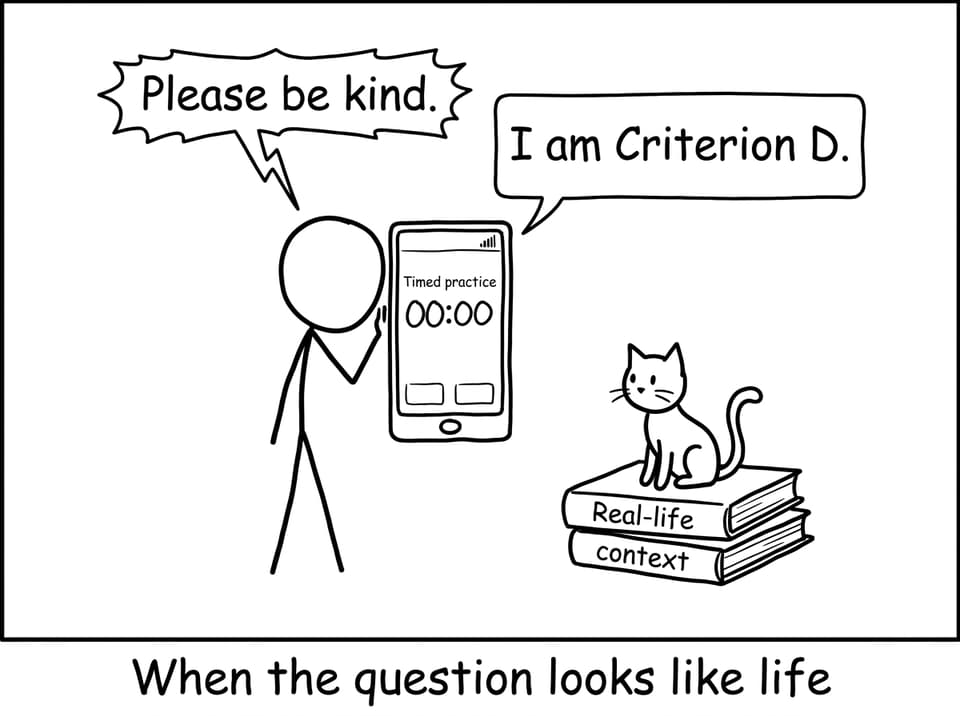
In MYP Math, unclear working is expensive.
Even when you’re right, you can lose marks for:
-
jumping steps
-
unlabeled diagrams
-
missing units
-
unclear notation
How to fix it in MYP
Make your working “gradable” by design:
-
One line per logical step
-
Label diagrams immediately
-
Write units every time the quantity is real-world
-
Use short math sentences when needed: “Let x represent…”
If you want help tightening explanations quickly, use RevisionDojo’s AI Chat to ask: “What is the clearest way to justify this method for Criterion C?” Then rewrite your solution once. That rewrite is where your grade changes.
MYP struggle #5: Passive revision creates fake confidence
Watching solution videos can feel like progress because everything seems obvious when someone else is driving.
But MYP performance depends on being able to:
-
choose a method under pressure
-
explain it clearly
-
adapt to unfamiliar contexts
How to fix it in MYP
Use active revision loops:
-
Attempt a set in the Questionbank
-
Mark and diagnose by criterion
-
Rewrite one response for clarity
-
Convert repeated mistakes into quick Flashcards
RevisionDojo makes this routine easier because Study Notes and Flashcards sit close to practice. If you haven’t explored them yet, see Flashcards and browse the wider IB Flashcards library for the active-recall habit that keeps skills from fading.
A simple 7-day reset plan for MYP Math
If exams are close and you want a plan that doesn’t rely on motivation:
-
Day 1: Read criteria basics + do a short mixed set
-
Day 2: Criterion C focus (rewrite solutions for clarity)
-
Day 3: Criterion D focus (context questions only)
-
Day 4: Criterion B focus (patterns and rules)
-
Day 5: Mixed set + error log
-
Day 6: Timed mini-set + review
-
Day 7: One mock-style set + rewrite your weakest response
For a longer runway, use MYP eAssessments: 30-Day Study Plan That Works. It’s designed to make MYP revision feel structured instead of chaotic.
The shift that unlocks MYP Math
MYP Math gets easier when you stop asking, “Did I get the right answer?” and start asking, “Did I leave enough evidence for marks?”
If you want one place to practise that evidence-building habit, start with the MYP Standard Mathematics resources, use the Questionbank for criterion-aware practice, and tighten memory with Flashcards.
MYP isn’t asking you to be a different kind of smart. It’s asking you to be visible about it.