

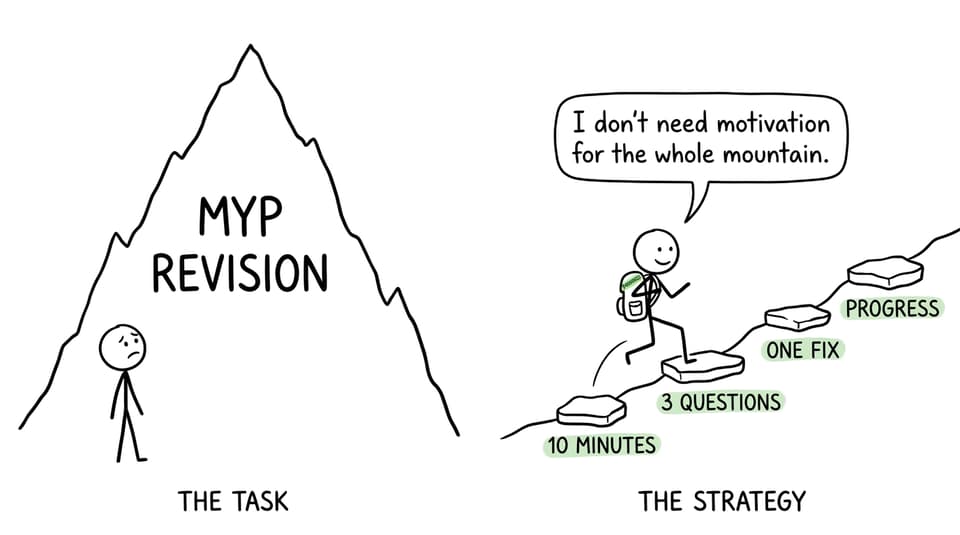
Motivation often disappears when a task feels larger than the next action you can take. “Revise science” sounds endless. “Answer three questions about energy transfers” feels possible.
That distinction matters if you want to stay motivated studying for MYP. You do not need to feel enthusiastic before every session. You need a study system that makes starting easy, shows evidence of progress, and gives you a clear next step when energy is low.
The MYP supports this through Approaches to Learning, or ATL skills. Self-management, reflection, communication, research, and thinking are practical skills you can practise. Motivation becomes more reliable when your routine helps you use them deliberately.
Your MYP motivation checklist
Use this checklist whenever revision feels heavy:
- Choose one subject and one specific skill
- Reduce the first task to ten minutes
- Retrieve information before rereading it
- Practise with questions, criteria, or command terms
- Record one improvement and one remaining weakness
- Decide the next task before finishing
- Stop at a planned time rather than studying until exhausted
You can find subject-specific materials in the RevisionDojo MYP resource hub. The goal is not to use everything at once. It is to remove the uncertainty involved in deciding what to do next.
A same-day method for starting now
This method takes about 45 minutes and works even if you have no timetable or have revised very little recently.
Choose a target you can finish
Write down the MYP subjects that concern you. Choose one based on an approaching assessment, a difficult topic, or teacher feedback.
Convert it into a small outcome. Instead of “study mathematics,” write “solve four linear equation questions and correct my errors.” Instead of “revise English,” write “analyse one authorial choice in a short paragraph.” A useful target includes a verb and a visible result.
Run a ten-minute starting block
Set a timer for ten minutes and place your phone outside reach unless you need it. Open only the resource required for the first task.
Begin with retrieval. Close your notes and write what you remember, explain the idea aloud, or attempt one question. This reveals the difference between recognising information and being able to use it.
If you are stuck, use RevisionDojo Study Notes to repair the gap. Then close the explanation and reproduce the idea in your own words. The MYP revision guide provides a broader framework for targeted review, practice, and reflection.
Complete a focused practice block
Continue for 20 minutes with one form of active practice:
- Answer three to five Questionbank questions
- Review Flashcards and separate confident answers from weak ones
- Plan a response around a command term
- Rewrite one answer using teacher feedback
- Explain a process without looking at your notes
Keep the task narrow. A small completed set provides more useful feedback than an ambitious session abandoned halfway through.
Make progress visible
Spend ten minutes checking your work. Do not only count correct answers. Ask why each mistake happened. Label it as a knowledge gap, command-term misunderstanding, weak explanation, careless error, or time-management issue. Then write one correction rule, such as: “When the question says evaluate, I will present strengths, limitations, and a supported judgment.”
RevisionDojo’s Grading tools and AI Chat can clarify feedback, but attempt the task independently first. The aim is to need fewer hints over time.
Leave yourself an easy restart
Use the final five minutes to write tomorrow’s first action. “Retest the four Flashcards I missed” is better than “continue biology.” Put the required book or digital page somewhere easy to access.
This reduces tomorrow’s starting friction. You are returning to one decision you have already made, not an undefined workload.
Stop treating motivation as an entrance requirement
Students often imagine this sequence: feel motivated, begin working, make progress. In practice, the order is frequently reversed. A small action creates evidence of progress, and that evidence makes another action easier.
Your routine should function on an ordinary Tuesday when you are tired, distracted, or unsure where to begin. Create a minimum version for those days: ten Flashcards, one paragraph plan, or two Questionbank problems. Minimum work will not replace deeper study, but it protects the habit.
If several subjects are the main problem, use a rotation instead of studying everything deeply every evening. The guide to balancing the eight MYP subject groups explains how focus sessions and maintenance tasks can work together.
Use MYP revision techniques that create feedback
A revision session becomes motivating when it answers: What can I do now that I could not do before? Passive rereading often gives no clear answer.
Revise against the assessment criteria
MYP assessment is criterion-related, so identify the criterion connected to the task and examine the descriptors provided by your school. Compare your response with those expectations instead of relying on whether it simply “feels good.”
Choose one improvement at a time. You might strengthen evidence, explain a relationship more fully, communicate with greater precision, or evaluate a method more carefully. One focused rewrite makes feedback actionable.
Practise command terms
Words such as identify, describe, explain, analyse, compare, and evaluate ask for different kinds of thinking. Make a Flashcard for each term, with the term on one side and the required action on the other.
Before answering, underline the command term and translate it into an instruction. “Analyse” might remind you to break material into parts and explain relationships. Students preparing for digital assessment can add the strategies in these MYP eAssessment success tips.
Match the technique to the subject
Sciences require conceptual understanding, data interpretation, and application in unfamiliar contexts. The guide to revising MYP Sciences without memorising everything shows how to move from recall into application.
Language and Literature requires analysis, organisation, and controlled writing. Short responses to unseen material can be more useful than repeatedly reading old annotations. Use these MYP Language and Literature revision strategies to build a focused routine.
Build a weekly system that survives difficult days
At the beginning of each week, choose two priority subjects and give the others short maintenance sessions. Schedule tasks, not vague blocks of time:
- Monday: four algebra questions and corrections
- Tuesday: one literary analysis paragraph
- Wednesday: science Flashcards and one data question
- Thursday: rewrite a response using criterion feedback
- Friday: mixed retrieval and weekly reflection
Leave one flexible block for unfinished work. A timetable with no spare capacity can collapse after one difficult day, while a flexible plan gives you somewhere to recover.
As assessments approach, gradually introduce timed practice. RevisionDojo’s Mock Exams and Predicted Papers, where available for your subject, can make timing and sustained concentration more familiar. The 30-day MYP eAssessment study plan can help organise that progression.
Use support without giving away the thinking
RevisionDojo works best as a connected study system. Use Study Notes for clarity, Flashcards for retrieval, and the Questionbank for application. Then use AI Chat and Grading tools to diagnose confusion and improve responses.
The Coursework Library can help you examine how strong work is structured, while Tutors provide human guidance when you need accountability or cannot identify a recurring problem. Mock Exams and Predicted Papers can support later rehearsal when suitable resources are available.
The boundary is simple: try before seeking help, study the feedback, and perform the skill again without assistance.
Motivation grows from keeping small promises
The goal is not to become someone who always wants to study. It is to become someone who knows how to begin when motivation is quiet.
Start today with one subject, one ten-minute block, and one measurable task. Record what improved. Choose tomorrow’s first action before you stop.
RevisionDojo can hold resources, practice, feedback, and support in one place. You still do the thinking, but you spend less energy wondering what to do next. That is often where lasting MYP motivation begins.