To stay calm when everyone around seems more prepared, stop treating other students’ visible effort as reliable evidence. You can see the books they carry, the hours they claim and the questions they answer in class. You cannot see what they misunderstand, forget or avoid.
Your task is not to become the most prepared-looking person in the room. It is to build enough evidence, one completed revision block at a time, that you can trust your own preparation.
That distinction matters during the September-to-November window. The IB November session is close enough to feel real, but there is still time to make meaningful progress. Comparison consumes attention that could be invested in practice.
Your calm-response checklist
When comparison starts turning into panic, use this sequence:
- Name the thought: “I am comparing my preparation with someone else’s presentation.”
- Check your own evidence: recent scores, recurring errors and completed topics.
- Choose one paper skill or subtopic, not an entire subject.
- Work for 25-45 focused minutes.
- Review mistakes before beginning another task.
- Decide tomorrow’s first action before finishing.
- Protect sleep instead of extending revision indefinitely.
Calm is not the absence of pressure. It is knowing what to do next while pressure is present.
Why everyone else can seem further ahead
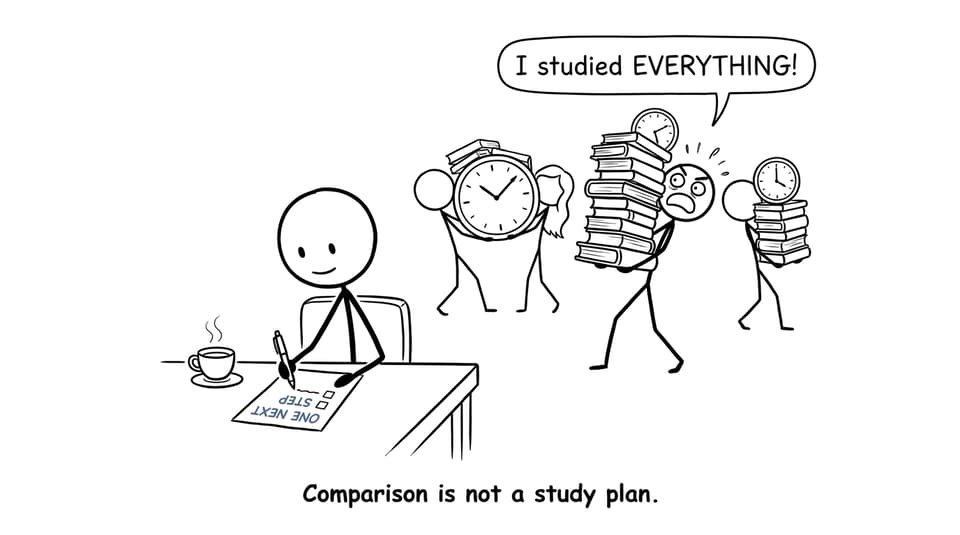
Preparation is unusually easy to perform socially. A student can mention a three-hour study session without mentioning that much of it was spent rereading. Someone can say they have “finished Biology” when they mean they have reviewed their notes once. Another person may be strong in Mathematics while privately worrying about English.
The mind turns these fragments into a complete story: everyone is ready except me. That conclusion is built from incomplete information. Even when another student is ahead, their position does not change the next useful action available to you.
Try replacing social questions with diagnostic ones:
- Which question type repeatedly costs me marks?
- Can I recall this topic without looking at notes?
- Am I losing marks through knowledge, interpretation or timing?
- What can I retest within 48 hours?
These questions return your attention to variables you can control.
Build a September-to-November plan you can trust
The official 2026 November examination schedule currently runs from late October into mid-November. Check your school’s confirmed arrangements, then use the IB November 2026 exam schedule and study plan to identify demanding clusters and double-session days.
A useful plan changes as the session approaches:
| Period | Main purpose | Practical focus |
|---|---|---|
| September | Diagnose and repair | Topic checks, concise notes and targeted questions |
| Early October | Improve execution | Mixed questions, timed sections and mistake reviews |
| Final 2-3 weeks | Rehearse stability | Mock conditions, recall and recovery between sessions |
| Final 48 hours | Protect readiness | Light review, logistics, food and sleep |
In September, breadth matters because you need to discover gaps while there is time to repair them. Use concise IB revision notes for quick review, close the notes and retrieve the idea from memory. Then answer questions on that exact topic.
In October, shift toward performance. Practise selecting questions, interpreting command terms and working under a clock. The goal is to learn how your knowledge behaves under exam conditions.
During the final weeks, study your timetable as carefully as your syllabus. RevisionDojo’s guide to the hardest November exam days can help you plan for consecutive papers without turning every day into a marathon.
Replace vague reassurance with visible evidence
Telling yourself “I’ll be fine” may help briefly, but evidence is more dependable than reassurance. Create a small preparation dashboard for each subject with four measures:
- Topics tested
- Accuracy or marks achieved
- Recurring error patterns
- Next scheduled retest
After a Questionbank set, do not merely record the score. Label each mistake as a content gap, command-term error, timing problem or careless slip. Use Study Notes or AI Chat to clarify the smallest relevant gap, then turn anything worth remembering into Flashcards. If your response needs judgement rather than another explanation, use the Grading tools to make the feedback concrete.
This is the quiet advantage of an error log. A disappointing score stops being a verdict and becomes a map.
For a broader system, follow the step-by-step IB exam study guide. RevisionDojo brings the loop together through its Questionbank, Study Notes, Flashcards, AI Chat and Grading tools, so you spend less time hunting for resources and more time responding to evidence.
Control comparison before it controls the day
You do not need to avoid classmates. You need boundaries around conversations that make you less effective.
Before studying, mute group chats and keep your phone beyond arm’s reach. At school, leave conversations that become competitive inventories of completed chapters. A simple sentence is enough: “I’m following my own plan today.” No defence is required.
An anxious classmate may unintentionally multiply your uncertainty. A teacher, coordinator or qualified Tutor can help you distinguish a real preparation gap from a fear-driven one.
If remaining coursework competes with revision, use the Coursework Library to inspect structure and criteria rather than guessing what strong work looks like. For additional structure, the IB time-management guide explains how to convert an overwhelming calendar into bounded tasks.
Practise calm under controlled pressure
Calm cannot be saved exclusively for exam day. It needs rehearsal.
Begin with a short timed section rather than jumping directly into a full simulation. Sit somewhere quiet, remove unnecessary materials and obey the time limit. When discomfort appears, continue working instead of interpreting that feeling as failure.
Gradually build toward Predicted Papers and Mock Exams. These tools help you practise pacing, question selection and recovery after getting stuck. Review each attempt carefully, because simulation without correction can repeat the same habits.
If anxiety rises during a session, use a brief reset:
- Put down your pen.
- Relax your shoulders and place both feet on the floor.
- Breathe out slowly for longer than you breathe in.
- Identify the smallest answerable part of the task.
- Restart there.
The purpose is not to feel perfectly relaxed. It is to restore enough attention to act. The RevisionDojo guide to beating IB exam anxiety offers more ways to build this response before the real session.
Protect the final weeks from panic decisions
As November approaches, students often respond to fear by adding resources, abandoning routines or studying deep into the night. These actions feel serious because they are dramatic, but they are often less useful than repeating a familiar system.
During the last two weeks before IB exams, prioritize short recall, targeted corrections and realistic timed work. Keep a firm stopping time at night. Prepare approved equipment and confirm transport before each paper.
After an exam, allow a brief factual debrief if it produces a useful lesson. Then stop. Reconstructing every answer with classmates cannot recover marks, but it can drain attention from the next paper.
Your preparation does not need to look impressive
The student carrying the thickest folder may feel calm or terrified. You cannot know. What you can know is whether you completed today’s questions, reviewed the errors and scheduled the next attempt.
That is enough to build momentum.
RevisionDojo is designed to make that process easier to repeat. Use Study Notes for clarity, Flashcards for retention, the Questionbank for application, AI Chat and Grading tools for feedback, and Predicted Papers or Mock Exams for timed rehearsal. When coursework or a stubborn subject needs deeper support, the Coursework Library and Tutors are there too.
You do not have to win the appearance of preparation. You need a plan that remains usable on an ordinary September evening, a tense October weekend and the morning of a November exam. Calm grows when the next step is clear, and RevisionDojo gives every IB student one place to take it.


