



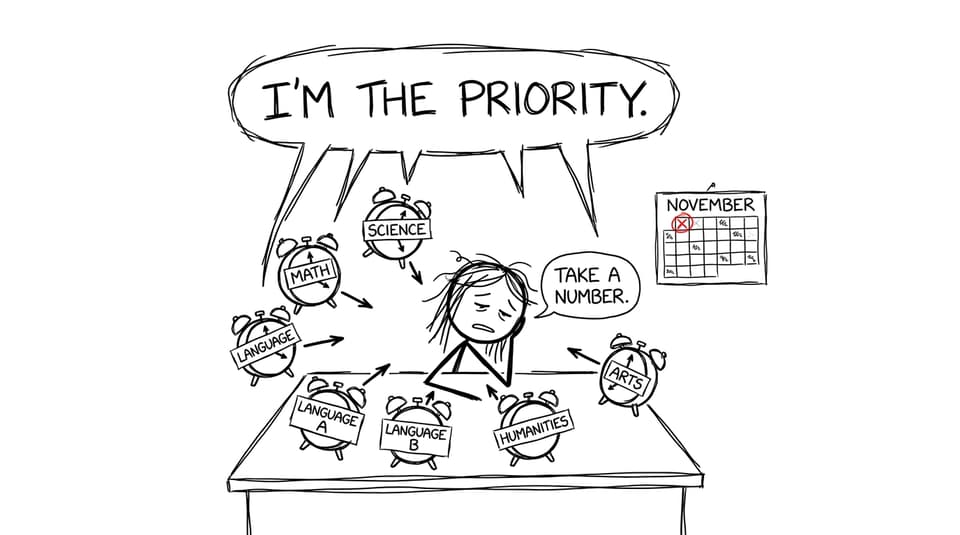
The final revision push creates a strange illusion: because every subject matters, every subject appears to deserve equal time. It does not.
This subject-by-subject priority guide for final revision helps November-session students decide what to study from September onward. The short answer is to prioritise by exam date, current weakness, assessment weight, and the type of practice each subject requires. Mathematics needs frequent problem-solving. Language A needs repeated analysis and planning. Biology may demand precise retrieval. Giving each subject the same revision routine feels fair, but it is rarely effective.
For November 2026, the official IB schedule runs from 23 October to 13 November. Most students begin their papers on or after 26 October, depending on their subjects. Check your personal timetable and exam zone with your coordinator, then use RevisionDojo’s November 2026 exam schedule and study plan to plan backwards.
Your final revision priority checklist
Before deciding what to revise tonight, ask:
- Which paper comes first?
- Which subject is currently furthest below my target?
- Which weaknesses can still improve through deliberate practice?
- Which paper requires stamina, not just knowledge?
- Which mistakes have appeared more than once?
- What can I test today instead of merely rereading?
A simple priority score can help when everything feels urgent:
You do not need mathematically precise values. Rate each factor from 1-5 and compare subjects. The purpose is not perfect measurement. It is to prevent mood from choosing your study plan.
Language A: prioritise interpretation and argument
Language A revision should move beyond collecting quotations or literary techniques. Your priority is producing a defensible interpretation quickly, supporting it precisely, and maintaining a coherent argument under time pressure.
From September, build a compact bank of textual knowledge, analytical methods, and flexible comparisons. Each week, complete several 10-minute plans and at least one timed paragraph. By October, progress to complete timed responses and review where your argument becomes descriptive.
For Paper 1, practise identifying the central purpose, audience, structure, tone, and most consequential authorial choices. For Paper 2, prioritise comparisons that can serve several plausible questions. RevisionDojo’s subject-specific IB revision guide offers a wider framework for turning analysis into exam-ready routines.
Language B and ab initio: prioritise daily contact
Languages decline when revision is saved for one long weekend. They improve through repeated exposure.
Use 20-30 minutes most days for vocabulary retrieval, reading, listening, and short writing. Maintain a list of recurring grammar errors and rewrite corrected sentences rather than simply reading feedback. For writing, practise selecting the right text type, register, conventions, and tone before worrying about sophisticated vocabulary.
Listening deserves deliberate attention because it is difficult to rescue with last-minute memorisation. Complete short, timed listening tasks and note whether mistakes come from vocabulary, speed, inference, or lost concentration. In the final week, keep daily contact with the language but reduce exhausting sessions.
Individuals and societies: prioritise usable evidence
History, Economics, Geography, Business Management, Psychology, Global Politics, and related subjects contain more material than you can productively reread. The priority is usable knowledge: evidence you can retrieve, select, and apply to the exact command term.
Build plans around common task types. Historians should connect evidence to competing interpretations. Economics students should combine accurate theory, diagrams, application, and evaluation. Psychology students need studies that can support multiple prompts while remaining methodologically accurate. Geography and Business Management students should practise moving from case evidence to reasoned judgement.
By October, use timed outlines and full responses to expose weak selection. RevisionDojo’s IB Study Notes organised by subject can repair a narrow knowledge gap, while Grading tools can help you examine structure and completeness. Always compare feedback with your teacher’s guidance and the current assessment criteria.
Sciences: prioritise retrieval, data, and method
Biology, Chemistry, Physics, Environmental Systems and Societies, Computer Science, and Sports, Exercise and Health Science combine knowledge with application. Knowing the chapter is not the same as answering the question.
Biology
Prioritise precise definitions, processes reconstructed from memory, data analysis, and clear extended responses. Draw a process without notes, label it, explain each step, then test it with targeted questions. Vague familiarity is the main enemy.
Chemistry
Prioritise calculation setups, units, reaction logic, experimental reasoning, and movement between representations. Keep a reaction map and an error log organised by method. A repeated stoichiometry error is more valuable to fix than another hour of comfortable reading.
Physics
Prioritise model selection. Before calculating, sketch the situation, identify the governing idea, choose an equation, and check units. Daily short sets usually build more fluency than occasional marathons.
Across the sciences, alternate focused Questionbank sets with mixed practice from RevisionDojo’s complete IB resource library. Use AI Chat when a misconception survives your first correction, then explain the repaired idea without assistance.
Mathematics: prioritise recognition and clean execution
Math AA and Math AI require more than remembering procedures. Under pressure, you must recognise which procedure fits.
From September, practise by topic to repair foundations. As October approaches, mix topics so the question no longer announces its method. Separate errors into concept, setup, algebra, calculator use, interpretation, and timing. That classification tells you what to do next.
Paper-specific practice matters. Train non-calculator reasoning where relevant, efficient calculator use where permitted, and unfamiliar multi-step work for HL components. Write enough working to preserve method marks and check whether your answer is sensible in context.
RevisionDojo’s guide to smarter IB exam preparation explains how to progress from untimed accuracy to complete simulation without rushing the process.
The arts: prioritise the component still in play
Arts subjects do not fit one universal revision template. Depending on the course, substantial assessment may already sit in completed creative, performance, comparative, or process-based work.
First confirm with your teacher which components remain and what evidence the current criteria require. If coursework is still open, prioritise missing evidence, weak reflection, unclear artistic intention, and alignment with the rubric. Do not spend hours polishing a visually attractive page if the assessed explanation remains thin.
RevisionDojo’s Coursework Library and Tutors can be useful for understanding structure and receiving human guidance. They should support your own work, not replace your judgement or authorship.
Change the plan from September to November
September: diagnose and repair
Use the fall term to find the truth early. Complete short diagnostic sets across every subject, identify the weakest papers, and repair foundational gaps with Study Notes, Flashcards, and topic-filtered Questionbank practice. Students searching for an “IB NovExam” plan often start with a generic calendar, but your actual timetable should determine the order.
October: integrate and time
Move from isolated topics to mixed sets, timed essays, and complete sections. Use RevisionDojo Predicted Papers and Mock Exams as fresh rehearsal, not as forecasts of exact questions. Review every attempt, convert recurring errors into Flashcards, and repeat the same skill after a delay.
Pay special attention to consecutive or demanding exam days. The November 2026 hardest exam days guide can help you identify pressure clusters, but your personal combination of subjects remains decisive.
The final 72 hours: stabilise
Do not attempt to rebuild an entire course. Use brief retrieval, a small targeted question set, your error log, and one light planning exercise. Confirm equipment and logistics with your school. Protect sleep and arrive with a routine that already feels familiar.
Make the next decision small
Final revision is not won by creating the most ambitious timetable. It is won by repeatedly identifying the next mark you can realistically recover.
RevisionDojo is the ultimate IB resource for keeping that process connected. Study Notes clarify, Flashcards strengthen retrieval, the Questionbank develops application, AI Chat resolves stubborn confusion, and Grading tools sharpen responses. Predicted Papers and Mock Exams build timing, while the Coursework Library and Tutors support the parts of the diploma that still need considered guidance.
Choose one subject, one paper, and one weakness. Test it today. Let the evidence choose tomorrow’s priority.