

If you have ever opened your IB binder and felt a quiet panic rise in your chest, you are not alone.
It usually starts innocently: you decide to "just review one topic." Then you notice how many topics there are. Then you remember you also have another IB subject. Then another. Suddenly your brain is doing that thing where it tries to solve the entire future at once, and fails.
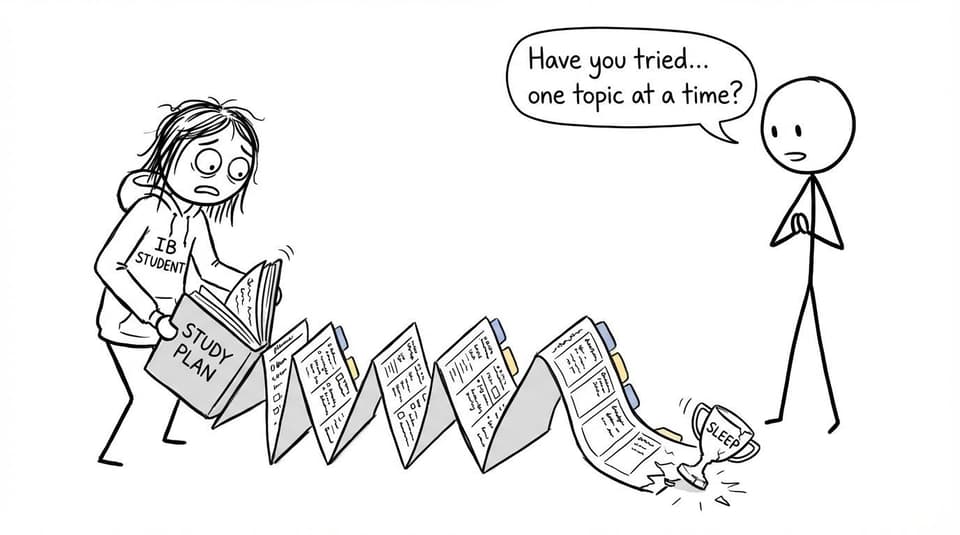
The truth is that most IB stress is not caused by the workload itself. It comes from the feeling that you do not have a system. When you build a system, the work shrinks to its proper size.
This is a practical, step-by-step guide on how to study for IB exams. It is not motivational fluff. It is the kind of plan you can follow on a tired Tuesday night when your willpower is low but your goal still matters.
The IB exam study checklist (keep it simple)
Before we go deep, here is the short checklist you can return to every week of IB revision:
- Choose the next IB paper you are training for (not the whole syllabus).
- Use Study Notes to understand the topic.
- Use Flashcards for daily recall.
- Use a Questionbank for exam-style questions by topic.
- Run timed Mock Exams to build pacing.
- Review mistakes, then loop back to notes + questions.
- Protect sleep and consistency, the real secret weapon in IB.
If you want extra structure, the RevisionDojo blog has strong planning frameworks you can borrow, like Countdown to IB Exams: A Guide to Effective Studying and What's the Best Way to Revise for IB Exams?.
Step 1: Pick your IB target, paper, then topic
Most IB students plan in "subjects." High scorers plan in "papers."
A paper is concrete. A paper has timing. A paper has a predictable style. And when you study for a specific IB paper, you stop wasting time preparing in ways the exam will never reward.
Do this today:
- List every IB paper you will sit (by subject, SL/HL, Paper 1/2/3 where relevant).
- Circle the one paper that currently scares you most.
- Break it into the smallest possible units: topic -> subtopic -> question type.
This matters because your brain can tolerate honest work; it struggles with vague work. "Revise IB Biology" is vague. "Do 25 exam-style questions on Topic X and review mistakes" is specific.
To make this easy, build your system around RevisionDojo's hubs and tools: start with Notes + Flashcards + Question Bank (Free) and keep your IB plan anchored to real practice.
Step 2: Build a weekly IB study plan you can actually keep
A good IB plan is not ambitious. It is sustainable.
Sustainable means you can do it on an average day, not your best day.
Here is a simple weekly structure that works across IB subjects:
The "3 layer" IB week
Layer 1: Daily recall (10-20 minutes)
- Flashcards every day, even on busy days.
- If you miss, restart the next day with zero guilt.
Layer 2: Topic blocks (4-6 blocks per week, 45-90 minutes)
- Study Notes -> then questions on that same topic.
- End each block by writing down 3 mistakes you made.
Layer 3: Timed training (1-2 times per week)
- A mini-mock, a section, or a full Mock Exam depending on time.
- Review like a scientist, not like a critic.
If you need ideas for building efficient routines, skim 5 Proven IB Revision Hacks Backed by Science and IB Revision Hacks: Quick Tips for Efficient Studying.
Step 3: Use IB Study Notes the right way (not as a comfort blanket)
IB students love notes because notes feel like progress.
But rereading notes is often a form of avoidance. It is calm. It is familiar. It is also easy to mistake for learning.
Here is how to use Study Notes so they actually improve IB exam performance:
- Read with a purpose: "What would the exam ask me to do with this?"
- After every subsection, close the page and write 3 questions you could be tested on.
- Convert those questions into Flashcards.
- Immediately do Questionbank practice on that exact topic.
RevisionDojo makes this workflow smooth because everything connects: examiner-written Study Notes, Flashcards for spaced repetition, and a Questionbank designed for exam-style practice.
If you want a deeper explanation of why notes work best when they are interactive, see Digital IB Study Notes: Access Anywhere, Anytime.
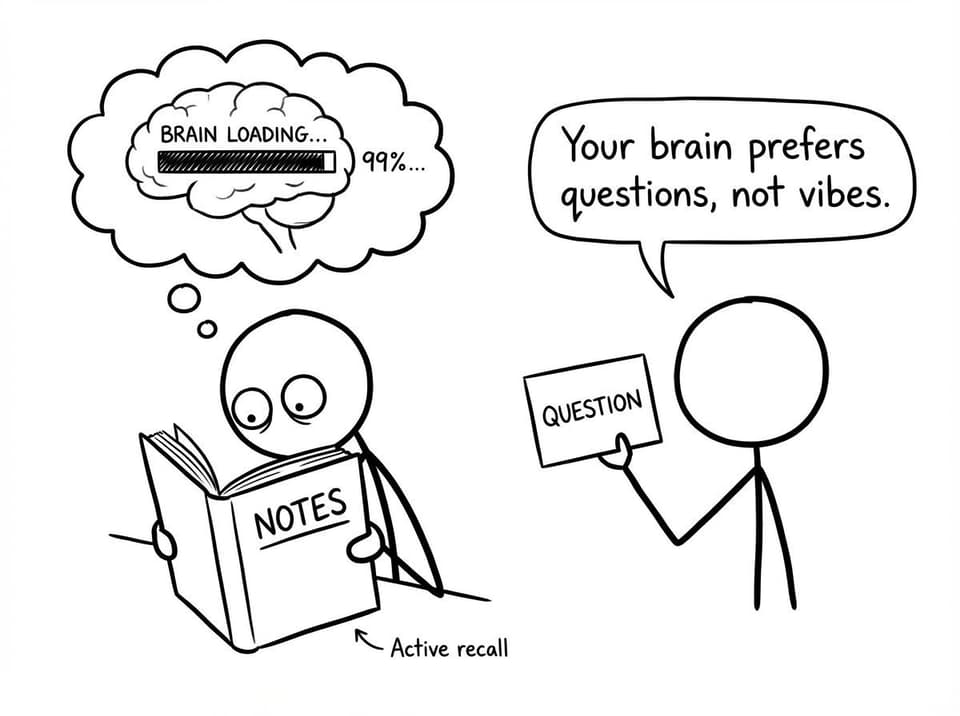
Step 4: Switch to active recall (the IB skill that changes everything)
A surprising number of IB students spend months studying without practicing retrieval.
Retrieval is the act of pulling an answer out of your mind without looking.
It feels harder. That is why it works.
Try this in your next IB study session:
- Read one concept.
- Look away.
- Explain it out loud in simple language.
- Then answer one exam-style question on it.
Your goal is not to "cover" the syllabus. Your goal is to become the kind of person who can produce answers under pressure.
RevisionDojo is built for this. Use the Comprehensive IB Question Bank: Thousands of Practice Questions to drill weak topics by difficulty and command term.
Step 5: Train IB timing with Mock Exams (confidence comes from reps)
Knowledge is not the only variable in an IB exam.
Pacing is its own skill.
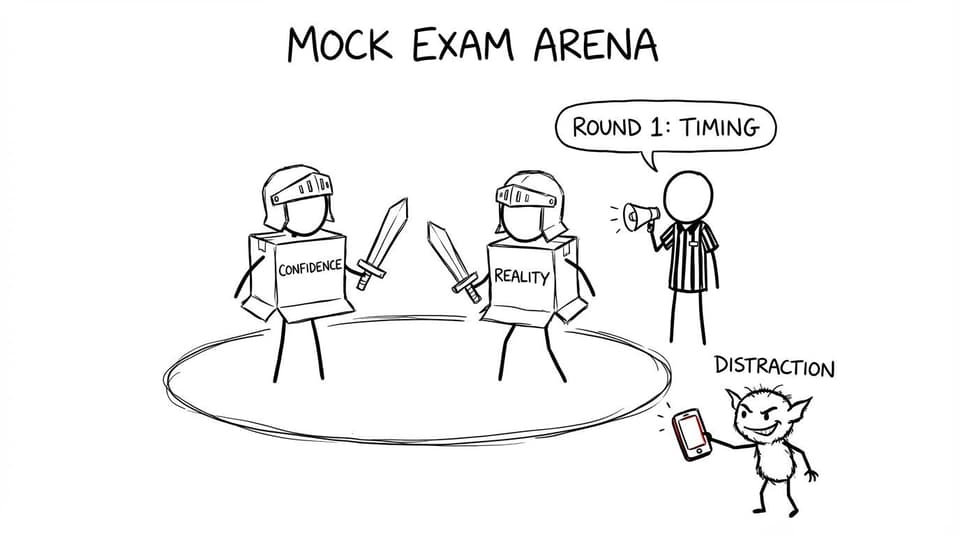
Many students discover too late that they can answer questions, just not fast enough. The fix is not more reading. The fix is more timed work.
Here is a simple ladder for IB timed training:
Start with timed sets
- 15-25 minutes
- Topic-specific questions
- Focus: keeping your thinking clean under time pressure
Move to timed sections
- 30-60 minutes
- Mixed topics
- Focus: switching contexts without losing control
Then full Mock Exams
- Full paper timing
- Exam conditions
- Focus: stamina, strategy, and calm
RevisionDojo supports this with Mock Exams, Predicted Papers, and grading tools that make the feedback loop fast.
To practice in a way that mirrors what IB actually feels like, use IB Questions: Official Exam Practice and explore the IB Predicted Papers collection.
Step 6: Review mistakes like an IB examiner (not like an anxious student)
After a timed paper, most IB students do one of two things:
-
Avoid marking it because they feel bad.
-
Mark it quickly, nod, then move on.
Neither works.
A better approach is to treat errors as data.
Use this "IB mistake log" after every practice:
- What went wrong? (content gap, command term misunderstanding, timing, careless error)
- Why did it happen? (rushed, forgot definition, misunderstood method)
- What is the smallest fix? (one Flashcard, one Study Note section, 10 similar questions)
- When will I retest it? (schedule the retest)
This is where RevisionDojo's AI Chat and Grading tools shine: they shorten the distance between mistake and correction. You can ask AI Chat to explain a concept in a new way, then immediately drill a targeted Questionbank set, then retake a mini-mock.
Step 7: Use Flashcards for IB without turning your life into a deck factory
Flashcards help because IB has a lot of "know it cold" material: definitions, processes, formulas, quotes, diagrams, and key case studies.
But students often waste time making perfect cards.
Keep your IB flashcards ruthless:
- One idea per card.
- Question on the front, answer on the back.
- Include command terms when relevant.
- If it takes more than 30 seconds to answer, break it into smaller cards.
If you want a clean strategy for daily practice, start with Mobile IB Flashcards: Study Cards on Your Phone.
RevisionDojo's Flashcards plus spaced repetition is the "small daily deposit" version of IB success.
Step 8: Finish with exam-week routines that protect your brain
The final stretch of IB exams is rarely lost because someone forgot a topic.
It is usually lost because someone is exhausted.
Your exam-week rules should be boring:
- Sleep is non-negotiable.
- No new study systems in the last week.
- Short recall sessions, light question practice, quick review of mistake log.
- Pack materials the night before.
If you want reminders on what not to do, read Common Mistakes to Avoid During IB Revision.
Closing: Your IB plan should make you calmer, not busier
A good IB study plan does not ask you to become a different person. It asks you to make small, repeatable bets: one topic, one set of questions, one timed session, one mistake log.
That is what RevisionDojo is designed to support: Study Notes for clarity, Flashcards for memory, a Questionbank for targeted practice, AI Chat for quick explanations, Grading tools for feedback, Predicted Papers for realism, Mock Exams for timing, a Coursework Library for context, and Tutors when you need a human voice to untangle a knot.
If you want the simplest next step, choose one IB paper you are sitting soon. Then do this today: read one topic in notes, complete one targeted Questionbank set, and finish with 10 minutes of Flashcards. Repeat tomorrow.
That is how you study for IB exams, step by step, until the pressure turns into familiarity.