


The week before exams has a particular kind of silence.
Your folders are full. Your tabs are open. Your brain is doing that thing where it remembers everything you should have done earlier, and then tries to solve it at 2 a.m.
If you are an IB student sitting the November 2026 session, the schedule below is more than dates. It is your pacing guide. It tells you where the pressure will peak, where recovery is possible, and how to plan revision like someone who wants to finish strong, not just survive.
In this post, you will find the full IB November 2026 exam schedule you shared, plus a practical way to use it: identifying crunch days, building a reverse plan, and using RevisionDojo to turn “I should study” into a repeatable system.
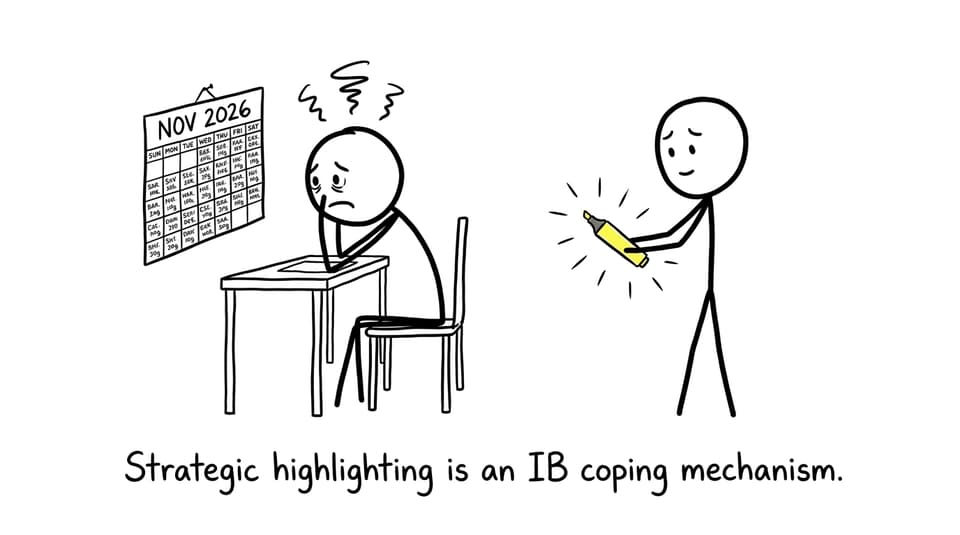
IB November 2026 exam schedule (quick checklist)
Before you read the timetable, do this quick setup. It takes ten minutes and saves weeks.
- Copy the IB dates into a calendar you actually check.
- Mark your HL subjects in one color, SL in another.
- Circle “double-load” days (writing-heavy or calculation-heavy back-to-back sessions).
- Decide your revision rhythm now: daily practice + weekly timed simulation.
- Pick your tools so you do not waste time hunting resources mid-week.
If you need a clean system for daily practice and feedback, start with the core RevisionDojo flow: Study Notes (learn), Flashcards (retain), Questionbank (apply), then timed work using Mock Exams and Predicted Papers.
Helpful starting points:
IB November 2026 exam schedule (full timetable)
Use this as your master reference. Then we will translate it into a study plan.
Friday 23 Oct
- Morning: No exams
- Afternoon: School-based syllabus (SBS) SL Paper 1
Monday 26 Oct
- Morning: SBS SL Paper 2
- Afternoon: Language A Literature HL Paper 1; Language A Literature SL Paper 1; Language A Language & Literature HL Paper 1; Language A Language & Literature SL Paper 1 (except English & Spanish)
Tuesday 27 Oct
- Morning: Language A Literature HL/SL Paper 2; Language A Language & Literature HL/SL Paper 2 (except English & Spanish)
- Afternoon: Biology HL Paper 1 (1a & 1b); Biology SL Paper 1 (1a & 1b)
Wednesday 28 Oct
- Morning: Biology HL Paper 2; Biology SL Paper 2
- Afternoon: Business Management HL/SL Paper 1; Business Management HL Paper 3
Thursday 29 Oct
- Morning: Business Management HL Paper 2; Business Management SL Paper 2
- Afternoon: Spanish A Literature HL Paper 1; Spanish A Literature SL Paper 1; Spanish A Language & Literature HL Paper 1; Spanish A Language & Literature SL Paper 1; Spanish B HL Paper 1; Spanish B HL Paper 2 (Reading); Spanish B SL Paper 1; Spanish B SL Paper 2 (Reading); Spanish ab initio SL Paper 1; Spanish ab initio SL Paper 2 (Reading)
Friday 30 Oct
- Morning: Spanish A Literature HL/SL Paper 2; Spanish A Language & Literature HL/SL Paper 2; Spanish B HL Paper 2 (Listening); Spanish B SL Paper 2 (Listening); Spanish ab initio SL Paper 2 (Listening)
- Afternoon: Computer Science HL Paper 1; Computer Science SL Paper 1; Environmental Systems & Societies HL Paper 1; Environmental Systems & Societies SL Paper 1
Monday 2 Nov
- Morning: Computer Science HL Paper 2; Computer Science HL Paper 3; Computer Science SL Paper 2
- Afternoon: History HL/SL Paper 1; History HL/SL Paper 2; Environmental Systems & Societies HL Paper 2; Environmental Systems & Societies SL Paper 2
Tuesday 3 Nov
- Morning: History HL Paper 3
- Afternoon: Language B HL Paper 1; Language B HL Paper 2 (Reading); Language B SL Paper 1; Language B SL Paper 2 (Reading); Language ab initio SL Paper 1; Language ab initio SL Paper 2 (Reading) (except English & Spanish); Latin HL Paper 1; Latin SL Paper 1
Wednesday 4 Nov
- Morning: Language B HL Paper 2 (Listening); Language B SL Paper 2 (Listening); Language ab initio SL Paper 2 (Listening) (except English & Spanish); Latin HL Paper 2; Latin SL Paper 2
- Afternoon: Physics HL Paper 1 (1a & 1b); Physics SL Paper 1 (1a & 1b); Sports, Exercise & Health Science HL Paper 1 (1a & 1b); Sports, Exercise & Health Science SL Paper 1 (1a & 1b)
Thursday 5 Nov
- Morning: Physics HL Paper 2; Physics SL Paper 2; Sports, Exercise & Health Science HL Paper 2; Sports, Exercise & Health Science SL Paper 2
- Afternoon: English A Literature HL Paper 1; English A Literature SL Paper 1; English A Language & Literature HL Paper 1; English A Language & Literature SL Paper 1; English B HL Paper 1; English B HL Paper 2 (Reading); English B SL Paper 1; English B SL Paper 2 (Reading); English ab initio SL Paper 1; English ab initio SL Paper 2 (Reading)
Friday 6 Nov
- Morning: English A Literature HL/SL Paper 2; English A Language & Literature HL/SL Paper 2; English B HL Paper 2 (Listening); English B SL Paper 2 (Listening); English ab initio SL Paper 2 (Listening)
- Afternoon: Digital Society HL Paper 1; Digital Society SL Paper 1; Geography HL Paper 1; Geography SL Paper 1; Global Politics HL/SL Paper 1; Social & Cultural Anthropology HL Paper 1; Social & Cultural Anthropology SL Paper 1; Literature & Performance SL Paper 1
Monday 9 Nov
- Morning: Digital Society HL/SL Paper 2; Digital Society HL Paper 3; Geography HL/SL Paper 2; Geography HL Paper 3; Global Politics HL/SL Paper 2; Social & Cultural Anthropology HL Paper 2; Social & Cultural Anthropology SL Paper 2
- Afternoon: Mathematics: Analysis & Approaches HL Paper 1; Analysis & Approaches SL Paper 1; Applications & Interpretation HL Paper 1; Applications & Interpretation SL Paper 1
Tuesday 10 Nov
- Morning: Mathematics: Analysis & Approaches HL Paper 2; Analysis & Approaches SL Paper 2; Applications & Interpretation HL Paper 2; Applications & Interpretation SL Paper 2
- Afternoon: Economics HL/SL Paper 2; Global Politics HL Paper 3
Wednesday 11 Nov
- Morning: Economics HL Paper 1; Economics HL Paper 3; Economics SL Paper 1
- Afternoon: Chemistry HL Paper 1 (1a & 1b); Chemistry SL Paper 1 (1a & 1b); Design Technology HL Paper 1; Design Technology SL Paper 1; Design Technology HL/SL Paper 2
Thursday 12 Nov
- Morning: Chemistry HL Paper 2; Chemistry SL Paper 2; Design Technology HL Paper 3
- Afternoon: Philosophy HL Paper 1; Philosophy SL Paper 1; Psychology HL Paper 1; Psychology SL Paper 1
Friday 13 Nov
- Morning: Philosophy HL/SL Paper 2; Philosophy HL Paper 3; Psychology HL Paper 2; Psychology HL Paper 3; Psychology SL Paper 2
- Afternoon: Mathematics: Analysis & Approaches HL Paper 3; Mathematics: Applications & Interpretation HL Paper 3
How to use the IB November 2026 exam schedule (instead of just reading it)
Most students treat the IB schedule like weather: something that happens to them.
High scorers treat it like navigation: information that changes what they do today.
Here are three lenses that matter.
Find your pressure blocks
A pressure block is not just “many exams.” It is a sequence where the brain is asked to do the same hard thing repeatedly.
Examples inside this IB timetable:
- Writing-heavy stretches (Language A, History, Philosophy, Psychology)
- Calculation-heavy stretches (Math, Physics, Chemistry)
- Mixed cognitive loads in a single day (a language listening in the morning, Physics Paper 1 in the afternoon)
Once you mark these blocks, you stop planning revision as equal slices. You start planning energy.
For a deeper guide on turning an official schedule into a plan, use: How to Plan Final IB Revision Using the Official Timetable.
Plan backwards in phases
A calm IB revision plan usually has three phases:
- Foundation phase (earliest): patch weak content with notes and targeted questions.
- Technique phase (middle): timed sections, command terms, mark allocation awareness.
- Stamina phase (final): full-paper simulations, review cycles, sleep protected.
RevisionDojo is built to match those phases: Study Notes for foundation, Questionbank for technique, and Mock Exams plus Predicted Papers for stamina.
If you want a sustainable routine while you do this, see: How to Create a Balanced IB Study Schedule and The Ultimate Daily IB Study Schedule.
Build around the “two-a-day” reality
On days with both sessions, the mistake is trying to revise both subjects equally the night before.
A better IB rule:
- The night before: light review for the morning paper, then stop early.
- Between sessions: only low-friction recall (Flashcards, definitions, formulas, essay plans).
- After the afternoon paper: no heroic catch-up. Short debrief, then sleep.
A practical IB study plan mapped to the November 2026 schedule
Below is a simple structure many IB students can follow without burning out. Adjust the time, keep the logic.
Four weeks out: build accuracy before speed
Goal: stop losing marks to gaps you can actually fix.
- 4 days/week: 30-45 minutes Questionbank drills per subject (topic-filtered).
- 3 days/week: 10 minutes Flashcards (definitions, formulas, essay quotes, key studies).
- 2 days/week: 20-30 minutes Study Notes to patch the gaps revealed by practice.
- 1 day/week: one timed section (not full papers yet).
Useful reads:
- Comprehensive IB Question Bank: Thousands of Practice Questions
- RevisionDojo App: The Smarter Way to Prep for IB Exams
Two weeks out: shift to timing and decision-making
Goal: finish on time and choose the right approach quickly.
- 3 timed sessions/week using Mock Exams style practice (paper sections).
- After each timed set, use AI Chat to ask one targeted question you keep avoiding (a concept, a command term, or a marking nuance).
- Create an error log: “What happened? Why? What rule fixes it?”
This is where RevisionDojo’s feedback loop matters: AI Chat for clarification, Grading tools for quality control, and the Questionbank for repetition until the mistake stops showing up.
If you take Math, these are strong supports:
Final week: simulate the schedule, not just the papers
Goal: make exam week feel familiar.
- Do at least two “two-a-day” simulations: one paper in the morning, one in the afternoon, then review lightly.
- Use Predicted Papers when you want full-paper structure and realistic pacing.
- Use Flashcards as your between-session tool: short, sharp, confidence-building.
Explore: IB Predicted Papers by IB Examiners (Free).
Day-by-day tactics for tough stretches in the IB timetable
The IB schedule is not equally hard every day. A few stretches tend to hit students harder.
Language + Biology (late Oct)
Writing in the morning, then data-heavy Bio Paper 1 later is a context switch.
Tactic:
- Two days before: do Bio multiple-choice practice in the Questionbank.
- The night before: only light Bio review (Flashcards, diagrams, key processes).
- After the language paper: do 15 minutes of Bio recall, then rest.
Physics and English cluster (4-6 Nov)
Physics demands precision, English demands interpretation and stamina.
Tactic:
- Front-load Physics formula recall using Flashcards.
- Practice short Physics Paper 1 sets under time.
- For English, build 6-8 flexible essay “paragraph cores” you can adapt.
Math block (9-10 Nov) and the late run (11-13 Nov)
This is where students try to sprint.
Tactic:
- For Math: do timed Paper 1 style sets, then Paper 2 style sets, alternating days.
- For Chemistry and Economics: treat Paper 1 accuracy as a daily drill.
- Protect sleep. In the IB, fatigue is a mark-losing mechanism.
How RevisionDojo fits into your IB November 2026 schedule
The easiest way to waste an IB exam season is to collect resources instead of using a system.
RevisionDojo is designed as the system:
- Questionbank to practice exactly what you are weak at, with fast feedback.
- Study Notes to repair understanding without reading ten different PDFs.
- Flashcards to make memory automatic, especially for definitions, formulas, quotes, and studies.
- AI Chat to unblock you quickly when you are stuck.
- Mock Exams and Predicted Papers to build timing and exam stamina.
- Grading tools to check quality against criteria, not vibes.
- Coursework Library to reduce stress from IAs and written components while you revise.
- Tutors when you need a human who can see the pattern you keep missing.
If you want a mindset guide for staying consistent, see: IB Exams Without Pausing Your Life and How 45-Point IB Students Prepare for Exams.
Closing: make the IB schedule work for you
The IB November 2026 exam schedule is fixed. Your experience of it is not.
If you use the timetable to spot pressure blocks, plan backwards, and practice under realistic timing, exam season becomes something quieter: a series of familiar routines instead of a series of surprises.
Start small today. Open RevisionDojo, pick one subject, run a short Questionbank set, and turn the mistakes into Flashcards. Then repeat tomorrow. When you are ready, add Mock Exams and Predicted Papers so the real IB papers feel like another rehearsal.
Your goal is not to study harder forever. It is to arrive at the first exam already believing, through evidence, that you can do the work.