



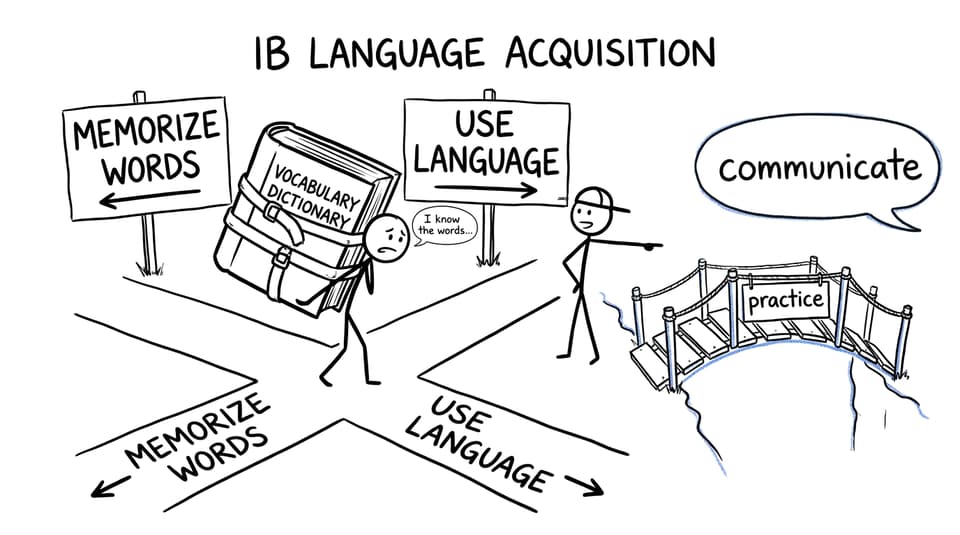
The biggest of the IB Language Acquisition first term struggles is not usually learning more vocabulary. It is learning to communicate before you feel completely ready.
Many students expect a familiar language course: memorize words, study grammar, complete exercises, and gradually become more accurate. Then the IB asks them to interpret authentic material, address a particular audience, choose an appropriate register, justify opinions, and respond spontaneously. Knowing the language is no longer enough. You must use it with purpose.
That shift can feel like a sudden loss of ability. It is not. You are converting knowledge into performance, and that requires a different kind of practice.
The first-term adjustment checklist
Focus on these priorities during your first term:
- Learn vocabulary as usable phrases, not isolated translations.
- Produce short spoken or written responses several times each week.
- Practise reading, listening, writing, and speaking.
- Identify the audience, purpose, context, and register of each task.
- Track recurring errors instead of correcting everything at once.
- Treat mistakes as evidence about what to practise next.
These principles apply across the Diploma Programme language acquisition group, although expectations differ between language ab initio, Language B SL, and Language B HL. If your placement feels uncertain, explore choosing between IB Language B and ab initio.
Why vocabulary knowledge suddenly feels insufficient
Traditional language exercises often reward recognition. You see a word and remember its translation, or complete a conjugation because the required tense has already been identified. Communication removes those clues.
An IB task might ask you to persuade a school audience, discuss a cultural perspective, interpret a speaker's attitude, or maintain a conversation when the next question is unknown. You must retrieve vocabulary, control grammar, organize ideas, and make decisions simultaneously.
The Language B framework develops receptive, productive, and interactive skills through five prescribed themes: identities, experiences, human ingenuity, social organization, and sharing the planet. The IB Language B syllabus breakdown shows how these elements connect.
A student may recognize 30 words about technology yet struggle to explain whether technology strengthens relationships. The missing piece is not necessarily knowledge. It is retrieval and organization under pressure.
Build language moves instead of collecting words
Vocabulary lists feel productive because they are easy to count. Yet you can know hundreds of nouns and still be unable to disagree politely, develop an example, or recover when a sentence goes wrong.
Build phrase banks around functions such as:
- giving strong, balanced, or cautious opinions
- showing cause, contrast, consequence, or concession
- introducing evidence and examples
- clarifying or correcting an idea
- addressing formal, semi-formal, and personal audiences
Store complete expressions in RevisionDojo Flashcards, then retrieve each one inside a new sentence. Recognition is only the first step. A phrase becomes useful when you can produce it without seeing the answer.
This method also reduces vocabulary overload, an issue explored in common IB Language B problems and practical fixes. Ten flexible expressions you can control are generally more useful than 50 impressive words that disappear during a timed response.
Use a simple input-to-output loop
Students often spend most of their time reading because input feels safe. Speaking and writing, however, improve through output. Use this four-stage loop.
Take in one small model
Read a short article or listen to a manageable recording. Identify its main idea, attitude, audience, and two useful phrases. RevisionDojo Study Notes can clarify unfamiliar grammar or text conventions without turning the session into passive review.
Produce something immediately
Speak for 60-90 seconds or write one paragraph using the new phrases. Do not wait until you have mastered the topic. The purpose is to practise retrieval while the language is fresh.
Request narrow feedback
Focus on one or two areas, such as verb control, register, organization, or pronunciation. RevisionDojo AI Chat can generate follow-up questions, while Grading tools can help you examine a written response. A RevisionDojo Tutor can explain misunderstandings requiring human guidance.
Repeat the task
Re-record or rewrite your response. The second attempt connects feedback with action. For a broader structure, follow the IB Language B revision guide.
Speak early, even when it feels uncomfortable
Speaking exposes uncertainty immediately. In writing, you can pause. In conversation, silence feels louder than it really is.
Waiting until your grammar is perfect creates a trap. You avoid the activity that would make retrieval faster, so spontaneous communication remains unfamiliar. Fluency does not mean making no mistakes. It means continuing when a mistake occurs.
Start with two-minute recordings. State an idea, explain it, provide an example, and connect it to a course theme. Learn repair phrases equivalent to “Let me rephrase that” and “What I mean is” in your target language. The IB Language B oral practice guide develops this approach, while RevisionDojo's Questionbank provides focused prompts.
Treat writing as a communication decision
A common first-term mistake is trying to sound advanced throughout an entire response. Students force difficult vocabulary and structures into their work, then lose clarity or relevance.
Before writing, ask:
- Who will read this?
- What should the reader understand, feel, or do?
- Which text type suits the task?
- What level of formality is appropriate?
Only then should you choose language. A message to a friend should not resemble an institutional report. The guide to avoiding common Language B writing mistakes explains how register, structure, and vocabulary affect communication.
Prioritize controlled complexity. Use mostly reliable structures, then add one deliberate challenge, such as a conditional sentence or precise connector.
Follow a routine that survives busy weeks
A useful routine does not need to dominate your timetable:
- Monday: review phrases with Flashcards and use five aloud.
- Tuesday: complete a short listening task and summarize it.
- Wednesday: write one paragraph for a defined audience.
- Thursday: record a two-minute response to an unfamiliar prompt.
- Friday: correct three recurring errors in earlier work.
- Weekend: complete a longer Questionbank task and reflect.
Do not spend the whole week on the skill that already feels comfortable. Mock Exams and Predicted Papers become more useful once you can rehearse complete tasks. The Coursework Library can reveal how effective communication is structured, but models should inform your decisions rather than become scripts.
Redefine first-term progress
Progress may initially mean answering one unexpected question without freezing, choosing the correct register, recognizing a speaker's attitude, or correcting a familiar error during a second attempt.
These small changes matter. They show that you are no longer treating language as information to store. You are learning to retrieve it, shape it, and use it for another person.
RevisionDojo brings that process together. Study Notes clarify concepts, Flashcards strengthen retrieval, the Questionbank creates purposeful practice, and AI Chat supports low-stakes interaction. Grading tools, Tutors, Mock Exams, Predicted Papers, and the Coursework Library can then guide the transition toward confident performance.
The first-term shock does not fade because you suddenly know every word. It fades because uncertainty becomes familiar and you discover that communication can continue even when your language is imperfect.