


The first term IB Theatre experience usually moves from playful exploration into deliberate theatre-making. You may begin with ensemble games, movement, improvisation, and script work. By the end of term, you will probably be researching theatrical contexts, testing performance conventions, explaining artistic intentions, and documenting your choices.
IB Theatre is not simply an acting class. It asks you to think as a creator, designer, director, and performer, then communicate the reasoning behind your work.
Every school sequences the course differently, so this is a representative arc rather than a universal calendar. Still, it captures the pacing, workload, and surprises that commonly define the opening months.
Your first-term checklist
By the end of the term, aim to have:
- established a reliable rehearsal and reflection routine
- experimented with voice, movement, space, design, and direction
- learned how intention connects to audience impact
- explored at least one play, practitioner, tradition, or performance style
- kept dated evidence of experiments and revisions
- contributed constructively to ensemble work
- become familiar with the current assessment tasks
- identified how SL and HL expectations differ
For the wider course map, read the IB Theatre syllabus overview.
A realistic first term IB Theatre arc
| Stage | What class may look like | What changes for you |
|---|---|---|
| Weeks 1-2 | Ensemble exercises, improvisation, spatial work, introductory discussion | You learn to take creative risks without treating every attempt as a final performance |
| Weeks 3-5 | Performance experiments, play-text exploration, basic research, design tasks | You connect practical choices to intentions and context |
| Weeks 6-8 | Devising, collaborative rehearsals, practitioner or tradition study | Rehearsal, research, and documentation begin to overlap |
| Weeks 9-12 | Refined performances, presentations, written reflection, assessment-style tasks | You select evidence, evaluate outcomes, and justify decisions precisely |
Your teacher might reverse this order or spend an entire term on one area. Some classes begin with devised work; others start with a play, world theatre tradition, or practitioner. What remains consistent is the movement from trying things to making informed choices.
The opening weeks feel practical and unfamiliar
The first lessons often look deceptively light. You may complete trust exercises, transform ordinary objects, create tableaux, or improvise under unusual constraints. These activities establish habits needed for collaborative creation: concentration, physical awareness, responsiveness, and willingness to revise.
Experienced actors may have an initial advantage, but a confident performer still needs to explain how gesture, rhythm, proximity, lighting, or sound creates meaning. A quieter student may instead discover strength in directing, dramaturgy, design, or research.
This is why deciding whether IB Theatre suits you requires a broader question than whether you enjoy performing. The course rewards curiosity across multiple theatre-maker roles.
Research arrives earlier than many students expect
By the middle of the term, the room may feel like both a studio and a research space. You could investigate a theatrical convention, examine the cultural context of a tradition, read a play closely, or explore how a practitioner's ideas change performance.
The important sequence is:
- Research an idea accurately.
- Test it physically or visually.
- Observe what changes.
- Evaluate its effect.
Research should not sit in a document while rehearsal happens elsewhere. If you encounter direct audience address, test it in a short scene, compare it with another version, then record how the performer-audience relationship changed.
The guide to connecting culture and context in Theatre research helps prevent research from becoming a collection of disconnected facts.
Reflection becomes part of rehearsal
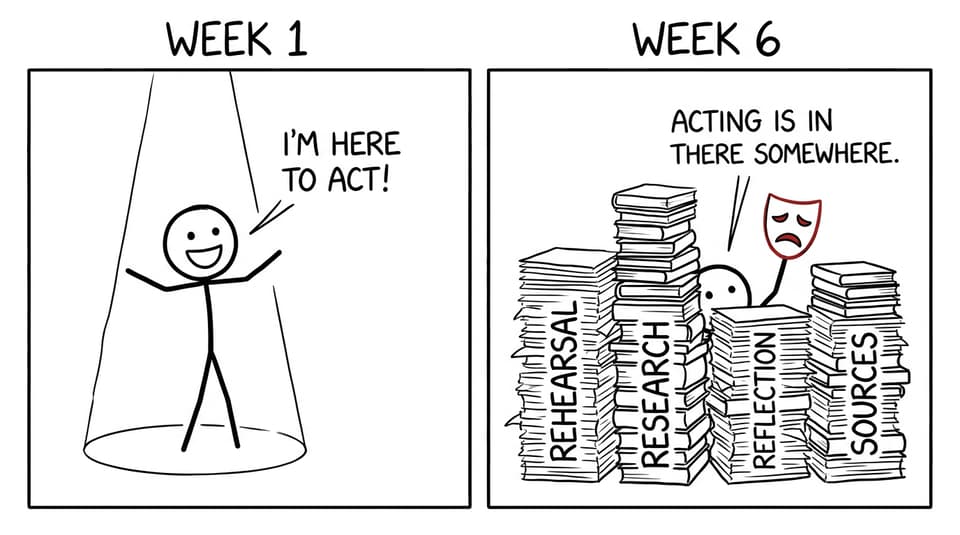
The biggest surprise may be discovering how much writing surrounds practical work.
A useful reflection does not say, "The rehearsal went well." It identifies the intention, experiment, evidence, and next adjustment. For example:
We reduced the distance between the performers to make the conflict feel claustrophobic. The new spacing increased tension, but it obscured one performer from part of the audience. Next time, we will keep the proximity while changing the formation's angle.
This preserves a decision so you do not have to reconstruct the process months later.
Use RevisionDojo's guide to critical reflection for higher marks. Study Notes can clarify terminology, while Flashcards help you retain conventions and practitioner principles. AI Chat can help distinguish description from evaluation, and Grading tools can provide rubric-aware feedback. Your final work must remain your own, but structured feedback can reveal vague reasoning.
Collaboration becomes real work
Early ensemble games make collaboration feel natural. Creating sustained theatre with other people is harder.
One student wants to discuss every possibility. Another wants to improvise immediately. Someone misses rehearsal, a design idea proves impractical, or strong moments fail to form a coherent structure. These are the actual challenges of collaborative theatre-making.
A productive group gives each rehearsal a narrow purpose: test a transition, compare two spatial arrangements, or clarify one audience response. It also records individual contributions. Each person needs to make identifiable artistic decisions and respond to the ensemble.
The current IB course includes a Collaborative Project in which SL and HL students create and perform an original 7-10 minute piece. Your first-term project may be formative, but its habits are directly relevant. See RevisionDojo's guides to developing original theatre collaboratively and documenting the collaborative process.
What the workload actually feels like
IB Theatre workload is uneven. One week may require a short reading and reflection entries. Another may combine research, script preparation, group messages, prop sourcing, rehearsal, and evaluation.
The difficult part is often coordination. A 60-minute rehearsal cannot simply be moved when four people, a performance space, and technical equipment are involved.
A sustainable weekly rhythm might include:
- two short research or reading sessions
- one terminology review using Study Notes or Flashcards
- brief reflection after each practical session
- one calendar check for rehearsals and deadlines
- one criteria check before polishing work
RevisionDojo's IB Theatre time-management guide offers a fuller system. During performance-heavy weeks, its Questionbank, Mock Exams, and Predicted Papers can keep your other IB subjects moving. The Coursework Library shows how strong academic work is structured, while Tutors can provide targeted support when progress stalls.
Understanding the assessment destination
Your first term may not produce final assessment work, but you should understand what the course is building toward. Under the current structure, both SL and HL complete a Production Proposal, Research Presentation, and Collaborative Project. HL students also complete a Solo Theatre Piece.
These tasks combine research, practical exploration, presentation, documentation, and evaluation. Theatre is assessed through coursework and performance tasks rather than a terminal written examination. Progress therefore accumulates through decisions made across the course.
Use the guide to what IB Theatre is actually like when the structure feels abstract. You do not need to master every task in term one. You need to build the habits each task will eventually demand.
What new students should remember
Your first term is not a test of whether you arrived as a polished actor. It is an introduction to becoming a reflective theatre-maker.
Take experiments seriously without expecting all of them to succeed. Write notes while rehearsal is fresh. Ask what the audience would see, hear, understand, or feel. Learn to resolve disagreement through practical testing rather than personal preference.
The students who settle into IB Theatre are not necessarily the loudest performers. They become attentive to process. RevisionDojo supports that process with Questionbank practice, Study Notes, Flashcards, AI Chat, Grading tools, Coursework Library examples, and specialist Tutors. Used consistently, these tools connect the course's different projects into one developing artistic journey.