


The night your brain turns into a browser with 37 tabs
The most frustrating part of IB exam anxiety is how normal it feels while it's happening.
You sit down to revise. You open your notes. And suddenly your mind starts sprinting: What if I blank? What if this is the topic I don't know? What if everyone else is calmer than me? Your body joins the conversation: tight chest, shallow breathing, restless legs. The content isn't even the enemy yet. The feeling is.
Here's the quieter truth: IB exam anxiety is rarely a sign you're incapable. It's usually a sign your brain is trying to protect you from uncertainty. Exams feel like a judgment. Your nervous system treats them like a threat.
This guide is about turning that threat back into a task.
A quick checklist to calm IB exam anxiety fast
If your IB exams are close and you need something practical, start here:
- Name the feeling: "This is anxiety, not danger."
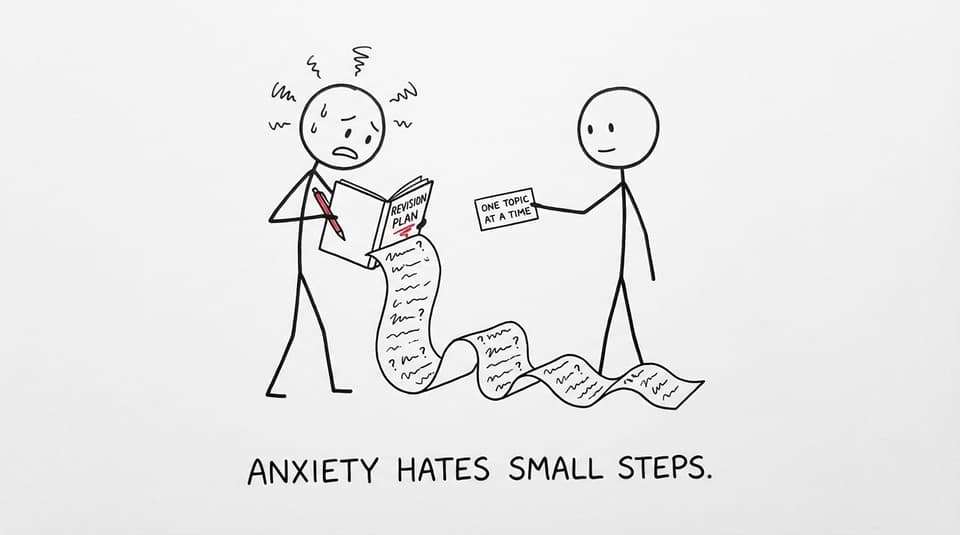
- Shrink the next step: one topic, one question set, one paragraph.
- Switch to active recall: do questions, not rereading.
- Add timed exposure: short timed practice blocks reduce panic.
- Sleep like it's revision: because it is.
- Build an exam-day script: what you'll do when stress spikes.
For structured practice (which lowers uncertainty), use RevisionDojo's Question Bank guide and pair it with Exam Mode to make pressure feel familiar.
Why IB exam anxiety feels so intense
Most students assume anxiety means: I'm not prepared.
In IB, anxiety often means something slightly different: There are too many moving parts. Six subjects, multiple papers, internal deadlines, and that constant background hum of comparison. Your brain can't tell the difference between "a lot to do" and "I am failing."
Anxiety loves vague plans
A vague plan sounds like: "Revise Biology."
A calming plan sounds like: "Do 12 Paper-style questions on Topic 2. Then review errors for 15 minutes."
That's why anxiety drops when you turn revision into a repeatable loop. It's not motivation. It's predictability.
RevisionDojo is built around that loop: Study Notes for clarity, Flashcards for recall, and Questionbank practice to convert knowledge into marks. If you want the full "core tools" overview in one place, start with Notes + Flashcards + Question Bank (Free).
The most effective way to beat IB exam anxiety: make exams less mysterious
There's a Morgan Housel-like pattern here: fear shrinks when you measure it.
An anxious mind treats the exam as an unknowable event. A prepared mind treats it as a familiar format with predictable moves.
Use "exposure" instead of "avoidance"
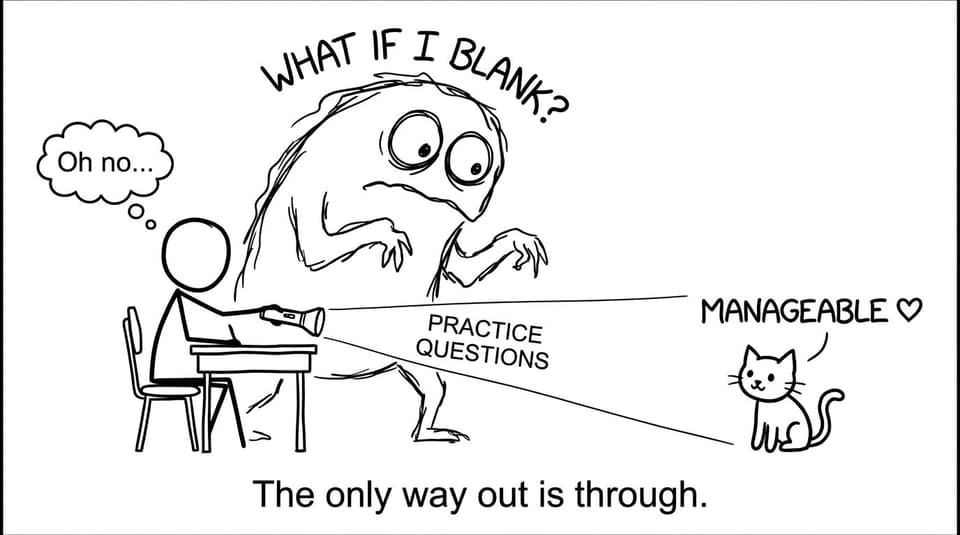
Avoidance feels like relief. It's also expensive. Every time you avoid timed practice, you keep the exam as a monster in the dark.
Do the opposite:
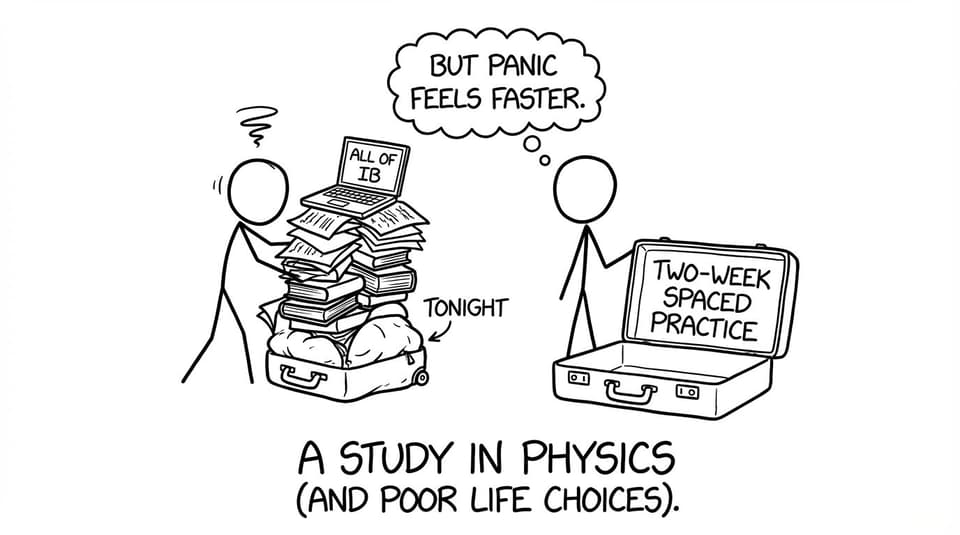
- Start with 10-minute timed sections
- Move to 25-minute mixed sets
- Build to full papers through mock simulations
If you don't know how to structure that, use RevisionDojo's Mock Exam Builder guide and pair it with Exam Mode so your brain learns: "I've been here before."
Study tactics that lower IB anxiety (because they create control)
When your revision method is passive, your confidence stays fragile. When it's active, confidence becomes earned.
Replace rereading with questions
If you only reread, your brain confuses recognition with mastery.
Instead:
- Read a short section
- Close it
- Answer questions from memory
- Mark what you missed
RevisionDojo makes this easy because your notes and practice can live side-by-side: use Digital IB Study Notes, then immediately switch into targeted drills with the Question Bank guide.
Use flashcards to calm the "what if I forget?" fear
A lot of IB anxiety is memory-based panic.
Flashcards reduce that panic because they create proof: you either recalled it or you didn't. And then you fix it.
To build a routine that actually sticks, use RevisionDojo's IB Flashcard System (and if you're revising on the move, Mobile IB Flashcards).
Build a "mistake notebook" (and let it humble you calmly)
Here's a habit high scorers don't always brag about: they collect errors.
Not to punish themselves. To stop repeating them.
After each practice session, write:
- The mistake pattern ("I rush command terms")
- The fix ("Underline command term; answer in that format")
- One example correction
For deeper feedback loops, RevisionDojo's AI Chat can quiz you on the exact misconception, and its Grading tools can help you tighten written responses for coursework-style tasks.
A simple IB anti-anxiety revision structure (60-90 minutes)
Use this when you feel scattered.
The "calm loop"
- 10 minutes: skim one targeted section in Study Notes
- 30 minutes: Questionbank practice (untimed, accuracy-first)
- 15 minutes: review mistakes + write "error rules"
- 10 minutes: Flashcards (active recall only)
- Optional 5 minutes: ask AI Chat one question you're avoiding
This is the same structure you can repeat every day across IB subjects. Repetition is calming because it removes decision fatigue.
If your stress is coming from overall workload, it's also worth reading Cope with IB Exam Stress & Anxiety.
What to do when your body panics during an IB exam
Your mind can know the content and still panic. That's not hypocrisy. It's biology.
Use a "reset protocol" (30-60 seconds)
- Put your pen down.
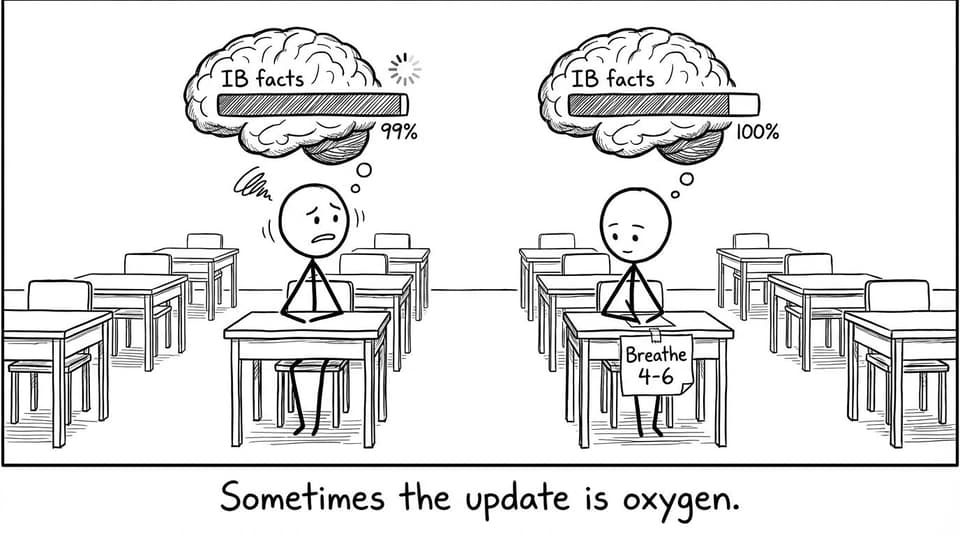
- Exhale longer than you inhale (try 4 seconds in, 6 seconds out).
- Name 3 neutral things you can see.
- Start again with the easiest question on the page.
The goal is not to become a meditation master in an exam hall. The goal is to restart motion.
If panic attacks are part of your experience, use this as extra support: How to Prevent Panic Attacks During IB Exam Season.
How RevisionDojo reduces IB exam anxiety (without pretending exams are easy)
A strong platform doesn't just give you more content. It reduces uncertainty.
RevisionDojo does that in a few practical ways:
- Questionbank: consistent exam-style practice that builds familiarity
- Study Notes: fast clarity when you're stuck
- Flashcards: daily recall to stop "forgetting spirals"
- AI Chat: a tutor-like voice when you're ashamed to ask the same question twice
- Grading tools: feedback that turns vague worry into specific improvements
- Predicted Papers and Mock Exams: realistic practice that trains calm under time pressure
- Coursework Library: examples that remove the fear of "I don't know what good looks like"
- Tutors: when you need a human to steady the plan and raise the bar
If you want a broader look at confidence-building through practice, see How IB Teachers Can Build Exam Confidence.
Closing: You don't need to feel fearless to do well in IB
Beating IB exam anxiety isn't about becoming a different person. It's about becoming more predictable to yourself.
When your plan is specific, your practice is active, and your exposure is timed, the exam stops being a mystery. And when it stops being a mystery, anxiety loses one of its favorite fuels.
If you want a single place to run that whole system: Questionbank, Study Notes, Flashcards, AI Chat, Grading tools, Predicted Papers, Mock Exams, Coursework Library, and Tutors; start your next study block on RevisionDojo and keep it small, repeatable, and real.