

Spaced repetition means reviewing information several times, with time between each review. For MYP students, the most effective version combines that schedule with active recall: close your notes, retrieve the idea from memory, check your answer, and revisit weak material later.
Start with one small topic today. Test yourself, then schedule short reviews for tomorrow, three days later, one week later, and two weeks later. The intervals do not need to be perfect. What matters is returning to the material as it begins to feel less familiar.
This works well in the MYP because you are expected not only to remember content, but also to explain concepts, interpret information, communicate clearly, and apply knowledge in unfamiliar situations. Spaced repetition keeps the foundations available so your attention can move toward those higher-level skills.
Your MYP spaced repetition checklist
A workable system has five parts:
- Choose a specific topic rather than an entire unit.
- Turn it into questions that force recall or application.
- Review those questions across several days or weeks.
- Adjust the interval according to your performance.
- Include criterion-based practice, not only factual flashcards.
For a wider routine, begin with the MYP Revision Guide or browse the RevisionDojo MYP resources by subject.
What spaced repetition actually does
Spacing and retrieval are related, but they are not identical.
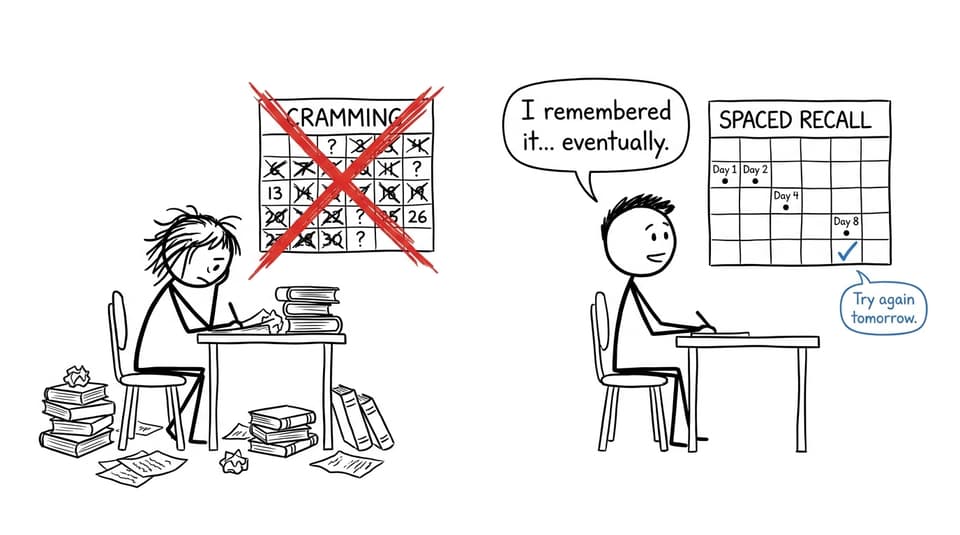
Spacing decides when you study. Retrieval practice decides what you do during the session. Reading the same page on four different days is spaced, but it remains passive. Trying to reconstruct the page's main argument from memory is retrieval.
Research on learning consistently finds that distributed practice produces more durable retention than placing the same amount of practice into one sitting. Retrieval also reveals an important difference: material can look familiar without being retrievable.
A highlighted page feels fluent because the answer is in front of you. An empty page feels harder because your memory must do the work. That difficulty often provides clearer evidence of learning.
How to use spaced repetition for MYP
You do not need a complicated algorithm. Use this method after school today.
Choose one 20-minute target
Pick something narrow enough to explain in a few minutes, such as:
- the stages of mitosis
- how to calculate gradient
- three effects of a historical policy
- the difference between metaphor and symbolism
- the meaning of one MYP command term
Avoid goals such as “revise science.” Large targets make it difficult to decide whether you genuinely remember something.
Create five useful prompts
Turn your material into questions requiring an answer, explanation, comparison, diagram, or decision. Instead of writing “Photosynthesis” on one side and copying a paragraph onto the other, ask:
- What are the reactants and products?
- Why does light intensity affect the rate?
- Can you draw and label the process from memory?
- What would you predict if light intensity decreased?
- Which evidence would support that prediction?
RevisionDojo Study Notes can help identify essential ideas, while Flashcards turn them into repeatable recall prompts. Use the MYP syllabus and assessment hub when checking how topics and resources are organised.
Test yourself before looking
Answer each prompt without notes. Say the answer aloud, write it down, sketch it, or solve the problem. Then check the source. Use a simple code:
| Result | What to do next |
|---|---|
| Wrong or mostly guessed | Review tomorrow |
| Correct but hesitant | Review in three days |
| Correct and clearly explained | Review in one week |
Feedback matters. Retrieval without checking can reinforce an error, so compare your response with notes, teacher feedback, or a reliable worked solution.
Schedule four returns
For a new topic, begin with this sequence:
- Day 1: Learn and test the topic.
- Day 2: Retrieve it without looking.
- Day 4: Mix it with questions from another topic.
- Day 8: Apply it in a less familiar context.
- Day 15: Complete a short cumulative check.
Treat this as a starting template. If you forget an item, shorten its next interval. If you recall and apply it accurately, extend the interval. A calendar, paper tracker, or digital flashcard queue is enough.
End with one applied question
Memory supports MYP performance, but it is not the finish line. MYP assessment is criterion-related, with teachers assessing subject-group objectives through varied tasks. Your review therefore needs to move beyond definitions.
After the flashcards, answer a question asking you to analyse, evaluate, justify, compare, interpret, or apply. RevisionDojo's Questionbank supports this shift from recall to performance. AI Chat can ask follow-up questions, while Grading tools can help you inspect whether your response addresses the relevant criterion.
Adapt the method to different subjects
The schedule can stay consistent while the retrieval task changes.
Mathematics and sciences
In mathematics, include prompts asking when a method applies, why a step is valid, and how an answer should be interpreted. The MYP Mathematics study techniques guide connects practice with Criteria A, B, C, and D.
For sciences, retrieve definitions and processes, then draw diagrams, analyse data, or explain an unfamiliar result. See how to revise MYP Sciences without memorising everything for a concept-first routine.
Language and literature
Use cards for terminology, but retrieve examples and analytical moves too. A prompt might show a short phrase and ask you to identify a choice, explain its effect, and connect it to purpose. The MYP Language and Literature revision strategies can support short writing drills.
Individuals and societies
Recall dates and vocabulary only when they support reasoning. Stronger prompts ask for causes, consequences, perspectives, source limitations, or comparisons. You can also reverse the question: provide the consequence and retrieve possible causes.
Concepts and global contexts
MYP learning is concept-driven, so include cards connecting facts to larger ideas. Ask how a topic demonstrates change, systems, relationships, identity, or another concept from your unit. The guide to MYP global contexts and concept-driven learning shows how to practise these connections.
Build a routine you can sustain
A system fails when maintaining it takes longer than studying. Ten focused minutes completed regularly is more valuable than an ambitious timetable abandoned after three days.
Try this rhythm:
- Monday to Thursday: 10 minutes of due flashcards and 15 minutes of questions.
- Friday: Review mistakes and rewrite weak prompts.
- Weekend: Complete one mixed or timed set and schedule the next reviews.
Rotate subjects instead of revising everything deeply each evening. The guide to balancing eight MYP subject groups offers a manageable structure for protecting focus and coverage.
Common mistakes to avoid
Do not put an entire page on one card. Split large answers into smaller prompts. Do not review every item equally: easy material can appear less often, while difficult material needs a shorter interval.
Do not confuse recognition with recall. Multiple-choice prompts can help, but first attempt the answer without seeing options. Also avoid memorising model wording without understanding it. Explain the idea in your own words, then apply it to a new example.
Finally, do not let flashcards replace extended performance. Mock Exams, Predicted Papers where available, and timed Questionbank sets build pacing and sustained reasoning. The Coursework Library can clarify qualities of strong work, while Tutors offer human guidance when repeated errors reveal a deeper misconception. Students preparing for optional external assessment can use the 30-day MYP eAssessment plan to combine spaced reviews with timed practice.
Make remembering the beginning, not the goal
Good revision often feels slower than rereading because it exposes what you cannot yet retrieve. That discomfort is useful information. It tells you what should return tomorrow and what can wait until next week.
Start with one topic and five prompts today. Review them tomorrow without looking, then let each result determine the next interval.
RevisionDojo brings that loop together: Study Notes establish understanding, Flashcards maintain recall, the Questionbank builds application, and AI Chat plus Grading tools sharpen explanations. Add Mock Exams, the Coursework Library, and Tutors when you need broader practice or feedback. Spaced repetition supplies the rhythm; RevisionDojo gives every return a clear purpose.