Reflecting on MYP English Language and Literature progress works best when you compare evidence from the term, assess it against the four subject criteria, and choose one specific skill to improve next. The goal is not to decide whether you are simply “good” or “bad” at English. It is to discover what changed, why it changed, and what you should practise now.
A grade gives you a snapshot. Reflection gives you a direction. Progress can be difficult to notice: your level may stay the same while your evidence becomes more precise or your organization improves. A term review makes those quieter gains visible.
A quick termly reflection checklist
At the end of each term:
- Collect two or three assessed pieces, their criteria levels, and teacher feedback.
- Compare your earliest and latest work, not only your highest mark.
- Review Criteria A, B, C, and D separately.
- Identify one repeated strength and one recurring difficulty.
- Rewrite a short section to apply the feedback.
- Set one measurable goal and schedule your first practice session.
The process should take about 30 to 45 minutes. More importantly, it should produce a decision rather than a page of general comments.
Start with evidence, not memory
Memory is a generous editor. It remembers the assignment that felt successful and quietly loses the paragraph that never developed its main idea.
Create a small evidence set containing an early task, a recent task, the relevant rubric, and your feedback. If possible, include analytical and creative work. RevisionDojo’s guide to building an MYP portfolio as evidence of learning can help you select useful examples rather than storing every document.
For each piece, record the task, assessed criteria, achievement level, one teacher comment, and one passage demonstrating your current ability. Then compare the first and latest examples. Did you move from identifying a technique to explaining its effect? Did your topic sentences become more purposeful? These observations are more meaningful than saying, “I think I improved.”
Use the four MYP criteria as separate lenses
MYP Language and Literature assesses four equally weighted areas: Criterion A, Analysing; Criterion B, Organizing; Criterion C, Producing text; and Criterion D, Using language. RevisionDojo’s explanation of the MYP Language and Literature criteria provides a student-friendly overview.
Review each criterion separately because one overall result can hide an uneven skill profile.
Criterion A: Analysing
Ask whether you moved beyond describing content. Effective analysis identifies a creator’s choice, uses precise evidence, explains an effect, and connects that effect to meaning or purpose.
Compare two paragraphs and highlight those elements. If you provide evidence but do not explain its effect, you have found a precise target. RevisionDojo’s guide to improving MYP English analysis can help you practise moving from description to interpretation.
Criterion B: Organizing
Examine how your ideas build. Can readers follow your argument without guessing how one paragraph connects to another? Review your thesis, topic sentences, sequencing, transitions, formatting, and referencing where relevant.
Organization means more than using paragraphs. The deeper question is whether your structure serves the task, context, and intention.
Criterion C: Producing text
Consider how deliberately you wrote for purpose and audience. In creative and transactional work, review your voice, details, style, structure, and engagement with the creative process.
Annotate one passage to explain your choices. If you cannot say why you used a particular image, tonal shift, or structural decision, aim to write more intentionally next term.
Criterion D: Using language
Review accuracy, vocabulary, sentence control, register, style, and communication. Look for patterns rather than isolated mistakes. Repeated tense changes deserve attention; one accidental typo probably does not require an entire term goal.
The MYP English Language and Literature resource hub offers Study Notes and Flashcards for reviewing terminology and language choices before applying them in writing.
Turn feedback into a pattern
A comment becomes valuable when you connect it to other evidence. Group similar feedback from the term together. You may discover that “explain the effect,” “develop this idea,” and “link to purpose” describe the same underlying problem.
Create two statements:
- Keep doing: “I select concise evidence supporting my claim.”
- Change next: “After identifying a choice, I will explain its effect and purpose.”
Test the second statement by revising one paragraph. RevisionDojo’s MYP Language and Literature revision strategies show how focused rewriting can turn feedback into visible action.
Protect motivation with smaller goals
MYP English Language and Literature motivation often declines when the goal is vague. “Become a better writer” offers no starting point. A smaller goal creates evidence of movement.
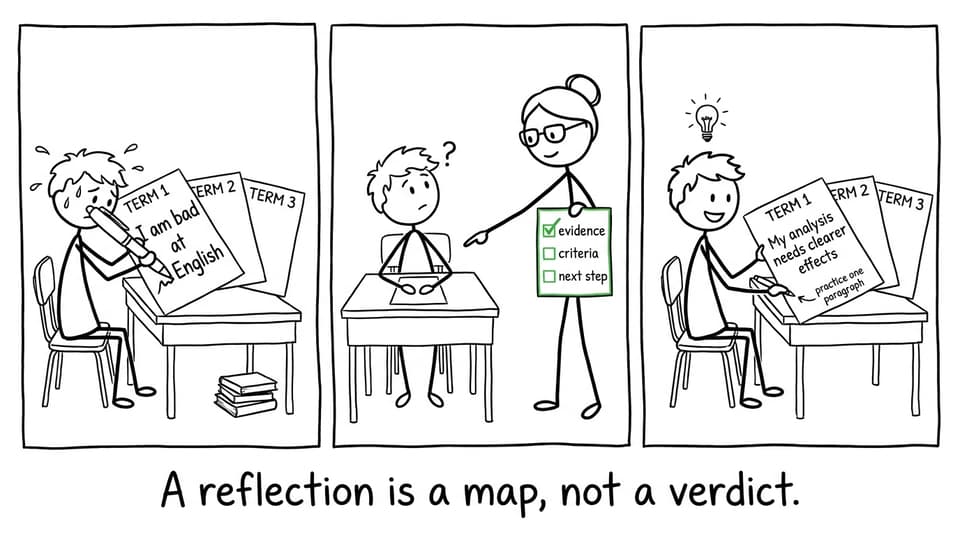
Instead of “improve my analysis,” write: “Once a week, I will produce one analytical paragraph connecting a specific choice to effect and purpose.” This defines the action, frequency, and measure of success. It also supports a healthier mindset: a weak result becomes information about a skill, not a verdict about your ability.
For a clearer picture of high-level performance, see how to score a 7 in MYP Language and Literature.
Build a reflection-to-practice loop
Reflection should end where practice begins. Review one concept through RevisionDojo Study Notes, retrieve terminology with Flashcards, and complete a short Questionbank task. Use Grading tools or teacher feedback to locate one gap, then rewrite the weakest section.
AI Chat can clarify a technique or ask probing questions, while your final explanation remains your own. Mock Exams and Predicted Papers can test whether the skill survives time pressure. The Coursework Library can reveal effective structures, and Tutors can help diagnose patterns continuing across several tasks. This follows the learning, practice, feedback, and adjustment cycle described in RevisionDojo’s MYP revision guide.
Your concrete next step
Open your earliest and latest English tasks. Choose one criterion, copy one example from each, and finish this sentence:
I improved at ___ because the evidence shows ___. My next step is ___, which I will practise on ___.
Put the practice date in your calendar. Reflecting on MYP English Language and Literature progress matters only when yesterday’s evidence changes tomorrow’s action. RevisionDojo gives you the connected tools to make that action part of a sustainable routine.

