
If you’ve ever walked out of a Language and Literature task thinking, “I knew the text, so why didn’t I score higher?”, you’re not alone.
In MYP, the grade is rarely about how much you remember. It’s about how clearly you show a specific skill. Two students can write about the same passage; one earns a 5, the other a 7. The difference is usually invisible until you start reading your work the way the criteria read you.
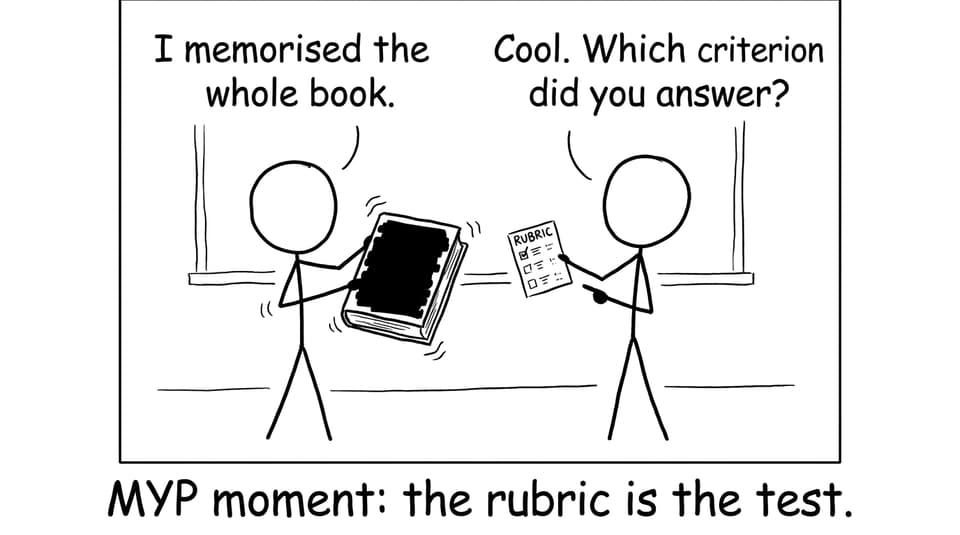
The MYP criteria in one quick checklist
Before you write a single sentence, run this fast MYP check:
-
Which MYP criterion (or two) is the task targeting?
-
What is the command term really asking you to do (analyse, explain, compare, persuade)?
-
What evidence will you use (quotation, detail, reference, example)?
-
What will the marker see that proves you met the criterion?
If you want a clean overview of the programme and how assessment works across subjects, keep the Middle Years Programme (MYP) hub open while you revise.
How MYP Language and Literature is assessed
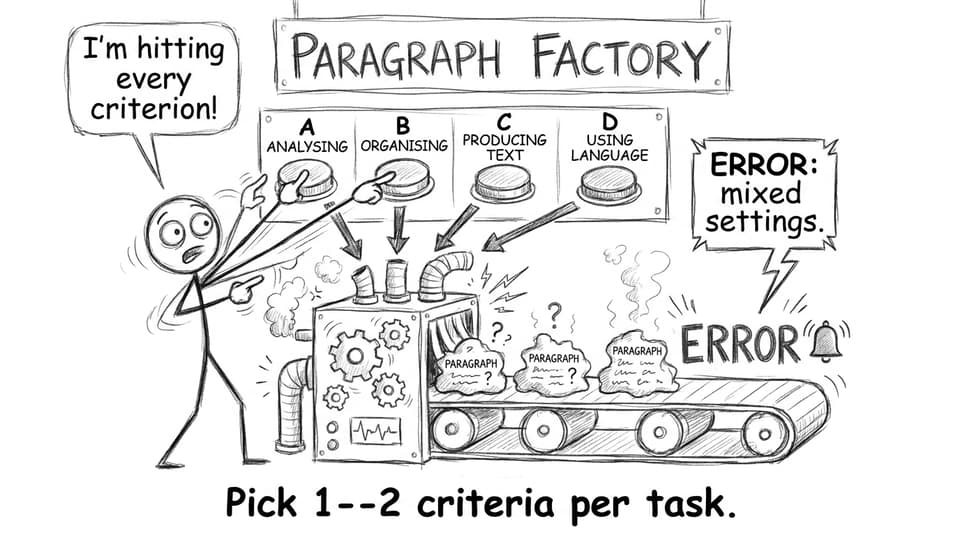
In MYP Language and Literature, tasks are scored using four criteria: A, B, C, and D. Most tasks focus on one or two criteria at a time, which is why trying to “do everything” often leads to unclear writing.
A helpful companion is the broader breakdown of how criteria-based grading works in general: How Are MYP Students Graded? Criteria Explained.
Criterion A in MYP: Analysing
Criterion A is where MYP students most often think they are analysing, but are actually summarising.
What it rewards:
-
Insight into authorial choices (language, structure, style, visuals)
-
Explanation of how those choices create meaning
-
Links to purpose, audience, and context
A high-scoring habit: build a “because” chain.
The writer uses X because Y, which makes the reader think/feel Z.
If you want targeted practice, RevisionDojo’s MYP English Lang & Lit resources are built around skill training (not just rereading). You can also sharpen specific analytical angles with Study Notes like Bias (MYP) Notes, where the technique-to-effect thinking is made explicit.
Criterion B in MYP: Organising
Criterion B is not “neat handwriting” or “longer paragraphs.” In MYP, organising means your reader can follow your thinking without re-reading.
What it rewards:
-
A clear line of argument (point A leads to point B)
-
Paragraphs that each do one job
-
Topic sentences and purposeful linking
Common ceiling: students have good ideas, but they arrive in the wrong order.
If structure is your weak point, you’ll improve quickly by doing short timed responses and then using RevisionDojo’s tools to review. Start with MYP revision strategies for Language & Literature and treat organisation like a repeatable template.
Criterion C in MYP: Producing Text
Criterion C is where MYP students sometimes lose marks by writing a great piece… for the wrong audience.
What it rewards:
-
Writing that fits purpose, audience, and context
-
Control of the chosen format (speech, article, essay, narrative)
-
Choices that are deliberate, not generic
A useful test: if you removed the task instructions, would a stranger still recognise the text type?
RevisionDojo helps here because you can practise multiple formats without reinventing your routine each time. Use Flashcards for format features, Study Notes for models, and AI Chat to generate new prompts in the same task style so you can repeat the skill, not the topic.
Criterion D in MYP: Using Language
Criterion D is about control. In MYP, markers reward writing that is accurate, clear, and appropriately varied.
What it rewards:
-
Correct grammar, punctuation, and spelling
-
Precise vocabulary (not random “advanced” words)
-
A consistent tone and register
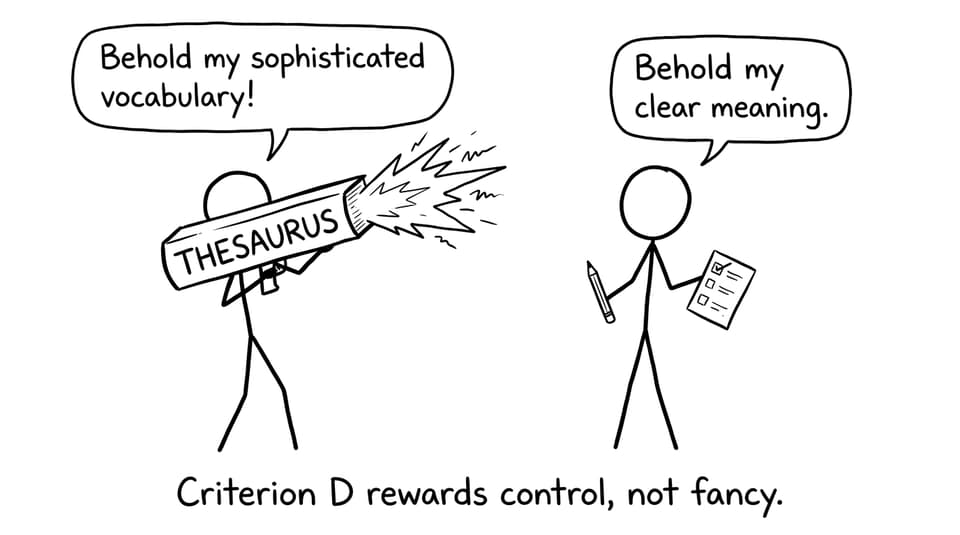
A surprising truth: “sounding smart” can lower your score if it hurts clarity.
Why MYP students plateau (and how to unstick fast)
Most plateaus in MYP Language and Literature come from one pattern: students revise content like it’s a memory test, then feel confused when the grade doesn’t move.
Try this instead:
-
Pick one criterion for the week (A or B is usually highest impact)
-
Do two short practices from a Questionbank style prompt
-
Use Grading tools to get rubric-aligned feedback
-
Rewrite only one paragraph with one improvement goal
If you want a simple “raise your level” roadmap, How to Score a 7 in MYP Language and Literature pairs well with the criteria lens.
Closing: make MYP scoring feel logical
Once you see MYP Language and Literature as criteria-first, the subject becomes calmer. Not easier, but clearer.
You don’t raise your level by writing more. You raise it by writing with proof that matches the criterion being judged.
If you want a single system to practise that skill loop, RevisionDojo is built for it: Questionbank for targeted drills, Study Notes for fast clarity, Flashcards for recall, AI Chat when you’re stuck, Grading tools for rubric feedback, plus Mock Exams, Predicted Papers, a Coursework Library, and Tutors when you need a precise reset. Start at the MYP hub, pick one criterion, and make your next practice response about evidence, not effort.