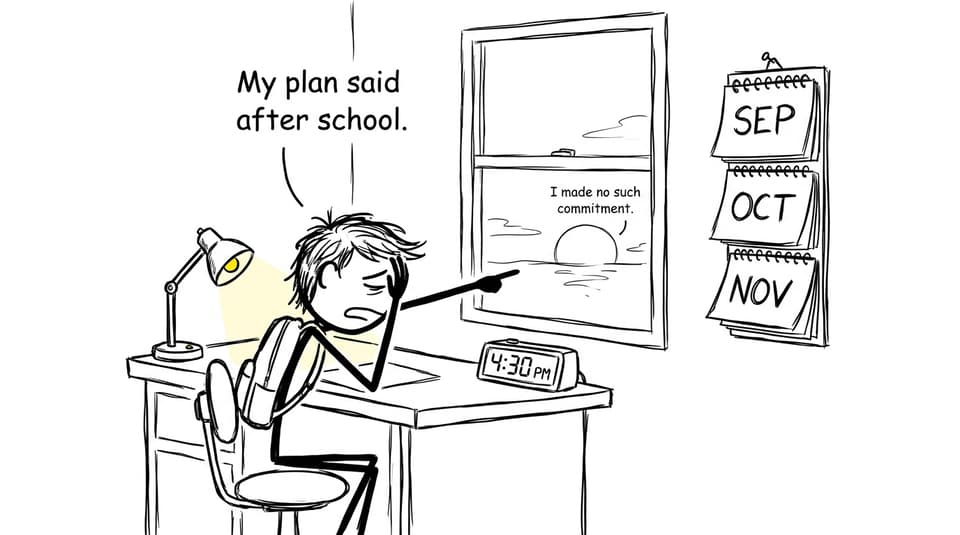
In September, studying after school can still feel connected to the day. By November, the same hour may arrive under a dark sky. Your IB workload has not changed, yet starting feels harder.
The practical question is how to handle shorter days without losing study energy. The answer is not to force longer evenings. Protect sleep, seek daylight earlier, move demanding work forward, and keep a smaller routine for low-energy days. Your autumn schedule should respond to changing conditions rather than ignore them.
Your shorter-day study checklist
- Get outside or near natural light early in the day.
- Keep sleep and wake times reasonably consistent.
- Complete your hardest academic task before lighter work.
- Study in defined 25-50 minute blocks.
- Keep a 10-15 minute minimum routine for tired days.
- Use active recall instead of extending study hours.
- Schedule coursework before it becomes an evening emergency.
- Review your routine each weekend and adjust it without guilt.
Why shorter days can change how studying feels
Light is one cue involved in regulating circadian rhythm, the internal timing system connected to alertness and sleep. As daylight decreases, your usual after-school study period may feel psychologically later, even when the clock says otherwise.
Teenagers also tend to experience a natural shift toward later sleep timing while school continues to begin early. Current guidance recommends that teenagers aged 13-18 regularly get 8-10 hours of sleep. Cutting sleep for revision can solve tonight's scheduling problem by worsening tomorrow's attention and energy.
Not every difficult evening is caused by darkness. Deadlines, inadequate meals, stress, illness, and unrealistic timetables also matter. The useful lesson is that energy is partly environmental, so your plan should not depend entirely on motivation.
Use daylight before manufacturing discipline
A good autumn routine begins before studying. Try to get outside in the morning, during a break, or at lunchtime. Daytime light supports the contrast between brighter days and darker evenings that helps regulate sleep and wake timing.
Walk part of the journey to school, spend lunch outside when conditions are safe, or take a brief outdoor break before returning home. If mornings are dark where you live, use whatever daylight is realistically available later.
A short walk after school can also create a boundary between lessons and revision without allowing a five-minute rest to become an hour of scrolling. If persistent fatigue, sleep disruption, or low mood affects daily life, speak with a parent, school counsellor, doctor, or another qualified professional.
Move your hardest IB work earlier
Many students save their most intimidating task for last. During shorter days, this becomes expensive. By the time they open a Chemistry problem set or Economics essay, they have spent their best attention on messages, easy homework, and administration.
Reverse the sequence. After a short transition, begin with one high-value task: a difficult HL concept, focused question set, analytical paragraph, Internal Assessment section, or Extended Essay research action.
Define the output before starting. “Study Biology” is vague. “Complete eight questions on membrane transport and correct every error” is actionable. The RevisionDojo guide to IB time management explains how specific actions reduce the friction of large assignments.
A workable weekday might include a 40-minute priority block, a 10-minute break, and a 25-minute secondary block. That is more useful than sitting at a desk for three unfocused hours. Adapt the balanced IB study schedule around your commute, meals, activities, and sleep.
Build a low-energy minimum
A routine becomes valuable when it survives an imperfect day. Your minimum should be small enough to complete when school was difficult and motivation has disappeared.
Try this 15-minute version:
- 7 minutes of Flashcards;
- 6 minutes correcting one recent mistake;
- 2 minutes choosing tomorrow's first task.
This is not a full revision session. It is a bridge to the next one. It preserves recall, keeps your error log active, and removes tomorrow's first decision.
RevisionDojo's IB Flashcards workflow supports brief retrieval practice rather than passive rereading. On stronger days, move from Study Notes to targeted Questionbank practice. If one misconception blocks progress, use Jojo AI as an IB study assistant for an explanation, then close it and solve something independently.
A low-energy day needs a smaller target, not a lower standard of thinking.
Separate maintenance from exam rehearsal
The fall term is usually better treated as a foundation period than as one continuous examination sprint. Aim to understand current topics, retain earlier material, and prevent coursework from accumulating unnoticed.
A weekly rhythm could include:
- Three focused blocks: Study Notes followed by Questionbank practice.
- Five short recall sessions: Flashcards for 10-15 minutes.
- One coursework block: IA, EE, or TOK work with a defined output.
- One feedback block: correct responses and classify recurring mistakes.
- One planning reset: choose next week's priorities.
Timed work still has a place before assessments. Use a short section instead of exhausting yourself with a full simulation every evening. Later, RevisionDojo's Predicted Papers and Mock Exams can develop timing and stamina. The guide to comprehensive IB mock preparation connects timed performance with targeted repair.
Coursework deserves its own block. RevisionDojo's Grading tools and Coursework Library can help you interpret criteria and identify improvements, while Tutors provide human guidance when the underlying problem remains unclear.
Protect the end of the evening
When energy falls, students often respond by delaying bedtime. The extra hour feels productive because it is visible. Its cost appears tomorrow, when ordinary tasks take longer.
Work backwards from your required wake time and protect an age-appropriate sleep window. Dim unnecessary lights later, reduce stimulating screen use near bedtime, and avoid turning your bed into a second desk.
Use the final five minutes to record what you finished, what remains unclear, and tomorrow's first action. Then stop. An unfinished syllabus does not become finished because you stayed awake rereading it.
Let the system carry you through fall
Shorter days expose a useful truth: motivation is unreliable, but a considered routine can still function when motivation is absent. Seek daylight when available. Put difficult work earlier. Maintain a fallback habit. Protect sleep as part of learning, not as time stolen from it.
RevisionDojo is the ultimate IB resource for building that system in one place. Its complete IB resource hub connects Study Notes, Flashcards, the Questionbank, AI Chat, Grading tools, Predicted Papers, Mock Exams, the Coursework Library, and Tutors. You can understand a topic, retrieve it, apply it, receive feedback, and choose the next step without rebuilding your workflow every evening.
The days will keep getting shorter for a while. Your study plan does not have to shrink with them. It simply needs to become more deliberate.

