

In the last week before a big assessment, most students do the same thing: they search for certainty.
Sometimes it looks like rewriting notes until your hand hurts. Sometimes it looks like watching one more video “just in case.” And sometimes it looks like scrolling through a messy folder of documents thinking, I know I learned something this year... but where is it?
That question is exactly why a MYP portfolio matters. Not as a scrapbook. Not as a dumping ground. As a calm, organized proof system that shows how your understanding and skills changed over time--and helps you revise smarter when exam season arrives.
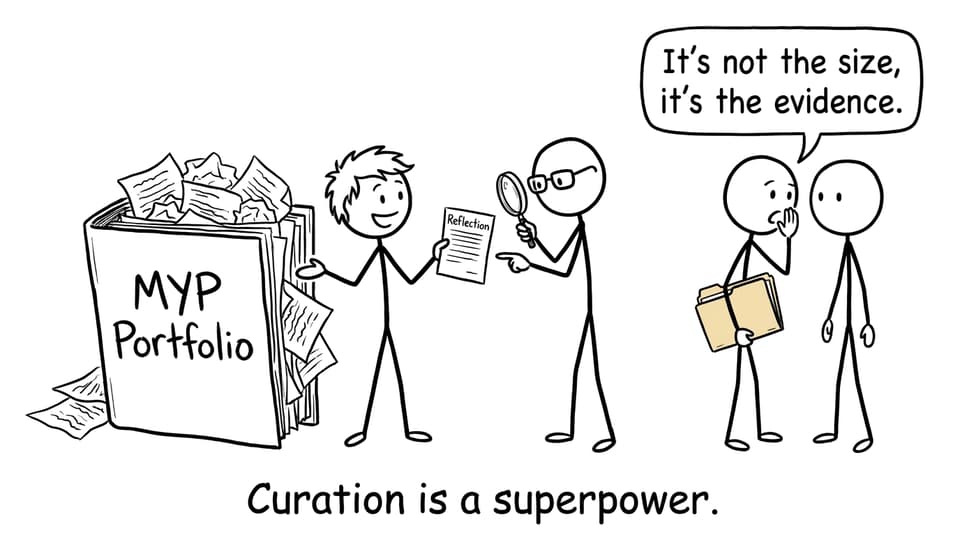
Quick portfolio checklist (save this)
Use this checklist to build a MYP portfolio that works as evidence of learning and as revision fuel:
-
One folder per subject group (plus one “projects” folder)
-
3--5 strong artifacts per subject, not 30
-
Each artifact includes: date, task context, criteria focus, and a short reflection
-
At least one “before and after” example (feedback + improvement)
-
ATL tagged explicitly (communication, research, self-management, social, thinking)
-
A running “exam skills” page: command terms, common mistakes, best strategies
If you want a clear home base for your MYP planning, start with the Middle Years Program (MYP) hub.
Why student portfolios matter in the MYP (especially for exams)
In the MYP, assessment is criterion-related. Your grades are trying to describe what you can do with your knowledge, not just what you can repeat. A portfolio becomes powerful when it captures that doing: investigating, creating, communicating, analyzing, reflecting.
For exam preparation, this has a hidden advantage. When you revise from a portfolio, you are revising from your own evidence:
-
the explanations you wrote when you understood the concept
-
the mistakes you made when you didn’t
-
the feedback that told you what to fix
-
the second attempt that proved you could fix it
That’s why portfolios are not “extra.” They are a personal data set.
To understand how criteria thinking works across subjects, keep this reference close: How Are IB MYP Students Graded? Criteria Explained and Evaluation and Reporting in the MYP: Best Practices.
What to include in a MYP portfolio (the 4 artifact types)
A useful MYP portfolio usually contains a mix of four artifact types. Think of them as different kinds of proof.
Proof of understanding
These are the pieces that show you can explain ideas clearly.
Examples:
-
a short written response that uses key terms accurately
-
a science explanation with a correct model
-
a humanities paragraph that uses evidence and analysis (not summary)
If you struggle to tell “knowledge” from “useful knowledge,” this guide helps: MYP Individuals & Societies Criteria Explained.
Proof of process
These show how you got from messy to better.
Examples:
-
first draft + teacher feedback + improved draft
-
planning document + revised timeline
-
experiment plan + revised method after errors
Portfolios love process because the MYP values growth that’s visible.
Proof of ATL skill growth
ATL is where your portfolio becomes more than schoolwork. It becomes transferable.
Examples:
-
research log showing source evaluation
-
collaboration reflection after group conflict
-
a time-management strategy that improved your output
For ATL alignment, read Linking ATL Skills to Conceptual Understanding in the MYP and How to Teach Transferable Skills Through MYP Units.
Proof of reflection (the difference-maker)
Reflection is the part students often rush. But it’s what turns “work” into “evidence of learning.”
A strong reflection does three jobs:
- names what you tried, 2) explains what changed, 3) states what you’d do next time.
If you want to see what high-quality curation looks like, use Examples of Outstanding MYP Student Portfolios as calibration.
A simple MYP portfolio structure you can maintain in 10 minutes
The portfolio that survives the year is the one that’s easy to update.
Here is a structure that works for most MYP students:
Subject folder template
For each subject group, create:
-
Unit snapshots (1 page per unit)
-
Top artifacts (3--5 pieces)
-
Feedback loops (2 pieces that show improvement)
-
ATL tracker (a running table)
-
Exam skills notes (command terms, strategies, error patterns)
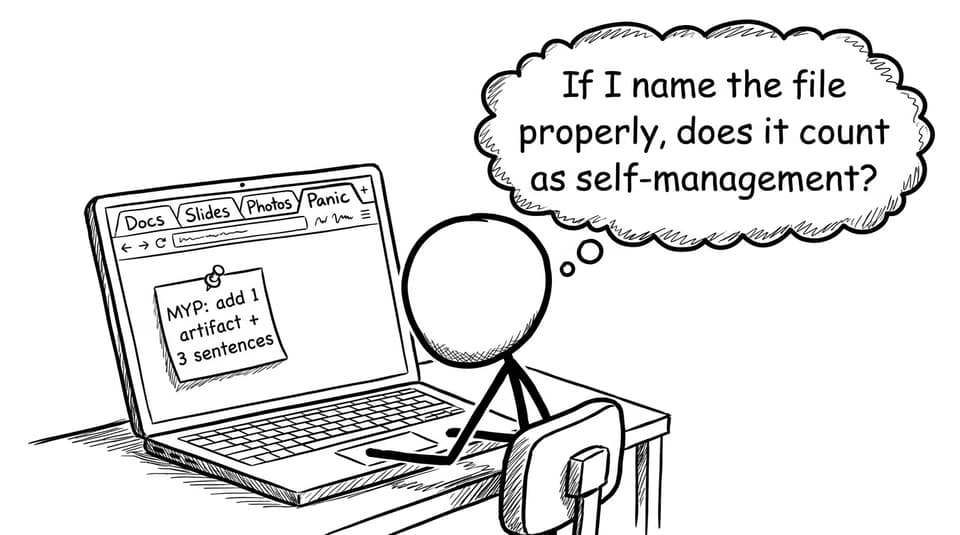
Then apply one rule: every upload gets a “context card” of 3 sentences:
-
What was the task and what criteria was it targeting?
-
What did I do well, specifically?
-
What will I do differently next time, specifically?
How portfolios connect to Personal Project and ePortfolio
Even if you are currently focused on exams, your MYP portfolio is also training for your biggest performance tasks.
Personal Project
Personal Project success comes from evidence: research that changes decisions, planning that evolves, action that shows iterations, reflection that evaluates against success criteria.
If you want a full roadmap, use MYP Personal Project: The Ultimate Student Guide and MYP: How to Get a 7 in the Personal Project. For rubric-aligned feedback, the MYP Personal Project Grader is built for exactly this kind of evidence-checking.
MYP Certificate ePortfolio
The ePortfolio is essentially a formalized version of the same idea: curated evidence + reflection, submitted digitally.
A helpful overview is IB MYP Certificate: ePortfolio Subjects and What to Expect.
Using your MYP portfolio as an exam revision engine
Here’s the quiet win: a good MYP portfolio reduces revision anxiety because you don’t start from zero.
Try this weekly routine in exam season:
-
20 minutes: pick one portfolio artifact and rewrite the reflection as “exam advice to my future self”
-
20 minutes: practice 10--15 targeted questions (RevisionDojo Questionbank)
-
10 minutes: turn 5 mistakes into Flashcards
-
10 minutes: ask AI Chat to quiz you using command terms you keep misreading
Then once a week, run a timed set using Mock Exams or Predicted Papers (where available) and store the error log in your portfolio as evidence of growth.
If you need more structure for the final stretch, MYP eAssessments: 30-Day Study Plan That Works pairs well with a portfolio-based approach.
Closing: make your MYP learning visible
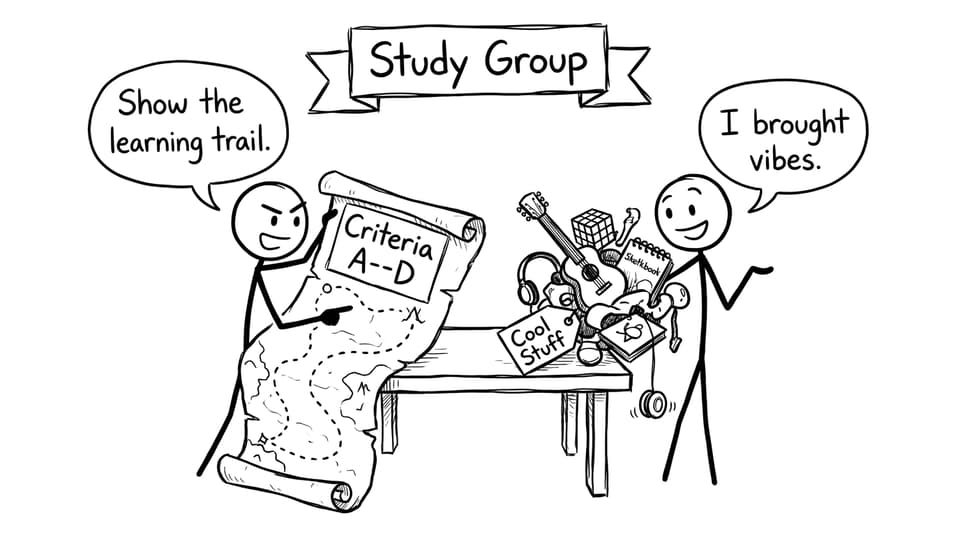
A MYP portfolio is one of those tools that feels small while you’re building it and huge when you need it. It turns scattered assignments into a story of skill--how you researched, wrote, solved, created, revised, and learned to think under pressure.
If you want that story to translate into exam confidence, build it on RevisionDojo’s ecosystem: Study Notes for clarity, Questionbank for repetition, Flashcards for recall, AI Chat for fast stuck-points, Grading tools for criteria alignment, and Mock Exams and Predicted Papers (where available) to rehearse calm performance. Add in the Coursework Library and Tutors when you need examples or human diagnosis.
Start today with one upload, one reflection, and one next step. Your future self, sitting down to revise for MYP assessments, will feel the difference.