


A parent-teacher meeting can feel surprisingly compressed. Months of reading, writing, discussion, and feedback must fit into a few minutes. The most useful questions to ask an MYP English Language and Literature teacher are therefore more specific than, “Is my child doing well?” Ask which assessment criterion needs attention, what the teacher sees in the work, and what one manageable action would help next.
That approach changes the conversation. Instead of leaving with a grade and a vague instruction to “write more,” you leave knowing what progress looks like and how to support it without becoming the second English teacher at home.
A quick parent-teacher meeting checklist
Bring these questions, but do not feel obliged to ask every one:
- What is my child doing well?
- Which MYP assessment criterion is strongest?
- Which criterion should be the next priority?
- Can you show me evidence from a recent task?
- Is the main difficulty analysis, organization, creativity, or language control?
- What would the next achievement level look like?
- What is one low-pressure action we can take at home?
- When should we review progress?
For broader context, read this guide to supporting a child in the MYP. Familiarity with the framework can make the meeting clearer without requiring you to master the course.
Ask about progress across the four criteria
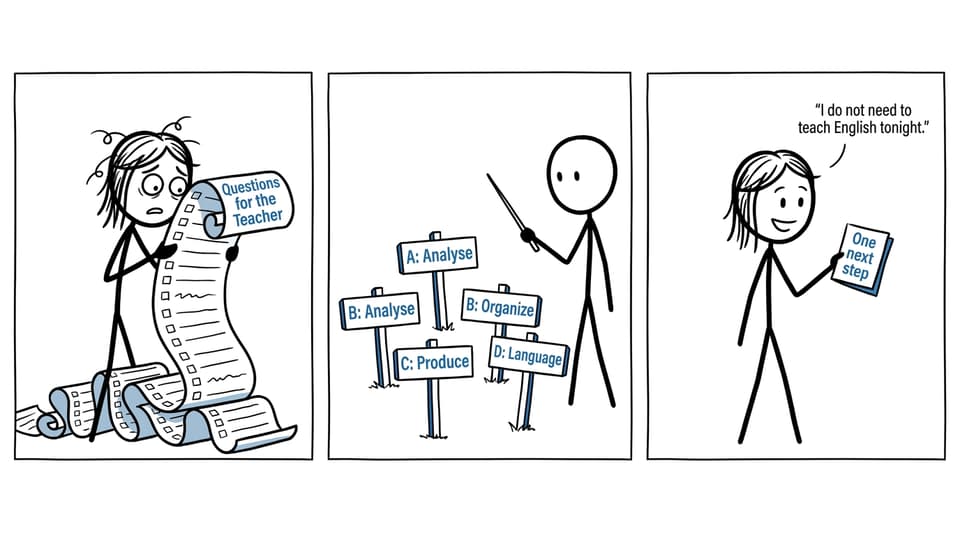
MYP Language and Literature uses four equally weighted assessment criteria: Analysing, Organizing, Producing text, and Using language. Each has achievement levels from 1 to 8, with descriptors appropriate to the student’s MYP year. A task may assess only selected criteria, so one result rarely tells the whole story.
A useful opening question is:
“Could you explain my child’s progress across Criteria A, B, C, and D, rather than only the overall result?”
Then ask which criterion is most secure, whether a pattern appears across assignments, and what would become visible in work at the next achievement band. This last point matters. “Improve analysis” is abstract; “explain how the writer’s choice affects the audience” is actionable. RevisionDojo’s MYP Language and Literature assessment criteria guide helps translate criterion language into recognizable skills.
Ask what the teacher sees in the work
Grades summarize. Work samples explain.
Ask the teacher to show one recent paragraph, presentation, or creative response and identify both a strength and a next step:
“Could you point to one place where my child met the criterion well, and one place where the response could go further?”
This may reveal that a student understands the text but struggles to explain authorial choices, has insightful ideas but organizes them loosely, or writes accurately without adapting tone to audience and purpose.
Also ask whether classroom contributions and written work tell the same story. A perceptive speaker who freezes when writing may need planning practice. A student who struggles under time limits may need shorter timed responses. The MYP English curriculum overview explains the wider reading, writing, viewing, speaking, and presenting skills involved.
Ask how feedback should become action
Students can receive accurate feedback without knowing how to use it. Ask which comment appears most often, what should change in the next task, and how your child will recognize improvement. It may be more useful to rewrite one paragraph than complete another full response.
A simple routine is enough: identify one comment, translate it into a specific action, and apply it within the next few days. RevisionDojo’s MYP Language and Literature revision strategies show how focused rewrites and short practice can make feedback usable.
Ask about reading without making it a punishment
“Should my child read more?” is reasonable but too broad. Ask whether wider or closer reading would help, which text types matter most, and what your child should notice.
The answer may not be another novel. A student might benefit more from examining an advertisement for audience and bias, comparing two opinion pieces, or annotating how a writer creates tension. At home, keep the invitation light: “What does this writer want us to notice?” or “Who is this message trying to persuade?” The purpose is to make interpretation ordinary, not to test the child at dinner.
Ask what support preserves independence
Supporting a child in MYP English is less about editing sentences and more about protecting the conditions for independent thinking. Parents can create a short study window, ask the child to explain the task aloud, check that the rubric is available, and encourage one revision based on feedback.
Avoid polishing every sentence or supplying an interpretation. A useful boundary is: “I can ask questions, but the decisions and words remain yours.” For practical routines, see these MYP homework tips for parents.
Turn the answer into one weekly routine
After the meeting, resist creating a complete academic rescue plan. Choose one action for two or three weeks. If analysis is the priority, your child might write one paragraph explaining a creator’s choice and effect. For organization, they could plan three topic sentences before drafting. For language control, they could edit one paragraph for vocabulary, tense, and punctuation.
The RevisionDojo MYP English Language and Literature hub brings together Study Notes, Flashcards, lessons, and targeted practice. The Questionbank supports application, while AI Chat and Grading tools can help students identify specific weaknesses independently. Mock Exams and Predicted Papers, where available, add timed rehearsal; the Coursework Library and Tutors offer deeper support when a recurring problem needs models or human guidance.
RevisionDojo works best as a bridge from confusion to independent action, not another source of pressure. Families wanting a broader structure can also use the MYP revision guide.
Leave with clarity
A productive meeting identifies a pattern, names the skill behind it, and gives the student a realistic next move. Ask about criteria, request evidence, clarify how feedback should be used, and agree on one low-pressure action. With the teacher’s insight, a calm home routine, and RevisionDojo’s MYP-specific tools, parents can offer something more valuable than constant supervision: clarity and room to grow.