


The moment you realise MYP isn’t testing the book
The week before a Language and Literature assessment, most students do the same thing: they reread the novel, highlight a few quotes, and hope inspiration shows up on exam day.
Then the task arrives.
It’s an unseen extract. Or a speech. Or a media text.
And suddenly, the MYP feels unfair, because you did the “right” kind of studying for a different kind of subject.
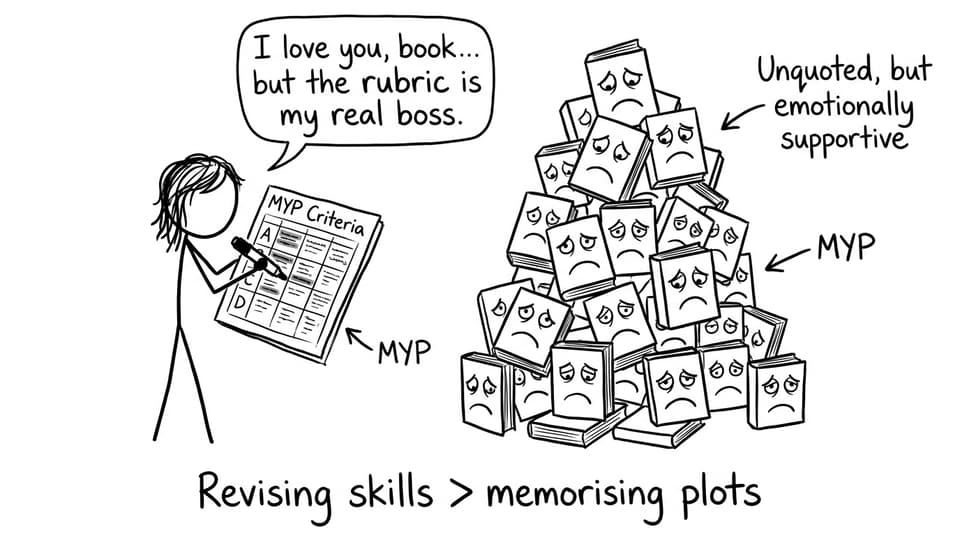
In MYP Language and Literature, your grade is rarely about how much you remember. It’s about what you can do with language: how you analyse choices, organise thinking, craft texts for purpose, and control expression under time pressure. Once you accept that, revision becomes calmer and more strategic.
MYP Language and Literature expectations: your quick checklist
Use this as your pre-exam reset. If you can do these consistently, you’re meeting MYP curriculum expectations.
-
You can explain how choices (diction, structure, voice, visuals) shape meaning
-
You can write in a clear structure that a stranger can follow
-
You can adapt tone and style to purpose and audience
-
You can use evidence precisely (quote, paraphrase, reference) and then explain it
-
You can reflect on how context (culture, time, situation) affects interpretation
When you want a single place to organise this kind of practice, start from the Middle Years Programme (MYP) hub and build a simple routine around skills.
What MYP Language and Literature is actually about
At its core, MYP Language and Literature trains you to notice how language works in the real world.
That’s why your texts aren’t limited to novels or poems. You’ll move between literary and non-literary works: narratives, speeches, articles, opinion pieces, advertisements, podcasts, infographics, film stills. The point is not to become a walking encyclopedia of content. The point is to become a reader and writer who can:
-
interpret meaning beyond the surface
-
evaluate viewpoint and representation
-
communicate with clarity and intention
If you want a clear picture of the skill-first mindset, these two reads are worth bookmarking: Best Revision Strategies for MYP Language and Literature and Common MYP Mistakes in Language Tasks (And Fixes).
The MYP framework: concepts, inquiry, and global contexts
A classic misunderstanding is thinking the MYP is “less academic” because it talks about inquiry and concepts. In practice, the concept-based approach is what forces deeper analysis.
Most Language and Literature units are built around:
-
Key concepts (like communication, creativity, connections)
-
Related concepts (like genre, purpose, audience, theme, point of view)
-
Global contexts that connect texts to real life (identity, fairness, scientific innovation, etc.)
This means your analysis should often answer two layers at once:
-
What does the text do?
-
Why does it matter in this context?
That second layer is where high achievement levels live.
MYP assessment criteria (A--D): how you’re graded
In MYP Language and Literature, every task is mapped to criteria. Each criterion is scored 0--8, and together they convert to a 1--7 grade.
To understand the grading model across subjects, keep this guide nearby: How Are MYP Students Graded? Criteria Explained.
Criterion A: Analysing (meaning, methods, context)
This is where you prove you can read like a critic, not a summariser.
High-level MYP analysis usually includes:
-
a claim about meaning or viewpoint
-
precise evidence
-
an explanation of how a choice creates an effect
-
a link to purpose, audience, or context
If you want a full breakdown of what markers look for, use MYP Language and Literature Assessment Criteria Explained.
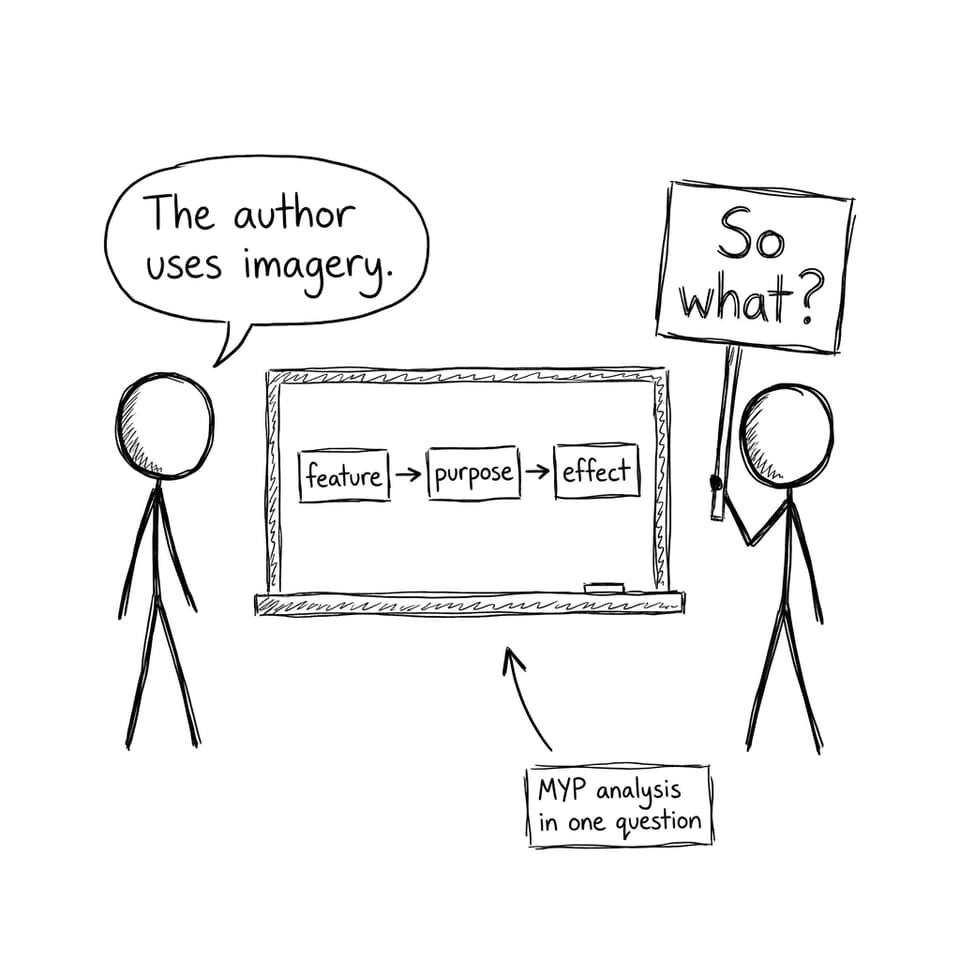
A practical way to train this is to study one focused skill at a time, like bias. RevisionDojo’s Notes for Bias - MYP are built exactly for that kind of targeted improvement.
Criterion B: Organising (structure that earns trust)
Organisation is not decoration. In MYP, it’s a scoring category.
Markers reward writing that has:
-
a logical line of argument
-
topic sentences that control paragraphs
-
transitions that show relationships between ideas
-
a conclusion that answers the task, not just repeats points
Most students can improve Criterion B faster than any other criterion because it’s about habits. Build a reusable paragraph frame and practise it under time limits.
Criterion C: Producing Text (purpose and audience)
Criterion C is where you show you can make texts, not just analyse them.
In MYP, you might be asked to write:
-
a persuasive article
-
a speech
-
a narrative
-
a review
-
a creative transformation
Top responses feel intentional. The tone fits. The register fits. The format fits. You’re not just “writing well” -- you’re writing for someone, for a reason.
Criterion D: Using Language (control, accuracy, style)
Criterion D is not a vocabulary contest. It’s control.
Strong MYP language use looks like:
-
varied sentence structures that stay readable
-
accurate conventions (spelling, punctuation)
-
vocabulary that is precise, not flashy
-
phrasing that suits the task (formal, semi-formal, conversational)
If you want a model of what high performance looks like overall, read How to Score a 7 in MYP Language and Literature.
How to revise MYP Language and Literature like an exam student
Here’s the shift: stop revising texts, start revising moves.
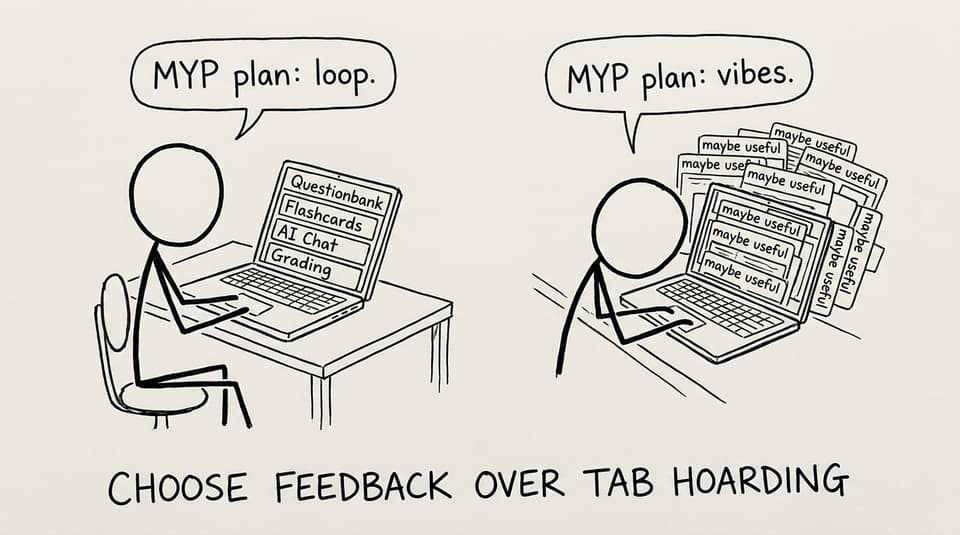
A reliable MYP practice loop looks like this:
-
Study Notes to clarify one skill
-
short timed practice
-
feedback and correction
-
repeat with a slightly harder text
RevisionDojo is built for that loop. The MYP English Lang & Lit hub gives you Study Notes, Flashcards, and skill-by-skill lessons. Pair that with the Questionbank for steady drills, then use AI Chat when you’re stuck and need a better example or a tougher prompt. When you write, use the Grading tools to get rubric-aligned feedback, and use Mock Exams and Predicted Papers (where available) to rehearse pacing and pressure. If you need a human diagnosis, Tutors help you fix patterns quickly instead of repeating them.
For broader structure across subjects, the MYP Revision Guide: Study Tips for Success and MYP eAssessments: 30-Day Study Plan That Works help you build a schedule that doesn’t collapse under stress.
Closing: the calm advantage in MYP
The quiet secret of the MYP is that it rewards students who stop chasing the “right” interpretation and start building reliable processes.
Read like a detective. Write like an architect. Revise like an athlete.
If you want that approach in one place, use RevisionDojo as your practice loop: Study Notes for clarity, Flashcards for recall, Questionbank for repetition, AI Chat for quick coaching, Grading tools for rubric alignment, and Mock Exams plus Predicted Papers (where available) to make exam pressure feel familiar. Start with the Middle Years Programme (MYP) hub, and turn MYP Language and Literature into a subject you can control.