


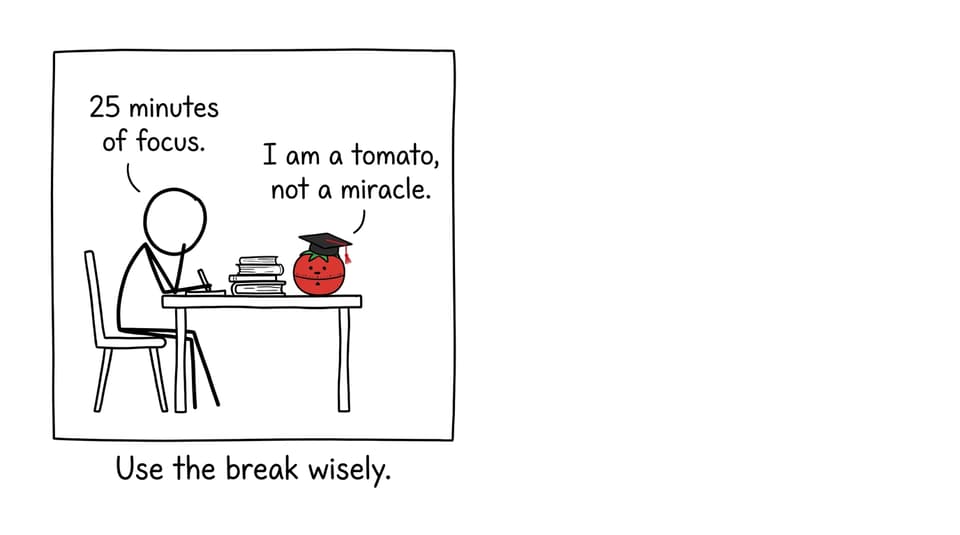
The Pomodoro Technique is a time-management method built around short periods of focused work and planned breaks. The standard version uses 25 minutes of work followed by five minutes of rest. After four rounds, you take a longer break.
For students researching the Pomodoro technique and whether it works for MYP, the short answer is yes, it can help, but it is a timer system, not a complete revision method. It may make starting easier, limit unplanned distractions, and stop a study session from becoming an exhausting marathon. It will not, by itself, help you remember concepts or answer MYP command terms effectively.
The method works best when each timed block contains a clear learning action: recalling information, answering questions, explaining a concept, or improving work from feedback.
The Pomodoro Technique at a glance
Use this simple structure:
- Choose one small, specific task.
- Work on it for 25 minutes without switching activities.
- Take a five-minute break away from the task.
- Repeat the cycle up to four times.
- After four cycles, take a longer break of roughly 15-30 minutes.
- Record what you completed before planning the next session.
For younger MYP students or difficult tasks, 15-20 minutes of work may be more realistic. For extended writing or a deep mathematics problem, 30-40 minutes may be better. The useful principle is not that 25 minutes is magical. It is that focus and rest are planned before your attention begins negotiating with you.
Does the Pomodoro Technique work for MYP students?
It can work particularly well for MYP students who procrastinate, feel overwhelmed by large assignments, or regularly drift between tabs. A vague instruction such as “revise science” feels endless. “Answer four data-analysis questions for 25 minutes” has a visible finish line.
Research offers cautious support rather than a guarantee. A 2023 study involving 87 university students found that predetermined breaks were associated with less fatigue and distractedness than self-regulated breaks, with similar task completion in less time. However, a later real-life study found no overall productivity or task-completion advantage for Pomodoro over self-regulated breaks. Some participants using fixed intervals also experienced faster increases in fatigue as a session continued.
These studies involved older students, not MYP learners, so their findings cannot be transferred perfectly to students aged 11-16. The sensible conclusion is that Pomodoro is worth testing as a personal structure, but there is no reason to force it when another rhythm produces better concentration.
MYP assessment also values more than memory. Students are expected to apply knowledge, communicate reasoning, investigate patterns, analyse evidence, and respond to subject criteria. That means an effective timer block must contain meaningful practice. The MYP Revision Guide explains how criteria, command terms, active recall, and reflection fit together.
A Pomodoro method you can start today
You do not need a special app. A timer, paper, and the relevant resources are enough.
Prepare for five minutes
Choose one subject and define an outcome you can see. Avoid tasks such as “study maths.” Write something measurable instead:
- Solve five linear-equation questions and correct every error.
- Recall ten biology terms without looking at notes.
- Write one analytical paragraph responding to an MYP command term.
- Add one evidence-based entry to a Personal Project process journal.
Open only the materials needed for that outcome. Put your phone beyond reach unless it is acting as the timer. Start from the RevisionDojo MYP resource hub if you need resources organised by subject.
Pomodoro one: retrieve
Set a timer for 25 minutes. Begin by recalling what you know before opening an explanation. You might complete Flashcards, draw a process from memory, solve a question, or explain a concept aloud.
This matters because rereading can feel smooth even when little can be recalled independently. Retrieval gives you honest information about what is secure and what needs attention.
Take a real five-minute break
Stand up, stretch, drink water, or look outside. Do not begin an activity designed to hold your attention indefinitely. A five-minute social-media break can easily become a 25-minute disappearance.
The break should make returning easier. If it creates a new argument about whether to return, it is not serving its purpose.
Pomodoro two: practise and apply
Spend the next 25 minutes answering questions or applying the idea in an unfamiliar context. RevisionDojo’s Questionbank can turn this block into active practice rather than another round of reading.
Match the task to the subject. The MYP mathematics study techniques guide focuses on criteria, reasoning, and unfamiliar contexts, while the MYP sciences revision guide shows how to combine concepts with data and application questions.
Pomodoro three: review errors
Do not measure success only by how many questions you completed. Review each mistake and classify it:
- missing knowledge
- misread command term
- weak explanation
- incorrect method
- unsupported conclusion
- careless notation or units
Use RevisionDojo’s Grading tools or AI Chat to clarify feedback, then rewrite one weak answer. For writing practice, the MYP Language and Literature revision strategies provide focused drills that fit comfortably inside one interval.
Finish with a two-minute record
At the end, write three lines:
- What did I complete?
- What mistake or gap appeared?
- What is the first task for my next session?
This prevents tomorrow’s revision from beginning with ten minutes of deciding what to do. It also turns the timer into a learning loop rather than a collection of completed intervals.
Match the interval to the MYP task
Different tasks create different kinds of attention. Use the timer flexibly.
| MYP task | Suggested work and break rhythm |
|---|---|
| Flashcard recall | 15-20 minutes, then 5 minutes |
| Question practice | 25 minutes, then 5 minutes |
| Analytical writing | 30-35 minutes, then 5-10 minutes |
| Personal Project work | 40 minutes, then 10 minutes |
| Timed assessment rehearsal | Follow the real assessment timing |
Do not interrupt useful concentration merely because a timer rings. If you are halfway through a complicated explanation, note that the interval has ended and finish the thought. Conversely, shorten the block if you repeatedly lose focus after 18 minutes. Good MYP revision techniques adapt to the learner and the task.
When Pomodoro does not work
The method becomes less useful when you spend every block passively highlighting, choose tasks that are too broad, or treat breaks as opportunities to open distracting apps. It can also interrupt flow during extended writing, design work, art, coding, or a complex investigation.
Pomodoro may not suit you if the ticking timer creates anxiety. Try a silent timer, a longer interval, or a stopwatch that records natural focus periods instead. Students preparing for final-year on-screen assessment should also complete longer, uninterrupted rehearsals. The MYP eAssessment preparation guide explains how to practise pacing, command terms, and screen-based performance.
A useful seven-day test is simple: record your planned task, interval length, completed work, and focus rating from one to five. At the end of the week, keep the rhythm only if it helped you start reliably and produce work you could check.
Build a complete MYP revision system
A timer manages attention. RevisionDojo manages what happens inside that attention.
Use Study Notes when a concept needs clarification, Flashcards for retrieval, the Questionbank for application, and AI Chat when an explanation still feels unclear. Grading tools help turn answers into targeted improvements. Predicted Papers and Mock Exams support longer timed rehearsal where available, while the Coursework Library and Tutors provide examples and human guidance for work that needs deeper feedback.
For the Personal Project, a Pomodoro can be devoted to one journal entry, research decision, or criterion section. The MYP Personal Project guide helps turn those small sessions into a documented process.
The quiet advantage of Pomodoro is not doing more work every minute. It is making the next useful action small enough to begin. Pair that structure with RevisionDojo’s complete MYP resources, active practice, feedback, and reflection, and the timer becomes what it should be: a doorway into focused learning, not the learning itself.