

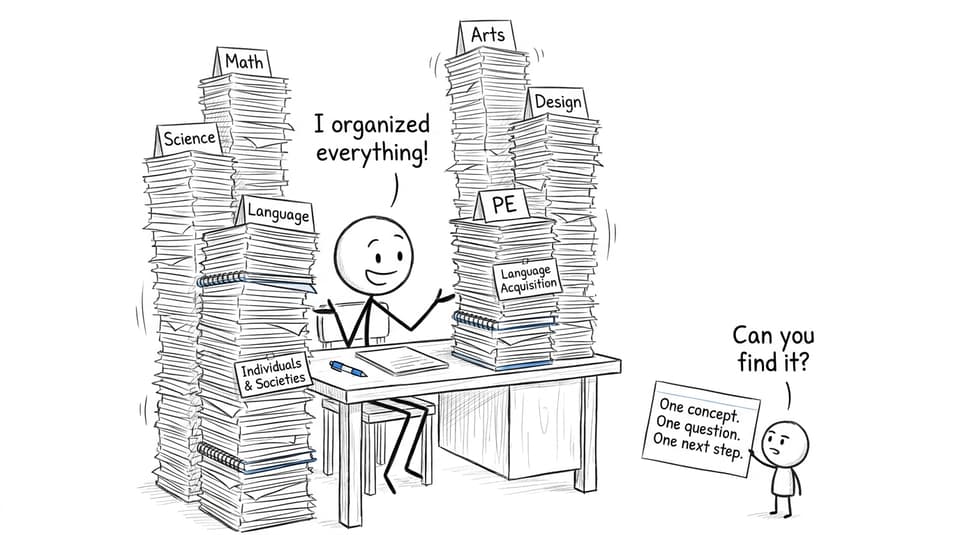
An organized notebook can still be a poor revision tool. The pages may be neat, headings underlined, and folders arranged by color. But if you cannot find an idea quickly, explain it without looking, or connect it to an assessment criterion, the system is storing information rather than helping you learn.
If you are wondering how to organize my MYP subject notes efficiently, use one home for each subject, divide it by unit, and give every unit the same five sections: overview, core notes, examples, criteria and feedback, and retrieval practice. Then schedule a short weekly reset to identify what to study next.
You can build this system today. You do not need new stationery, elaborate templates, or a weekend spent copying everything again.
The MYP notes system at a glance
Use this checklist before changing anything:
- Create one physical or digital home for each subject.
- Divide every subject into units rather than lesson dates.
- Build a one-page overview for each unit.
- Separate source material from your own summary notes.
- Label material by concept, skill, and relevant criterion.
- Convert important ideas into questions, flashcards, or practice tasks.
- Maintain an error log for mistakes and teacher feedback.
- Complete a 15-minute reset at the end of each week.
The IB describes the MYP as a framework spanning eight subject groups, with approaches to learning supporting independent learning across them. That breadth is why organization matters. A weak system asks your memory to remember where everything is. A strong one makes the location predictable.
How to organize my MYP subject notes efficiently today
Gather first, then sort
Begin by collecting notebooks, worksheets, slides, returned assignments, digital documents, and photographs of whiteboards. Do not start rewriting. Create an inbox for each subject. A physical inbox might be a temporary binder section; a digital inbox can be a folder named 00 Inbox.
Organizing and summarizing are different tasks. Trying to do both at once often turns a short sort into an evening of decorative copying.
Build one predictable structure
Use the same structure for every subject:
| Section | What belongs there |
|---|---|
| 00 Inbox | New material that has not been sorted |
| 01 Unit overview | Inquiry question, concepts, context, dates, and assessment |
| 02 Core notes | Short explanations arranged by topic |
| 03 Examples | Worked problems, evidence, diagrams, or models |
| 04 Criteria and feedback | Rubrics, teacher comments, and improvement targets |
| 05 Retrieval practice | Flashcards, questions, quizzes, and blank-page prompts |
| 06 Error log | Mistakes, corrections, and rules for next time |
Numbering keeps digital folders in the same order. For paper notes, use matching dividers. Consistency removes the small decisions that make studying feel harder than it is.
For reliable material while filling gaps, explore the RevisionDojo MYP resource hub. Check that its subject and topic match your school course, since MYP schools may organize content differently. The guide to subjects currently covered by RevisionDojo can help you choose relevant resources.
Make a one-page unit map
Place one overview page at the beginning of each unit. Include the unit title, inquiry question, key and related concepts, global context if your teacher uses one, essential vocabulary, two to four central ideas, relevant assessment criteria, assessment details, and your weakest area.
The page is a map, not a miniature textbook. If it grows beyond one page, it is probably becoming another set of notes.
MYP revision works best when facts remain connected to concepts and application. The complete MYP revision guide explains how concepts, command terms, criteria, and reflection can shape a broader study routine.
Compress each lesson into four blocks
After class, reduce the lesson to four parts:
- Core idea: Explain what the lesson was really about in two or three sentences.
- Evidence or method: Add the formula, quotation, process, example, or source that supports it.
- Criterion connection: Record the skill you were practising.
- Retrieval question: Write one question you should answer later without looking.
A science note should not merely preserve a diagram. It should ask you to redraw, label, and explain that diagram from memory. The guide to revising MYP Sciences without memorising everything shows how to combine concepts, data work, and unfamiliar applications.
Language notes need a different emphasis. Connect a technique to evidence, effect, purpose, and context instead of collecting long lists of terms. These MYP Language and Literature revision strategies turn notes into short analytical drills.
Organize by retrieval, not appearance
A useful note creates a small challenge. Cover the answer and define the term. Reconstruct the process. Solve a similar problem. Explain why an example fits the concept.
Mark each note with one of three statuses:
- Green: I can explain and apply this independently.
- Amber: I recognize it but cannot use it reliably.
- Red: I cannot yet explain it accurately.
Review red material first, then amber. Green material needs occasional retrieval, not repeated rereading.
RevisionDojo helps turn stored notes into a learning loop. Use Study Notes to clarify a gap, Flashcards to test recall, and the Questionbank to apply the idea. If your answer is wrong, add the reason to your error log instead of copying the entire solution. The MYP Mathematics study techniques guide gives examples of recording methods, justification, notation, and interpretation rather than answers alone.
Keep criteria and feedback beside the work
Students often place rubrics in one folder, feedback in another, and revision notes somewhere else. This separates the standard from the evidence.
For each major task, keep the instructions, relevant criterion descriptors supplied by your school, submitted work, teacher feedback, and one next-step sentence together. Write the next step as an action: “Explain how the evidence supports my claim” is more useful than “Improve analysis.” Before the next task, read that sentence and deliberately practise it.
RevisionDojo’s AI Chat can help unpack a confusing idea, while Grading tools can support criteria-focused review. Use AI as a coach: attempt the task first, request a hint or explanation, and then reproduce the reasoning independently. Always follow your school’s academic-integrity rules.
Use a 15-minute weekly reset
Good systems become messy. The solution is maintenance, not perfection.
Set a timer once a week and follow this sequence:
- Minutes 0-3: Empty each subject inbox.
- Minutes 3-6: File handouts and digital documents into the correct units.
- Minutes 6-9: Update unit maps with new concepts, dates, or criteria.
- Minutes 9-12: Turn three important ideas into retrieval questions.
- Minutes 12-15: Choose one red or amber topic for the next study session.
Do not rewrite everything. Repair only what would prevent you from finding, understanding, or testing the material later. If your week is crowded, the advice on balancing MYP schoolwork and extracurriculars can help you protect this habit.
Adapt the system to different MYP subjects
The folder structure should remain stable, but the contents should change by discipline.
In Mathematics, prioritize worked examples, explanations of why methods work, notation errors, and contextual interpretation. In Sciences, preserve diagrams, variables, data patterns, method evaluation, and links between evidence and conclusions. In Individuals and Societies, organize claims alongside evidence, source evaluation, perspectives, and key terminology.
For Language and Literature, group quotations and techniques by idea or effect rather than page number alone. In Design and the Arts, document iterations, decisions, constraints, feedback, and reflection. In Language Acquisition, combine vocabulary with phrases, contexts, model sentences, and common corrections.
As assessments approach, draw from the organized system rather than replacing it. Use Mock Exams and relevant Predicted Papers for timed rehearsal, then return mistakes to the error log. Consult the Coursework Library when you need to study the structure of strong work, and use Tutors when a persistent difficulty needs human diagnosis. The guide to MYP eAssessment success explains how to practise command terms, timing, unfamiliar contexts, and screen-based work.
Build a system that tells you what to do next
The best notes system is not the prettiest one. It answers three questions quickly: What am I learning? What can I do without help? What should I practise next?
Start with one subject today. Create the folders, sort the current unit, make its one-page map, and write three retrieval questions. Tomorrow, repeat the process for another subject. Within a week, your notes can become less like an archive and more like a working map.
RevisionDojo brings the next stage into one place. Its MYP Study Notes, Flashcards, Questionbank, AI Chat, Grading tools, Predicted Papers, Mock Exams, Coursework Library, and Tutors help you move from understanding to retrieval, application, feedback, and improvement. Organization clears the path. Deliberate practice is what moves you along it.