

The best MYP Individuals and Societies revision timetable is not the one with the most hours. It is a repeatable weekly plan containing three focused sessions, one short timed task, brief recall practice, and a weekly review.
Each session should have a clear purpose: retrieve content, practise an assessed skill, or improve work using feedback. This matters because Individuals and Societies is not simply a memory test. Students must know relevant material, investigate effectively, communicate clearly, and think critically.
A timetable works when it identifies the next action. “Revise migration” invites delay. “Recall five migration terms, analyse one source, and write one supported paragraph” creates a starting line.
Your timetable at a glance
A balanced week should include:
- Three focused sessions lasting 25 to 40 minutes
- Two or three brief Flashcard reviews
- Coverage of Criteria A, B, C, and D
- One timed source, planning, or writing task
- An error log containing specific improvements
- One buffer period for unfinished work
- A ten-minute weekly reset
- Protected time for sleep, activities, meals, and rest
The RevisionDojo MYP Individuals and Societies resource hub can keep the materials for this routine together. Match its topics against your school’s units because MYP courses may combine history, geography, economics, politics, sociology, and other humanities differently.
Build your timetable today
You do not need to plan the entire term. Set aside 30 minutes and build one useful week.
Start with real commitments
Write down lessons, travel, activities, deadlines, family commitments, meals, and bedtime. Schedule revision only in genuinely available periods.
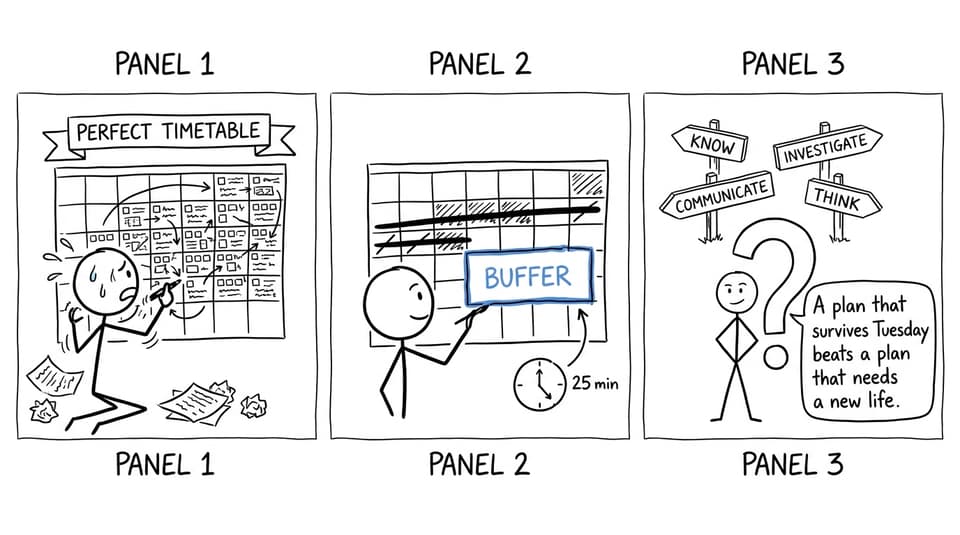
Many timetables fail because they assume an imaginary week with unlimited energy. A smaller plan that survives ordinary life is better than an ambitious plan abandoned on Tuesday.
Audit topics and criteria
List the relevant units and label your confidence:
- Red: I cannot explain or apply this yet.
- Amber: I understand parts but make inconsistent errors.
- Green: I can retrieve and apply it independently.
Then identify which assessment criteria need attention. The four Individuals and Societies criteria are Knowing and understanding, Investigating, Communicating, and Thinking critically. Each has a maximum achievement level of 8 and is equally weighted within the subject framework.
The criteria deserve scheduled practice rather than a quick glance before an assessment. This guide to MYP Individuals and Societies criteria explains what each criterion looks like in student work.
Turn topics into visible tasks
Every timetable entry needs a verb and an output. Replace broad labels with tasks such as:
- Retrieve ten terms about urbanisation without notes.
- Explain two causes of a conflict using evidence.
- Compare the origin and purpose of two sources.
- Plan an investigation around a focused research question.
- Write one Point, Evidence, Explanation, Link paragraph.
- Evaluate two perspectives on a development policy.
- Correct a response using the relevant criterion.
A finished product provides evidence of progress. Time spent at a desk does not.
Allocate four core blocks
Start with three 30-minute sessions and one 40-minute weekend block. Give two blocks to red areas, one to amber work, and use the fourth for mixed or timed practice. Maintain green topics through short retrieval sessions.
If an assessment is approaching, temporarily add one block. Do not permanently expand the timetable whenever you feel worried.
A realistic weekly revision timetable
This template can move around school, sport, and other subjects.
| Day | Time | Main focus | Concrete task |
|---|---|---|---|
| Monday | 30 minutes | Criterion A | Recall one topic, check gaps, and create five Flashcards |
| Tuesday | 10 minutes | Memory | Retrieve Monday’s terms and examples without notes |
| Wednesday | 35 minutes | Criteria B and D | Analyse sources or plan a focused investigation |
| Thursday | 10 minutes | Error review | Retry one weak question and explain the correction |
| Friday | Buffer | Catch-up or rest | Finish one missed task only if necessary |
| Saturday | 40 minutes | Criteria C and D | Plan and write a timed analytical response |
| Sunday | 15 minutes | Weekly reset | Review errors, update confidence colours, and schedule next week |
Blocks can be shorter if you are in an earlier MYP year or have competing deadlines. Before an assessment, extend Saturday’s block rather than filling every evening. For a whole-programme structure, see how to build a revision timetable for MYP.
Use a repeatable session routine
A timetable decides when you study. Your method determines whether that time changes anything.
Use this 30-minute loop:
- Five minutes: Close everything and retrieve what you know.
- Eight minutes: Repair one precise gap using class materials or Study Notes.
- Ten minutes: Apply the knowledge to a question, source, or argument.
- Five minutes: Check your work against criteria or feedback.
- Two minutes: Record one error rule and schedule a retry.
An error rule should tell your future self what to do. Instead of “weak analysis,” write: “After identifying a source’s purpose, explain how that purpose affects its value or limitation.”
RevisionDojo supports this loop through Study Notes, Flashcards, and the Questionbank. AI Chat can challenge an unsupported claim, while Grading tools can help you inspect a response through criteria language. Close the support and rewrite independently so the final thinking remains yours.
Rotate effective revision techniques
Good MYP Individuals and Societies revision techniques move beyond rereading.
Retrieve facts, then apply them
Use Flashcards for terminology, examples, concepts, and perspectives. Answer before turning the card over, then connect each answer to a possible question. Recalling a definition of globalisation supports Criterion A. Explaining how globalisation affects two groups differently begins to develop Criterion D.
Practise source analysis in small pieces
Choose one map, graph, photograph, speech, or article extract. Identify its origin and purpose, then explain a specific value and limitation in relation to the question.
Practising one decision at a time makes improvement easier to see. The MYP interdisciplinary learning guide shows how evidence and perspectives can connect across humanities disciplines.
Write and review one paragraph
Full essays are useful, but they take time. On many weekdays, one carefully reviewed paragraph teaches more than an uncorrected page.
Plan a claim, choose relevant evidence, explain why it supports the claim, and link back to the question. The guide to structuring MYP Individuals and Societies essays provides a dependable framework.
Add timed work gradually
Begin with a six-minute plan or ten-minute paragraph, then combine them into longer responses. Students preparing for on-screen assessments should sometimes type, read digital sources, and make decisions under realistic time limits.
The 30-day MYP eAssessment study plan provides a longer preparation sequence. RevisionDojo’s Mock Exams and suitable Predicted Papers, where available, become most useful after individual weaknesses have been repaired.
Adjust the timetable every Sunday
A timetable is a hypothesis about your future energy. Review the evidence: which sessions were completed, which skill improved, which error returned, and which task was too broad or badly timed?
Do not respond to missed work by doubling next week’s schedule. Move one priority into the buffer, reduce oversized tasks, and continue. The wider MYP revision guide offers further study tips for maintaining this rhythm across subjects.
If a misunderstanding survives several retries, seek diagnosis rather than more repetition. Ask your teacher, use RevisionDojo AI Chat for guided explanation, or work with Tutors for human feedback. The Coursework Library can also clarify effective organisation, provided examples remain learning tools rather than text to copy.
The best timetable turns one large worry into small appointments: retrieve, apply, check, and improve. RevisionDojo brings those moments together through its Questionbank, Study Notes, Flashcards, AI Chat, Grading tools, Mock Exams, Predicted Papers, Coursework Library, and Tutors. Start with one topic audit and one 30-minute session. A timetable becomes real when it produces your next action.