


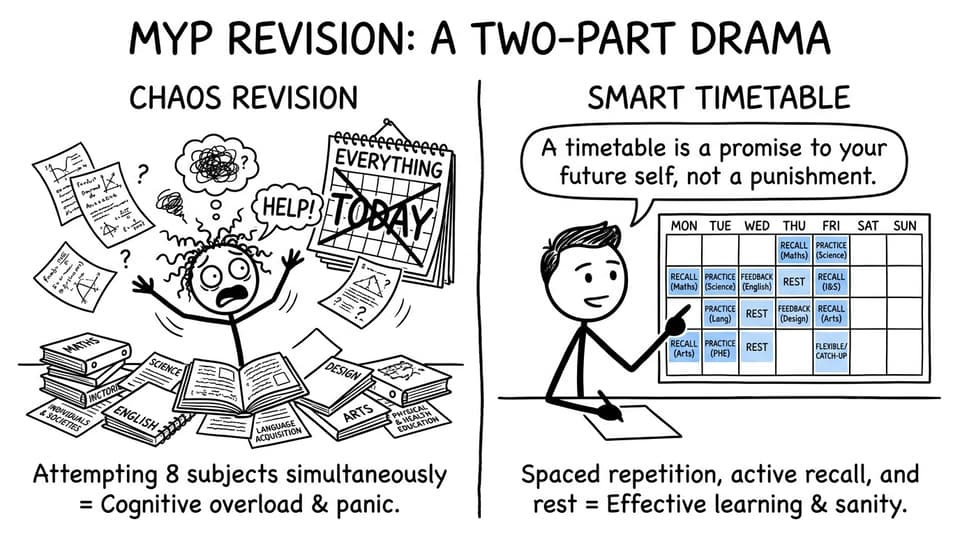
A revision timetable can look beautifully organised and still fail by Wednesday. The problem is rarely the colour coding. It is that the plan was built for an imaginary student with unlimited energy, no homework, and no unexpected deadlines.
To build a revision timetable for MYP that works, schedule specific actions rather than vague subjects. Give weaker or urgent areas more time, rotate through assessment criteria, include short review sessions, and leave room for ordinary life. You can create the first version today in about 45 minutes.
The goal is not to fill every empty hour. It is to make the next useful action obvious.
Your MYP timetable checklist
A workable plan should contain:
- One list of assessments, projects, and deadlines
- A quick rating of each subject by urgency and confidence
- Three to five focused revision blocks on school days
- Longer practice blocks where the week allows
- Short recall sessions for stronger subjects
- At least one buffer block for unfinished work
- A weekly review to adjust the next timetable
- Protected time for sleep, meals, movement, and commitments
For supporting materials, begin with the RevisionDojo MYP resource hub. Check that the available subject content matches your school's units before adding resources to your schedule.
Why an MYP timetable needs to be criterion-aware
The MYP serves students aged 11 to 16 and is organised around eight subject groups, although the exact combination varies by school and year. Assessment is generally ongoing and criterion-related. Schools may also register students for optional MYP eAssessment in the final year, while the Personal Project is a required culminating experience for MYP Year 5 students.
That structure matters. Revision may involve investigating, communicating, analysing sources, processing data, creating a solution, performing, or reflecting, rather than simply memorising content for one final test.
Most MYP subject groups use four assessment criteria, labelled A to D, but the skills represented by those letters differ between subjects. Your timetable should say what skill you will practise, not merely which textbook you will open.
Compare these entries:
- Weak: “Science, 45 minutes”
- Strong: “Science, Criterion C: complete one data-analysis task and correct errors, 45 minutes”
The second entry removes a decision you would otherwise need to make when tired. For more guidance, read the MYP revision guide and study checklist.
The same-day method for building your timetable
Set aside 45 minutes, gather your school calendar and subject information, and follow these steps.
Gather every fixed commitment
Write down lessons, travel, meals, sports, clubs, tutoring, family commitments, bedtime, assessments, and project deadlines. Do not begin by squeezing study into every gap. Start by recognising which time is genuinely available.
Make a subject and criteria inventory
List each subject, its current unit, the next assessed task, and the criteria likely to be assessed. Use the rubric or task sheet supplied by your teacher rather than guessing.
Create three confidence labels:
- Red: confused, behind, or approaching an important deadline
- Amber: partly understood but inconsistent in application
- Green: secure enough to maintain with brief retrieval
You can adapt the ideas in balancing MYP subject groups if your list feels unmanageable.
Turn broad goals into visible tasks
“Revise mathematics” is too large to start. Replace it with a task that produces evidence:
- Complete six questions on linear relationships
- Explain photosynthesis from memory, then check missing details
- Plan one source-analysis response using Criterion D language
- Practise a language speaking prompt and record the answer
- Improve one paragraph using teacher feedback
Each block needs a verb, a topic, and an output. If you cannot tell when the task is finished, make it smaller.
Allocate time by need, not fairness
Give more blocks to red areas, approaching assessments, and tasks requiring sustained creation. Give green subjects short maintenance sessions so they remain secure.
A useful starting ratio is 50% of available revision time for red priorities, 30% for amber areas, and 20% for green maintenance. This is a planning rule, not an MYP requirement. Change it when deadlines make another distribution sensible.
Choose repeatable block lengths
For many students, 25 to 45 minutes is enough for a focused school-day block. Divide longer tasks into planning, producing, and reviewing. Add a five- or ten-minute break between demanding sessions.
A useful 40-minute block might contain five minutes of retrieval without notes, 20 minutes of focused practice, ten minutes of correction and feedback, and five minutes to record the next step.
For mathematics, the MYP mathematics assessment and revision guide shows how sessions can rotate between knowledge, patterns, communication, and real-life application. Science students can use revising MYP Sciences without memorising everything for a similar structure.
Match tasks to your energy
Put challenging problem-solving, writing, or project work in the part of the day when you usually concentrate best. Reserve lower-energy periods for Flashcards, organising materials, correcting short responses, or reviewing vocabulary.
Time on a calendar is not the same as usable attention.
Add a buffer and weekly reset
Leave at least one block open. It can absorb a delayed assignment, a difficult topic, or a missed session. If nothing spills over, use it for light review or take the time back.
At the end of the week, ask which sessions you completed, what improved, which tasks were postponed, and whether each task was unclear, too long, or scheduled badly. Your timetable is a draft, not a verdict on your discipline.
A realistic weekly MYP timetable
This example assumes school-day sessions and a longer weekend block. Adjust it around your commitments and deadlines.
| Day | Focus block | Maintenance block | Review action |
|---|---|---|---|
| Monday | Mathematics problem set, 40 minutes | Language vocabulary, 15 minutes | Record two errors |
| Tuesday | Sciences data task, 40 minutes | Mathematics Flashcards, 10 minutes | Rewrite one response |
| Wednesday | Individuals and societies source analysis, 45 minutes | Science recall, 15 minutes | Check against criteria |
| Thursday | Language and literature analytical paragraph, 40 minutes | Vocabulary retrieval, 10 minutes | Apply teacher feedback |
| Friday | Buffer or light catch-up, 30 minutes | Weekly Flashcards, 15 minutes | Update confidence ratings |
| Saturday | Personal Project or major assessment, 60 minutes | Mixed Questionbank set, 20 minutes | Plan the next milestone |
| Sunday | Next-week planning, 20 minutes | Optional light recall | Protect recovery time |
Students approaching eAssessment may need more timed digital practice. The 30-day MYP eAssessment study plan offers a more intensive structure.
MYP revision techniques to place inside each block
A timetable decides when you work. Your technique determines what happens during that time.
Use active recall by closing your notes and retrieving an explanation, process, quotation, formula, or definition from memory. Follow this with application, such as solving a problem or answering a question in an unfamiliar context. Then use feedback to identify the difference between your response and the expected standard.
RevisionDojo helps organise this cycle. Use Study Notes to repair a defined gap, Flashcards for retrieval, and the Questionbank for application. AI Chat can clarify a misconception, while Grading tools can help you examine written work against relevant expectations. Attempt the work yourself first and follow your school's academic integrity rules.
When timed preparation becomes appropriate, add Mock Exams or relevant Predicted Papers where available. The Coursework Library can help you study structure, while Tutors provide human guidance when a recurring problem is difficult to diagnose. Coverage varies, so check the guide to RevisionDojo MYP subject coverage before building a tool into your routine.
Make the plan small enough to survive
The temptation is to design a perfect week. A better aim is to design a repeatable one.
Start today with one 40-minute planning session. Build tomorrow's first task before planning the entire month. After seven days, keep what worked and remove what did not.
The strongest MYP study tips are quiet ones: define the task, practise the assessed skill, review the evidence, and return before the knowledge fades. RevisionDojo brings that loop together through targeted notes, recall tools, questions, feedback, realistic practice, coursework support, and tutoring. Your timetable supplies the rhythm. RevisionDojo helps each block become useful.