The sensible target for MYP English Language and Literature study hours per week is usually 2 to 3 focused hours outside class. During an assessment week, increasing this to 3 to 5 hours can help. In a quiet week, 60 to 90 minutes may be enough to maintain your skills.
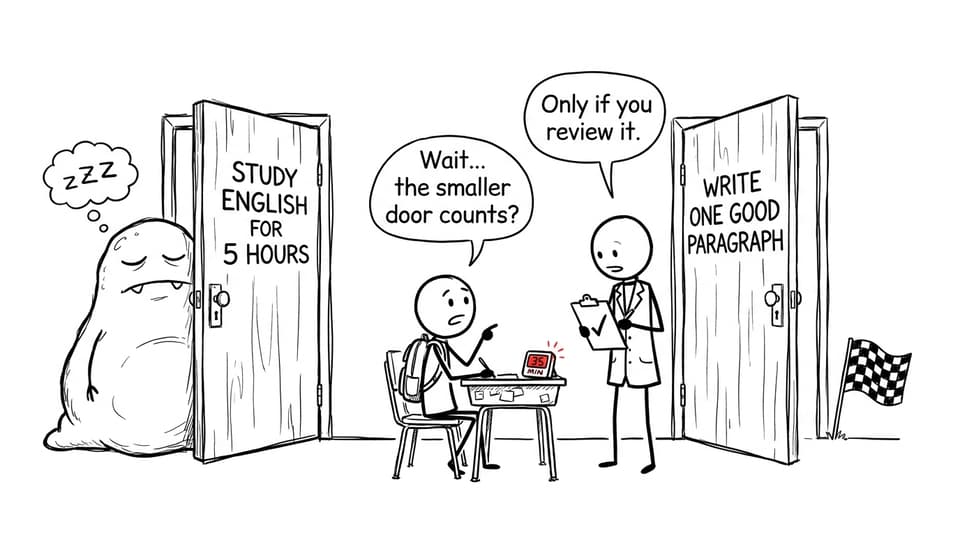
But hours are useful only when they produce something. Rereading a novel for three hours may feel responsible while changing little. Writing one analytical paragraph, checking it against a criterion, and improving the weakest explanation can take 35 minutes and teach you more.
That is the strange mathematics of English revision: progress is not simply time multiplied by effort. It is focused practice multiplied by useful feedback.
The short answer: choose your weekly range
Use this checklist to set your starting target:
- 60 to 90 minutes: maintenance during a quiet week
- 2 to 3 hours: a sustainable target for most students
- 3 to 5 hours: preparation for an important assessment
- More than 5 hours: usually needed only when catching up or completing a major task
- Three or four shorter sessions: generally more useful than one long session
These are practical guidelines, not official IB requirements. Your correct number depends on your MYP year, current performance, assignment load, reading speed, and teacher expectations. Homework may sit inside or outside these totals, depending on how demanding it is.
If you currently do little independent study, do not leap immediately to five hours. Begin with two focused sessions and one brief review. A timetable survives because it is repeatable, not because it looks impressive on Sunday evening.
Why study quality matters more than the total
MYP Language and Literature develops connected abilities in reading, writing, viewing, listening, speaking, and presenting. Its assessment framework focuses on four equally weighted criteria:
- Criterion A: Analysing
- Criterion B: Organizing
- Criterion C: Producing text
- Criterion D: Using language
The MYP Language and Literature assessment criteria guide explains what these categories look like in actual work. It also reveals why passive revision has limits. You cannot improve argument organization merely by highlighting notes about organization. At some point, you must plan and write.
Your weekly study should create visible outputs: an annotated extract, paragraph, essay plan, creative opening, recorded explanation, or edited response. If nothing exists at the end, ask whether you were practising or simply staying busy.
A balanced 2.5-hour weekly schedule
A strong default is four sessions totalling about 150 minutes. This creates repetition without making English consume the week.
| Session | Time | Main output |
|---|---|---|
| Analysis practice | 35 minutes | One developed analytical paragraph |
| Organization and planning | 30 minutes | Thesis, sequence, and topic sentences |
| Producing text | 40 minutes | One purposeful section in a chosen text type |
| Timed practice and review | 45 minutes | Short response, corrections, and next target |
Together, these sessions train analysis, argument structure, writing for a specific audience, and performance under time pressure. For more activities, use these MYP Language and Literature revision strategies. If your timetable must accommodate eight subject groups, the guide to balancing an MYP subject load can help.
A step-by-step method you can start today
You do not need to redesign your life. You need one text, one criterion, and 40 minutes.
Choose one weakness in five minutes
Look at your latest teacher feedback or rubric. Select one precise problem, such as describing instead of analysing, using vague evidence, writing unclear topic sentences, forgetting audience and purpose, or making frequent punctuation errors.
Do not choose “get better at English.” That goal is too large to guide the next sentence.
Review one explanation for eight minutes
Open the MYP English Language and Literature resource hub and review the relevant Study Notes, lesson, or Flashcards. Stop once you can explain the skill without looking.
If analysis is your weakness, remember this chain:
choice --> evidence --> effect --> purpose
The guide to improving MYP English analysis offers focused methods for moving beyond summary.
Produce something for 17 minutes
Choose a short literary, visual, or non-literary extract. Write one paragraph or compact response without repeatedly checking your notes.
For analysis, make a claim, select a precise detail, name the choice, and explain how it shapes meaning. For creative or persuasive writing, identify the intended audience and purpose before drafting. The MYP visual analysis notes can help when working with an advertisement, photograph, or film frame.
Review and rewrite for eight minutes
Compare your work with the relevant criterion. Underline the sentence that best demonstrates the skill. Circle the weakest sentence and rewrite it.
RevisionDojo's Questionbank provides targeted practice, while AI Chat can question your reasoning instead of simply supplying an answer. Grading tools turn a broad judgment into a clearer next step. When you need human diagnosis, Tutors can identify patterns that are difficult to notice alone.
Record the next action in two minutes
Finish this sentence: Next time, I will...
Your answer might be “explain why the image affects the audience” or “plan topic sentences before drafting.” Put it at the top of your next session. That small note connects separate study blocks into one learning process.
MYP English Language and Literature revision techniques
The best techniques train performance rather than recognition.
Use retrieval before rereading
Close your notes and list the techniques, text conventions, or quotations you remember. Then check what you missed. RevisionDojo Flashcards make this easier, but the important moment is attempting retrieval before seeing the answer.
Practise one criterion at a time
A complete response can hide why you are struggling. Instead, isolate a skill and spend one session on analytical explanations or topic sentences. The guide to scoring a 7 in MYP Language and Literature shows how precise evidence and controlled explanation support stronger work.
Rewrite selectively
Do not automatically rewrite an entire essay. Improve one paragraph, introduction, or creative section using feedback. Selective rewriting makes the difference between versions easier to observe.
Include unseen material
Familiar texts can create false confidence because you already know what they mean. Once a week, analyse an unfamiliar extract, image, speech, or article. Allow five minutes to annotate, fifteen minutes to respond, and ten minutes to review.
Closer to formal assessment, Mock Exams and Predicted Papers can help you practise timing and stamina. The Coursework Library can demonstrate purposeful structure in extended work, although examples should be studied rather than copied.
When should you change your hours?
Increase your weekly time when you repeatedly miss deadlines, cannot complete timed responses, or receive the same criterion feedback across several tasks. Add one 30-minute session, then reassess after two weeks. More time should always have a named purpose.
Reduce your time when concentration has collapsed, English is displacing urgent work in other subjects, or your schedule is cutting into sleep. A tired three-hour session is not automatically worth more than an alert 40-minute one.
Track outputs for two weeks: paragraphs written, plans completed, feedback applied, and errors corrected. Let your timetable follow that evidence. The broader MYP revision guide offers a framework for adjusting study across subjects.
Build a week you can repeat
For most students, 2 to 3 focused hours is a strong answer. Yet the deeper answer is that English improves through cycles: notice, practise, receive feedback, and rewrite.
Start today with one 40-minute block. Then use RevisionDojo as the system holding that cycle together: Study Notes for clarity, Flashcards for recall, the Questionbank for application, AI Chat and Grading tools for feedback, and Mock Exams for pressure practice. Predicted Papers, the Coursework Library, and Tutors offer further support when the task becomes more demanding.
The goal is not to spend the largest number of hours studying English. It is to make each week leave your writing visibly better than it found it.