



When you revise IB ESS, it’s easy to think integrity is just a rulebook word. No copying. No making up results. No shortcuts.
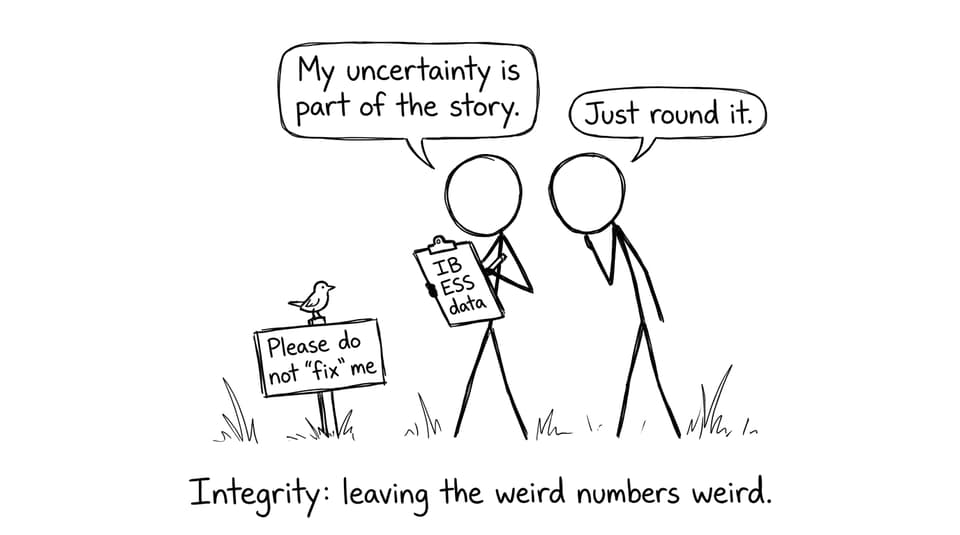
But integrity in IB ESS is bigger than not getting caught. It’s the quiet decision to tell the truth about what you saw, even when what you saw is messy. Especially when it’s messy.
Environmental science is full of inconvenient data: weather that changes mid-sampling, equipment that drifts, humans who answer surveys differently depending on the day. The subject is built on uncertainty, trade-offs, and imperfect systems. In other words, the exact conditions that tempt students to tidy reality.
This guide is here to help you do the opposite. You’ll learn how integrity works in IB ESS fieldwork, data processing, citations, and exam responses, so your work stays credible and your marks stay safe.
The IB ESS integrity checklist (save this)
Use this as a fast scan before you submit coursework, finish an investigation write-up, or even hand in a practice response.
-
Do no harm during data collection: minimize disturbance, waste, and risk to organisms and habitats.
-
Record raw data immediately: same day, same units, same method notes.
-
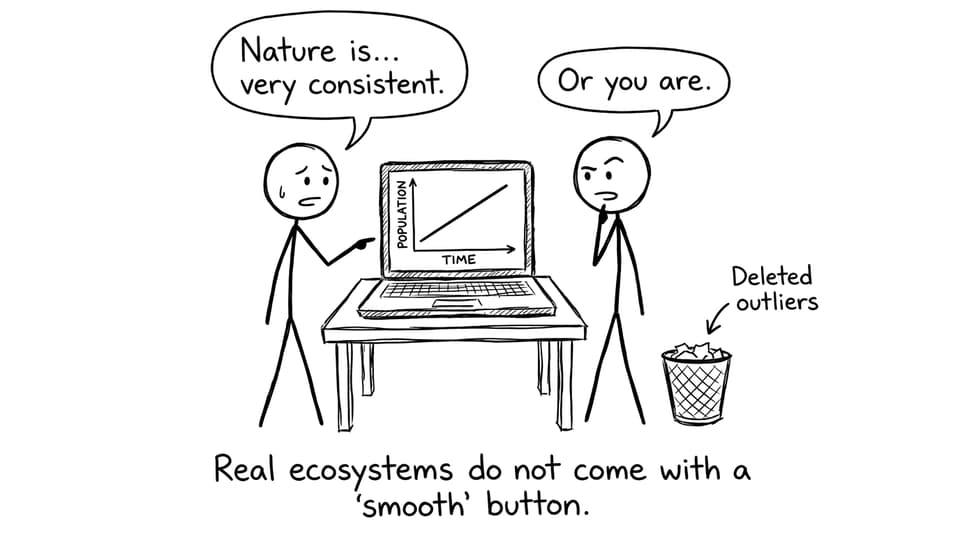
Don’t “repair” results: outliers get explained, not erased.
-
Show uncertainty clearly: measurement limits, sampling bias, and calculation assumptions.
-
Cite everything non-original: ideas, definitions, datasets, images, and graphs.
-
Use technology ethically: tools can support analysis, but they cannot replace authorship.
-
Make your reflection honest: trade-offs, limitations, and environmental implications.
Integrity in IB ESS means your methods and your morals match your conclusions.
What integrity means in IB ESS (beyond plagiarism)
In IB ESS, integrity sits at the intersection of academic honesty and environmental ethics. That combination is what makes the subject unique.
Academic honesty is about authorship: your writing is yours, your citations are complete, your data is real. Environmental ethics is about stewardship: your investigation should respect ecosystems, communities, and the long-term effects of your actions.
The examiners are not asking you to be a perfect scientist. They are asking you to be a trustworthy one. When your data looks imperfect but your reasoning is transparent, you often score higher than the student with “perfect” results and vague methodology.
If you want a structured, syllabus-aligned map of what you’re expected to know in IB ESS, start with the IB Environmental Systems and Societies (ESS) resources hub and build your revision routine around understanding first, then practice.
Ethical inquiry in IB ESS: planning that doesn’t damage what you study
Ethical inquiry starts before you measure anything. The simplest way to stay safe is to treat your investigation plan like a mini risk assessment.
Ask yourself:
-
Does this method disturb habitats (trampling vegetation, moving rocks, stressing organisms)?
-
Does it create pollution or waste (chemical kits, single-use plastics, contaminated water disposal)?
-
Do I need permission or consent (private land, schools, local communities, human surveys)?
-
Can I switch to a non-invasive alternative (photos, quadrats without removal, existing open datasets)?
A strong IB ESS investigation is rarely the most dramatic one. It’s usually the one that is repeatable, modest in scale, and clearly justified.
If you’re doing ecosystem fieldwork, review methods like quadrats, sampling strategies, and abiotic measurements in Notes for 2.5 Investigating ecosystems so your design is both ethical and technically credible.
Data responsibility in IB ESS: collecting and recording honestly
The easiest integrity problems are rarely intentional fraud. They’re sloppy documentation.
Here’s what “honest data” looks like in IB ESS:
-
Raw tables kept intact (including odd values).
-
Units consistent and stated everywhere.
-
Method notes written like someone else needs to replicate your work.
-
Context variables logged (time, weather, site conditions, equipment model, calibration notes).
-
Version control for spreadsheets (so changes are traceable).
A practical habit: take a photo of your raw notes right after fieldwork. It’s not just protection. It’s also a way to notice gaps while you still remember what happened.
Then move into structured practice. RevisionDojo’s IB ESS Questionbank is a clean way to test how well you can interpret real-looking data without “fixing” it.
IB ESS data manipulation: the temptation to make nature look neat
Most students don’t fabricate an entire dataset. They do something smaller that feels harmless:
-
Removing an outlier because it “must be wrong.”
-
Rounding aggressively to hide variation.
-
Editing a graph scale to exaggerate a trend.
-
Recalculating until the conclusion feels “right.”
The issue is that environmental systems often produce lumpy, uneven patterns. That’s the point of studying systems.
If an outlier exists, you have ethical options:
-
Explain a plausible cause (instrument error, microhabitat difference, human disturbance).
-
Use a justified statistical approach (median, IQR discussion, or clear exclusion rules stated before analysis).
-
Compare with secondary data carefully, as context not replacement.
Your job in IB ESS is not to make data beautiful. It’s to make your reasoning defensible.
Citing sources correctly in IB ESS: treat ideas like borrowed equipment
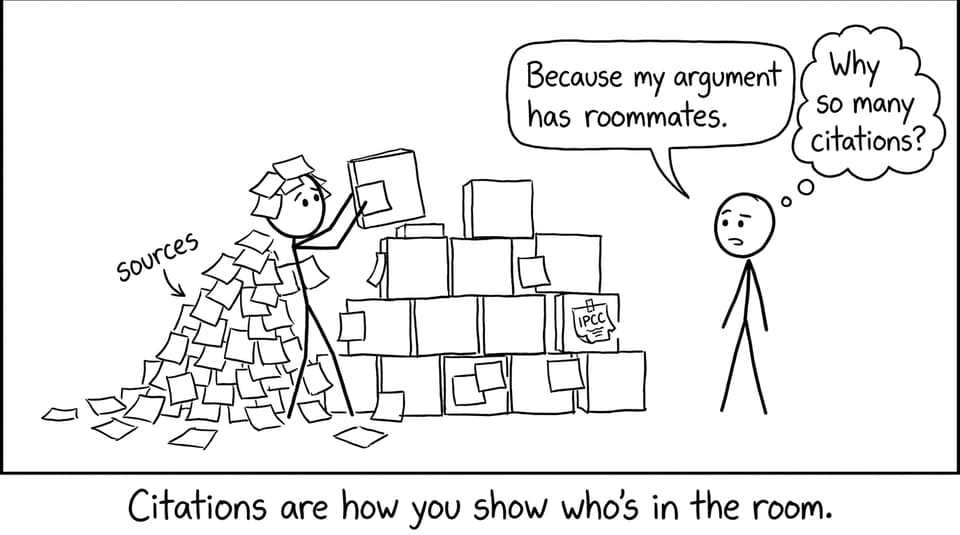
IB ESS lives on shared knowledge: IPCC summaries, national water quality datasets, UNEP indicators, journal articles, NGO reports, and even local government plans. The course expects you to use that ecosystem of information. It also expects you to label it.
A simple rule: if it didn’t come from your own brain or your own measurements, it needs a citation.
That includes:
-
Definitions (even if you paraphrase them)
-
Statistics and trend claims
-
Images, maps, and diagrams
-
Datasets and tables
-
Method descriptions that mirror a source closely
Two high-utility guides to keep open while you write:
In exam prep, citations aren’t usually required in the same formal way. But integrity still matters: don’t invent named studies, don’t fake statistics, and don’t pretend a debatable claim is a universal fact.
Using AI and tech responsibly in IB ESS (without losing your authorship)
Used well, technology makes IB ESS clearer. Used badly, it erases your role as the thinker.
Ethical uses include:
-
Spreadsheet tools for graphing and basic statistics
-
GIS visualization for understanding spatial patterns
-
AI Chat for explanations, self-quizzing, or planning a study schedule
Risky uses include:
-
AI writing your analysis paragraphs
-
AI generating “realistic” datasets
-
Copying polished model responses and lightly rewording
A clean standard is: you should be able to explain, out loud, how you produced every key claim in your work.
For a wider integrity framework you can apply across subjects (including tech and AI boundaries), use How to Uphold Academic Integrity in IB Assessments.
How integrity shows up in IB ESS exam answers
Integrity isn’t only for coursework. In IB ESS exams, integrity looks like intellectual honesty.
That means:
-
You acknowledge trade-offs rather than pretending a strategy has no drawbacks.
-
You evaluate stakeholders fairly, even when you personally disagree with them.
-
You describe uncertainty in data interpretation instead of forcing certainty.
-
You use case studies responsibly: specific, accurate, and not exaggerated.
If you’re building your case-study set for the new assessment style, pair integrity with memorability by using IB ESS Case Studies: How Many to Memorize for 2026 and practice applying them under timed conditions.
How RevisionDojo helps you stay principled in IB ESS
Most integrity slips happen when students are rushed, unsure, or trying to hide confusion. RevisionDojo is designed to make those moments less likely.
Here’s the practical support stack for IB ESS:
-
Study Notes to clarify concepts before you write anything high-stakes: see Foundations of ESS Revision Notes.
-
Flashcards to turn definitions and case-study details into active recall (so you don’t “borrow” wording under pressure).
-
Questionbank for exam-style practice with feedback that rewards clear reasoning, not perfect-looking data.
-
AI Chat as a tutor for explanations and self-testing, not as a ghostwriter.
-
Grading tools to sanity-check rubric expectations using the IB ESS (new) IA Grader.
-
Predicted Papers and Mock Exams for timed practice that reduces panic-driven shortcuts.
-
Coursework Library and Tutors for guidance when you’re stuck and tempted to copy.
Integrity becomes easier when your system makes learning the default.
FAQ: Integrity in IB ESS
What counts as academic misconduct in IB ESS?
Academic misconduct in IB ESS includes plagiarism, collusion, duplication of work, and data fabrication or falsification. It also includes smaller behaviors that lead to the same outcome, like patchwriting (keeping the same sentence structure as a source while swapping a few words). In IB ESS, misconduct can extend into fieldwork ethics if your investigation harms organisms or habitats unnecessarily and you misrepresent what you did. Misconduct is not always dramatic, which is why students sometimes drift into it accidentally through poor note-taking and last-minute drafting. The safest protection is process evidence: drafts, raw data tables, and a living source log. If you want a clear explanation of the most common traps, read IB Academic Misconduct Explained: How to Avoid Plagiarism and Collusion.
How do I make my IB ESS data handling ethical and examiner-proof?
Start by treating raw data as untouchable: record it immediately, store it safely, and never overwrite it. Then show your working transparently: include units, sampling methods, and environmental conditions so your dataset is understandable in context. When you see outliers, resist the urge to delete them; instead, explain plausible causes and discuss uncertainty and limitations. Ethical handling also means choosing graph scales honestly and avoiding visual tricks that exaggerate trends. If you do exclude a data point, you must justify the rule clearly and apply it consistently across the dataset. Finally, link your data responsibility to systems thinking in IB ESS by discussing how complex systems naturally produce variability.
Can I use AI tools while studying or writing for IB ESS?
Yes, you can use AI tools in ways that support learning, such as asking for explanations, generating quiz questions, or clarifying command terms. The integrity line is crossed when AI becomes the author of your assessed writing or the generator of your data. In IB ESS, your analysis and evaluation are what earn marks, and those need to be your own reasoning in your own words. If AI helps you plan, you should still produce the final structure and wording independently, and you should be able to explain your thinking step by step. Many integrity concerns also come from students using AI to make their data look “clean,” which undermines the whole point of environmental inquiry. Keep AI in the role of tutor, not substitute, and when in doubt follow the broader guidance in How RevisionDojo Helps You Maintain Academic Integrity While Studying.
Conclusion: In IB ESS, integrity is part of the result
The most convincing work in IB ESS isn’t the work with perfect trends. It’s the work that tells the truth about a complicated world, then thinks clearly inside that truth.
So keep the strange numbers. Explain the messy graph. Cite the idea that isn’t yours. And choose methods that respect the ecosystems you’re studying.
When you’re ready to revise IB ESS with a system that rewards honest thinking, start with the IB ESS resources hub, then build momentum using Study Notes, Flashcards, the Questionbank, AI Chat, and the IA Grader. Integrity is easier when your preparation is solid, and your score is stronger when your work is credible.