
Ecological succession is the quiet story happening behind every “empty” landscape. A black lava field. A burned hillside. An abandoned car park with cracks full of weeds. At first it looks like nothing is there. Then you notice the first stubborn colonisers. Then the next wave. Then, almost without permission, an ecosystem begins to rewrite itself.
In IB ESS, ecological succession matters because it turns ecosystem change into something you can explain, predict, and score marks on. It’s not just “nature recovering.” It’s systems thinking in motion: feedbacks, energy flow, nutrient cycling, equilibrium, and resilience.
Ecological succession in IB ESS (definition + why it’s tested)
In IB ESS, ecological succession is the gradual process of change in an ecosystem’s community structure over time. One community modifies the environment, which makes it easier (or harder) for new species to establish, leading to a sequence of seral stages.
Examiners like succession because it’s easy to test in multiple ways: labelled diagrams, short definitions, data analysis (biomass/diversity trends), and “apply to a scenario” questions. If you want the syllabus-aligned version of this topic, start with 2.5 Zonation, succession and change in ecosystems.
Quick checklist for exam answers (IB ESS)
-
State whether it’s primary or secondary succession
-
Mention pioneer species and why they matter
-
Describe changes in soil, biomass, and biodiversity over time
-
Link to equilibrium and resilience
-
Add one real example (volcanic rock, glacial retreat, fire, abandoned farmland)
Primary vs secondary succession in IB ESS
Succession is often taught as two doors into the same hallway.
Primary succession (starts with no soil)
Primary succession begins where there is no existing soil and little to no life: newly exposed rock after glacial retreat, fresh lava flows, or newly formed land. Pioneer species (often lichens and mosses) are first because they tolerate harsh conditions and begin soil formation by breaking down rock and adding organic matter.
A classic example is colonisation on new volcanic material (students often cite Surtsey, Iceland). The timeline is slow because soil has to be built from scratch.
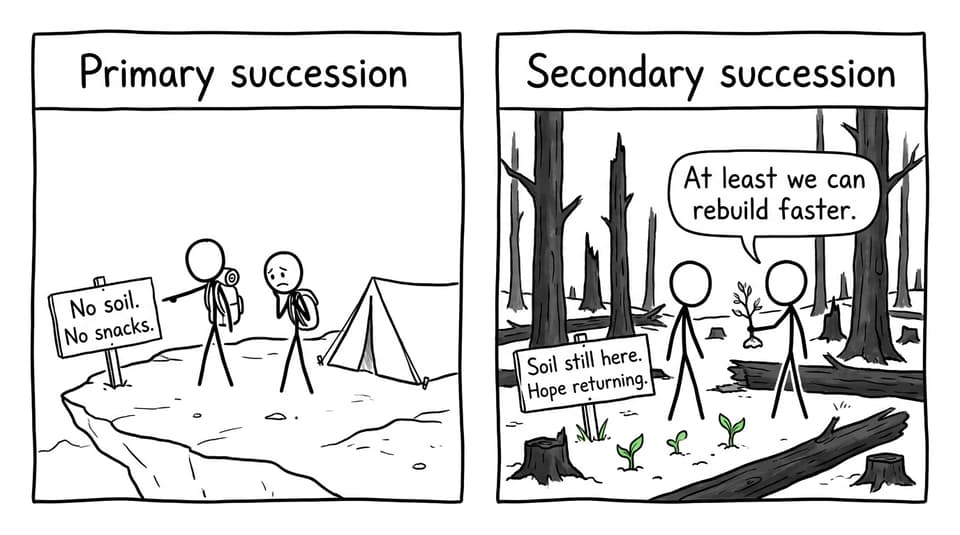
Secondary succession (soil remains)
Secondary succession happens after a disturbance removes a community but soil and nutrients remain: wildfire, flooding, storms, deforestation, or abandoned farmland. Because the “foundation” is still there (soil, microbes, seed banks), recovery is usually faster than primary succession.
To practise the way this appears in exam-style prompts, use the 2.5 questionbank and aim to explain patterns, not memorise scripts.
The stages of ecological succession (what changes over time)
Most IB ESS markschemes reward clear direction-of-change language.
Pioneer stage
Early species arrive and survive where others can’t. They stabilise surfaces, create microhabitats, and start nutrient accumulation. Think “tough, fast, simple.”
Intermediate stages
As soil deepens and moisture retention improves, more plants establish (grasses to shrubs to young trees in many terrestrial examples). Biodiversity often rises, competition becomes more important, and food webs become more complex.
Climax community (and the modern nuance)
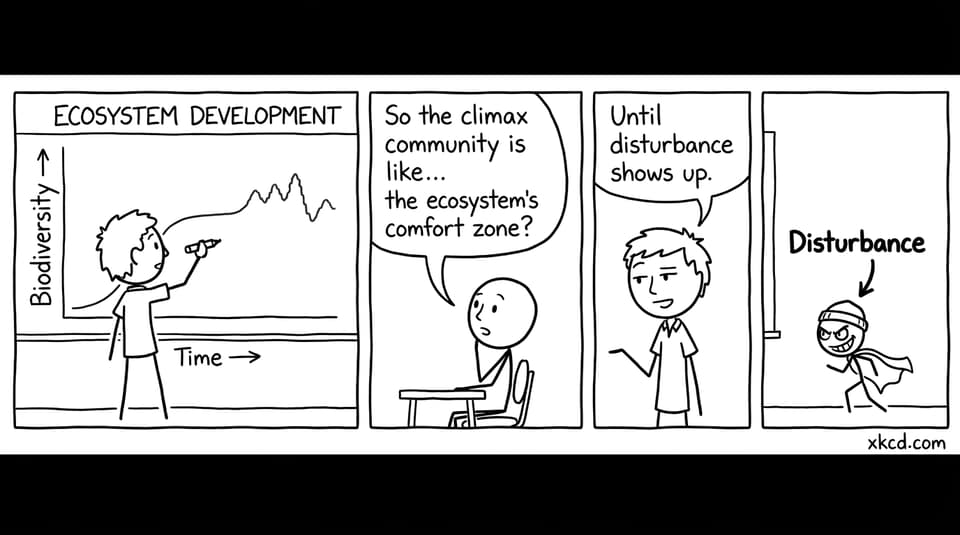
Traditionally, succession ends in a climax community: a relatively stable community in equilibrium with local conditions. In reality, ecosystems can have multiple stable states, and disturbances can keep resetting the pathway. For IB ESS, you can still use “climax community,” but pair it with equilibrium language: dynamic stability, not “frozen forever.”
To connect succession to broader ecosystem ideas, revise the core ecosystem definitions and flows in Ecosystems notes and the wider context in 2.4 Biomes, zonation and succession notes.
Factors that affect succession speed (IB ESS links)
In IB ESS, you’ll often be asked what could speed up or slow down succession:
-
Abiotic factors: temperature, precipitation, soil pH, nutrient availability, exposure
-
Biotic interactions: competition, facilitation (early species making conditions better), herbivory
-
Disturbance regime: frequency and intensity of fires, storms, human land use
For HL students, productivity and community shifts are treated in more depth in 2.5D Community and productivity in succession (HL) notes.
How to revise ecological succession efficiently with RevisionDojo (IB ESS)
The fastest way to improve your IB ESS succession answers is to combine understanding with repetition:
-
Use the IB ESS resources hub to keep Topic 2 revision in one place
-
Drill exam technique with the Ecosystems and Ecology questionbank and get targeted feedback
-
Lock in definitions using Topic 2 Ecology flashcards
RevisionDojo also supports the way students actually revise: build a mini Mock Exam from the Questionbank, use AI Chat to test explanations, and lean on Study Notes and Flashcards when your brain is tired but the exam isn’t moving.
Closing: the exam-friendly way to remember IB ESS succession
Ecological succession is what happens when time becomes a variable you can actually answer with. In IB ESS, it’s less about memorising a perfect “grasses-to-forest” story and more about explaining direction of change: soil builds, complexity increases, feedbacks strengthen, and disturbance can restart the process.
If you want to turn that understanding into marks, practise with RevisionDojo’s Questionbank, sharpen definitions with Flashcards, and consolidate with Study Notes and AI Chat. IB ESS rewards clear thinking, and succession is one of the best places to show it.