
Urban growth can feel quiet while it’s happening. One new road. One new housing estate. A new supermarket “just outside town.” Then you look up and realise the city has stretched its arms so far that the countryside is now just pockets between car parks.
That slow, almost invisible shift is exactly why IB ESS exam questions love urban sprawl. It’s a real-world process with clear causes, measurable impacts, and trade-offs you can evaluate with systems thinking, the heart of IB ESS.
What is urban sprawl in IB ESS?
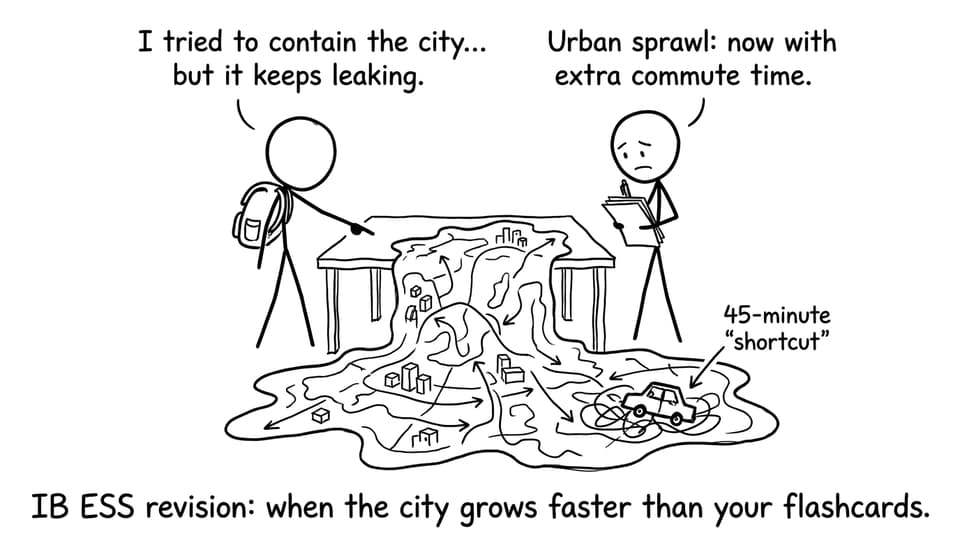
In IB ESS, urban sprawl means the uncontrolled outward expansion of urban areas into rural or natural land. Instead of concentrating growth through higher density (building “up”), sprawl spreads development “out,” often creating low-density suburbs and car-dependent landscapes.
This fits directly into Topic 8 urban systems: cities as systems with inputs (energy, water, materials), flows (transport, commuting), and outputs (waste, pollution). If you want a solid syllabus-aligned base, start with Topic 8: Human populations and urban systems and the Topic 8 Questionbank.
Quick exam checklist (what to write when you see “urban sprawl”)
-
Define urban sprawl clearly (outward, low-density growth)
-
Give two causes (population growth, cheap land, highways, zoning)
-
Give two environmental impacts (habitat loss, runoff, emissions, heat island)
-
Add one social/economic impact (infrastructure costs, inequality, health)
-
Evaluate two management strategies (compact growth, transit, growth boundaries)
Causes of urban sprawl (IB ESS-friendly)
Urban sprawl usually isn’t one decision. It’s many incentives pointing outward.
Population growth and housing demand
As urban populations increase, demand for housing rises. When inner-city housing is limited or expensive, development pushes to the edges.
Cheap land, zoning, and “separating” the city
Outskirts often offer cheaper land, and zoning can separate residential areas from jobs and services. That separation quietly forces longer travel distances.
Transport infrastructure and car dependency
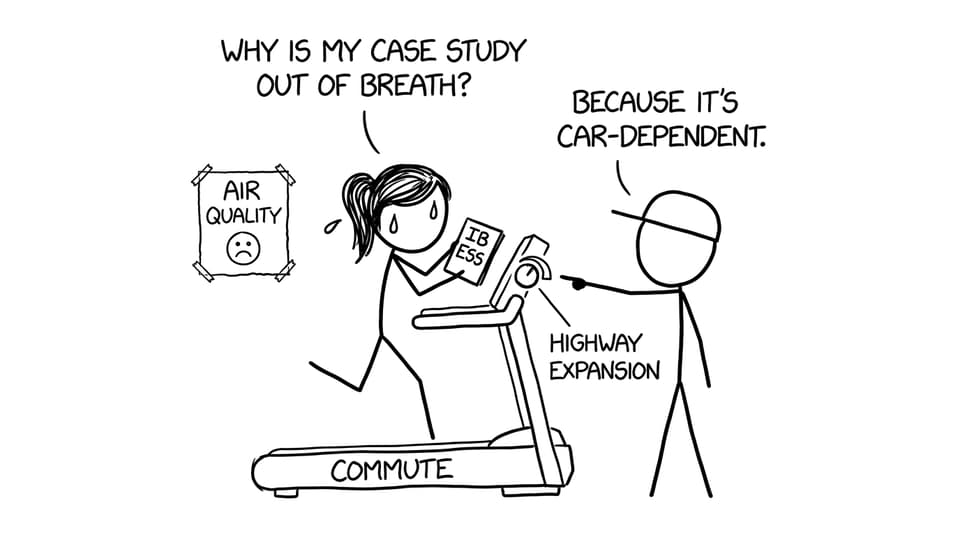
Highways make commuting possible, so people accept living further away. In IB ESS, this is a classic feedback loop: more roads -> easier commuting -> more sprawl -> more traffic -> pressure for more roads.
To revise the broader urbanization context, use 8.2B Urbanization and suburbanization notes and 8.2 Urban systems and urban planning notes.
Environmental impacts of urban sprawl (systems thinking)
For IB ESS, sprawl matters because it changes land cover and disrupts ecosystem processes.
Habitat loss and fragmentation
As cities expand into forests, wetlands, or farmland, habitats shrink and split. Fragmentation reduces biodiversity and can isolate populations, lowering resilience.
Air pollution and greenhouse gas emissions
Low-density growth increases car use. Longer commutes raise fossil fuel combustion, worsening air quality and carbon emissions. You can connect this to urban system outputs and to health.
Water and soil impacts
Sprawl increases impermeable surfaces (roads, roofs). That boosts surface runoff, reduces infiltration, and can raise flood risk while lowering groundwater recharge.
If you want a broader sustainability framing that examiners reward, review 1.4 Sustainability.
Social and economic effects (often the “evaluation” marks)
Urban sprawl isn’t only environmental.
-
Higher infrastructure costs: extending roads, electricity, and water to dispersed suburbs costs more per person.
-
Lower public transport efficiency: buses and trains struggle when homes are spread out.
-
Equity issues: those without cars can be locked out of jobs and services.
-
Public health pressures: more traffic, more air pollution, more sedentary living.
In IB ESS, these points help you evaluate management strategies rather than listing them.
Sustainable solutions to urban sprawl (what examiners want)
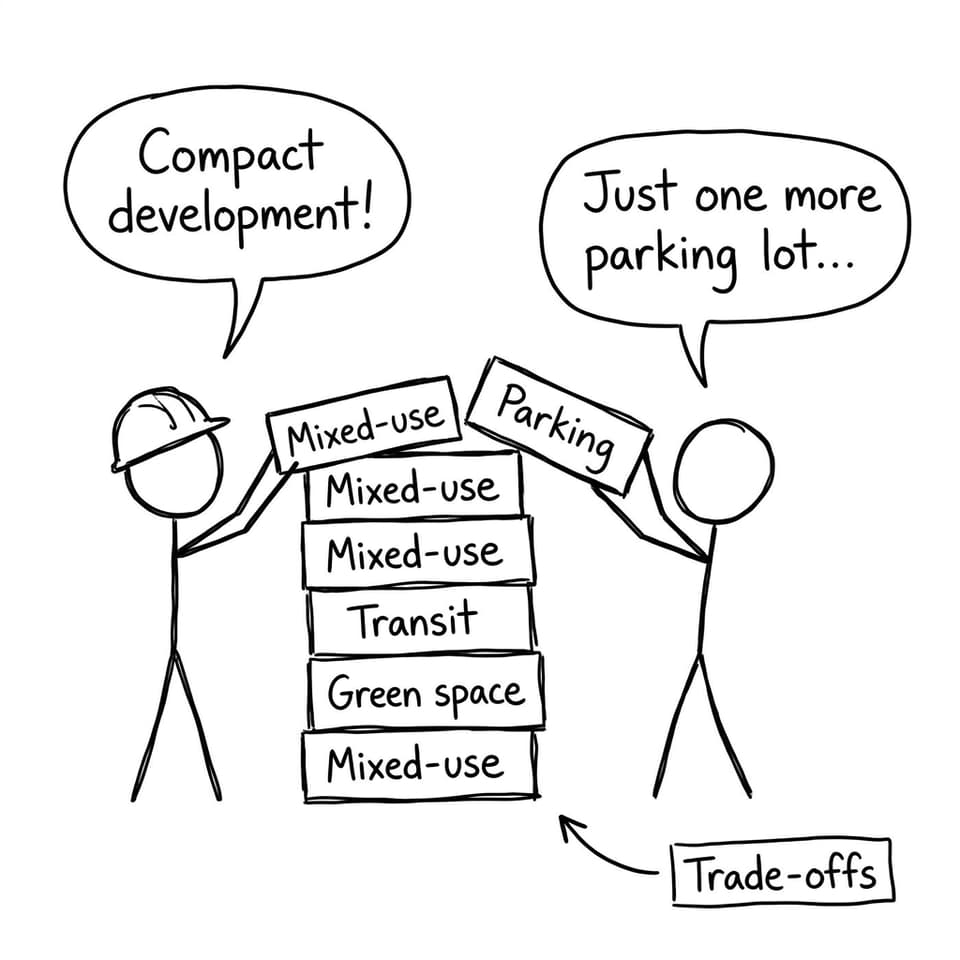
Good IB ESS answers show that every solution has benefits and limitations.
Compact, mixed-use development (smart growth)
Higher density and mixed land use reduce travel distances and protect surrounding ecosystems. Limitations can include higher housing prices if not managed.
Public transport and active travel
Investment in reliable transit, cycling routes, and walkable neighbourhoods reduces car dependence. Limitations: high upfront cost, slower results.
Urban growth boundaries and brownfield redevelopment
Setting legal boundaries can limit outward expansion, while reusing brownfield sites reduces pressure on greenfield land. Limitations: political pushback, land price effects.
To practise how these strategies appear in marks schemes, use RevisionDojo’s Human systems and resource use hub and the Human systems and resource use Questionbank.
Bringing it back to RevisionDojo (and your next mark)
Urban sprawl is one of those IB ESS topics that looks simple until you try to evaluate it under time pressure. The fix isn’t memorising more; it’s practising clearer chains of cause and effect.
Use RevisionDojo to make that practice feel structured: revise with Study Notes, lock in definitions with Flashcards, and pressure-test your thinking in the Questionbank. If you’re stuck, AI Chat can help you turn messy paragraphs into examiner-friendly evaluation, and Grading tools can show you what your answer is missing. Add Mock Exams and Predicted Papers for timing, and the Tutors and Coursework Library when you want real feedback. Urban sprawl is the story of a city spreading out, so your revision should do the opposite: tighten, focus, and build upward.
For more IB ESS urban systems support, see IB ESS: Do You Need Urban Systems for 2026 Exams? and browse all IB ESS posts.