
If you have ever stared at a blank document at 1:12 a.m., you know how quickly a good student can start thinking like a desperate one. The IB can feel like a chain of deadlines where your brain is always slightly behind your calendar. And in that gap between effort and time, academic misconduct often sneaks in. Not as a villainous plan, but as a small decision that feels temporary: borrowing a paragraph, sharing a “rough draft,” pasting an AI answer “just to get started.”
In the IB, those small decisions can carry a big price. This guide explains IB academic misconduct in plain language, with practical ways to avoid plagiarism and collusion while still studying efficiently for exams.
Along the way, you will see how RevisionDojo helps you do the thing the IB actually rewards: real understanding you can prove under pressure.
IB academic misconduct: a quick checklist before you submit anything
Use this as your 60-second IB integrity check for coursework, homework, and revision tasks.
-
Can you explain how you produced it? If not, you are too close to plagiarism, collusion, or AI misuse.
-
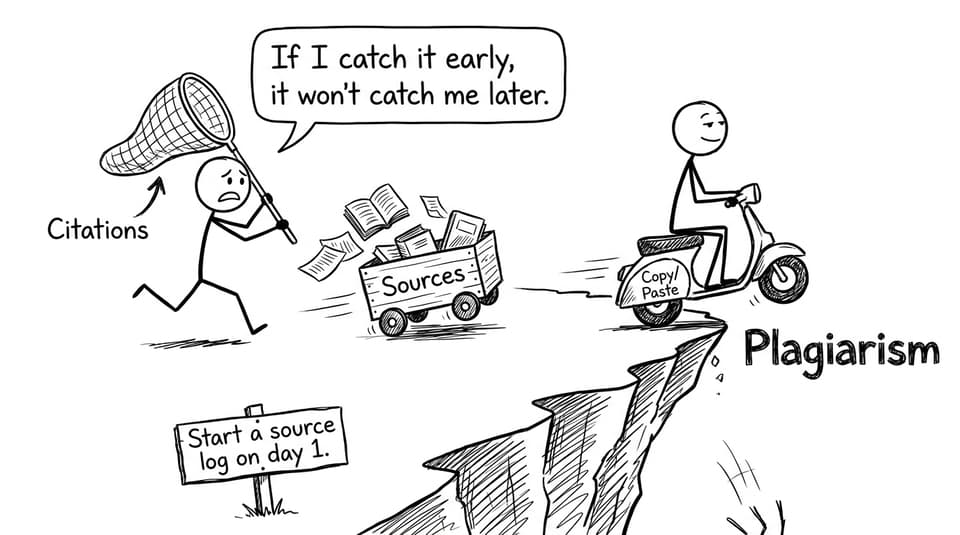
Do you have a live source log? Links, page numbers, screenshots, and dates.
-
Are quotes clearly marked? Quotation marks in your draft, not “later.”
-
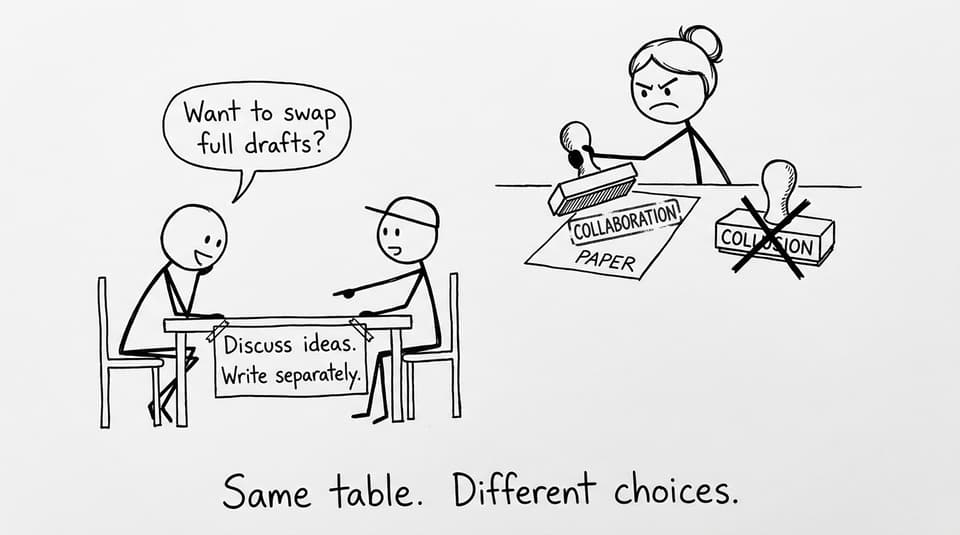
Is collaboration within the rules? Discuss ideas, but write separately.
-
Is anything duplicated from earlier work? Reusing your own work can still be misconduct.
-
Did you use AI? Then you need transparency, plus your own writing and thinking.
-
Final scan: citations complete, paraphrasing genuinely rewritten, and no borrowed structure hiding in plain sight.
If you want a study setup that makes this easier, start from RevisionDojo for IB and build a routine that produces original thinking by default.
What the IB counts as academic misconduct (and why intent is not enough)
The IB frames academic misconduct as behaviour that gives an unfair advantage to you or disadvantages others. That is the core idea: fair assessment.
Common forms of IB academic misconduct include:
-
Plagiarism: using someone else’s words, ideas, data, or media without proper acknowledgment.
-
Collusion: working with someone else in a way that creates shared authorship when the task must be individual.
-
Duplication: submitting the same work, or substantial parts of it, for more than one assessment component.
-
Fabrication or falsification: inventing data, sources, or results.
-
Exam misconduct: unauthorised materials, communication, or behaviour during assessments.
-
AI misuse: presenting AI-generated content as if it were your own work or failing to acknowledge meaningful AI assistance.
A hard truth that helps you stay safe in the IB: “I didn’t mean to” is not a reliable shield. You are responsible for what you submit.
For deeper context, you can also read RevisionDojo’s related guides on integrity culture and consequences, including Can I Cheat on an IB Exam? and Building a Culture of Academic Honesty in IB Classrooms.
IB plagiarism: the quiet versions students miss
Most IB students know that copy-paste is plagiarism. The more common danger is the subtle kind that happens when you are honestly trying to work fast.
Plagiarism can happen when you are “basically paraphrasing”
If you keep the original sentence structure and swap in synonyms, that is often still too close. IB plagiarism is not only about identical wording. It is about uncredited dependence.
Plagiarism can happen through notes
A common pattern:
-
You paste a source into your notes.
-
You return days later.
-
You cannot remember what was yours.
-
You write it into the draft.
That is why the best anti-plagiarism strategy in the IB is boring and effective: separate notes from draft wording.
Plagiarism can happen with images, graphs, and data
Students often cite articles but forget visuals. In the IB, using a chart, photo, infographic, or dataset without acknowledgment can still be plagiarism.
A simple IB anti-plagiarism workflow
-
Make a “source log” document from day one.
-
In your notes, label each paragraph as QUOTE, PARAPHRASE, or MY IDEA.
-
If you use a quote, place quotation marks immediately.
-
When paraphrasing, close the source and rewrite from memory, then check accuracy.
-
Cite as you go, not at the end.
IB collusion: how group study crosses the line
The IB actually wants you to collaborate as a learner. But collaboration is about learning together. Collusion is about producing assessed work together.
Clear examples of collusion risk in the IB
-
Sharing full drafts of an individual assignment.
-
Editing a friend’s writing so heavily that the phrasing becomes yours.
-
Splitting an “individual” task into sections and merging them.
-
Using a classmate’s IA or EE as a template for structure or analysis.
Safer ways to collaborate without collusion
-
Discuss concepts and plan approaches on a whiteboard.
-
Compare outlines, not paragraphs.
-
Share sources, then write separate notes.
-
Review each other using a checklist (argument clarity, missing citations, command terms) without rewriting sentences.
If you want a practical guide to studying with others without crossing boundaries, see Collaborative IB Question Sharing and Collaborative IB Mock Exams.
Why IB students slip into misconduct (and the calm way out)
Academic misconduct in the IB is often caused by pressure, not personality. Three triggers show up again and again.
Time pressure
When your deadline becomes a cliff, shortcuts look like bridges. The fix is not motivational posters. It is systems: smaller milestones, earlier drafting, and weekly timed practice so exams feel familiar.
A strong exam-prep structure is described here: IB Exams Without Pausing Your Life.
Confusion about what counts
Many students do not get explicit training in what the IB considers plagiarism, collusion, and duplication. Asking questions early is not suspicious. In the IB, it is protective.
Overreliance on tools
Technology makes work faster, but it can also blur authorship. You can use tools ethically, but the work must remain yours.
Using AI ethically in the IB (a practical rule you can follow)
A useful rule for IB students preparing for exams:
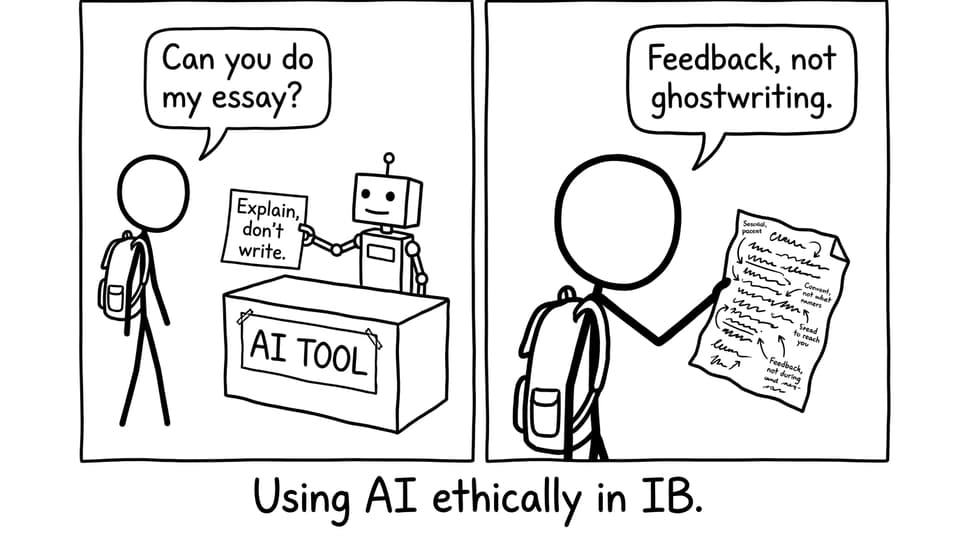
Use AI like a tutor, not a ghostwriter.
That means AI can:
-
explain a concept again,
-
quiz you,
-
help you plan a revision schedule,
-
point out unclear reasoning,
-
suggest what you might cite.
But AI should not:
-
write your final paragraphs,
-
generate your analysis and “voice,”
-
produce citations you did not verify,
-
replace the thinking that the IB is assessing.
RevisionDojo is designed around that ethical line. You can practice in the Questionbank to produce your own answers, then use feedback to improve. You can also use AI Chat as a clarification tool, and rely on Grading tools to check your work against rubrics while keeping authorship intact.
How RevisionDojo helps IB students stay original (without studying slower)
The easiest way to avoid IB plagiarism and collusion is to study in a way that constantly proves you know the material. When you can produce answers on demand, you stop needing shortcuts.
Here is a clean integrity-first loop using RevisionDojo features:
-
Study Notes: learn the idea quickly in examiner-aligned language (see IB Subject Note Collections and Digital IB Study Notes).
-
Flashcards: convert understanding into recall with spaced repetition (start with IB Flashcards or read IB Flashcard System).
-
Questionbank: practise exam-style questions so your writing is naturally your own (see IB Question Bank: Thousands of Practice Questions).
-
Mock Exams + Predicted Papers: rehearse pressure legally and repeatedly so you do not panic later (explore IB Predicted Papers and the guidance in IB Predicted vs Specimen Papers).
-
Coursework Library + Tutors: get examples and guidance the right way, with feedback that develops your own voice rather than replacing it.
The point is not to be perfect. It is to make integrity the default outcome of your routine.
Closing: the IB rewards what you can genuinely own
In the IB, integrity is not just a policy. It is a strategy for staying calm. When you can trace every claim to a source, and every paragraph to your own thinking, you stop fearing the moment someone checks.
Avoiding plagiarism and collusion is not about doing everything alone. It is about building a study routine where your understanding shows up reliably under exam conditions.
If you want that routine in one place, RevisionDojo gives you the tools to do it honestly: Study Notes for clarity, Flashcards for retention, Questionbank for authentic practice, AI Chat for explanations, Grading tools for rubric-aligned feedback, Predicted Papers and Mock Exams for timed confidence, plus a Coursework Library and Tutors when you need deeper support.
Start here: RevisionDojo for IB and make integrity the easiest option, not the hardest one.