
Smog rarely announces itself. It just shows up as a dull, brown-gray veil on a morning that should have been clear. You look down the street and realize the horizon has moved closer. In IB ESS, that quiet shrinkage of the world is the point: smog is what happens when everyday choices (cars, fuels, cities) meet the chemistry of sunlight and the physics of air movement.
Quick checklist for IB ESS revision
-
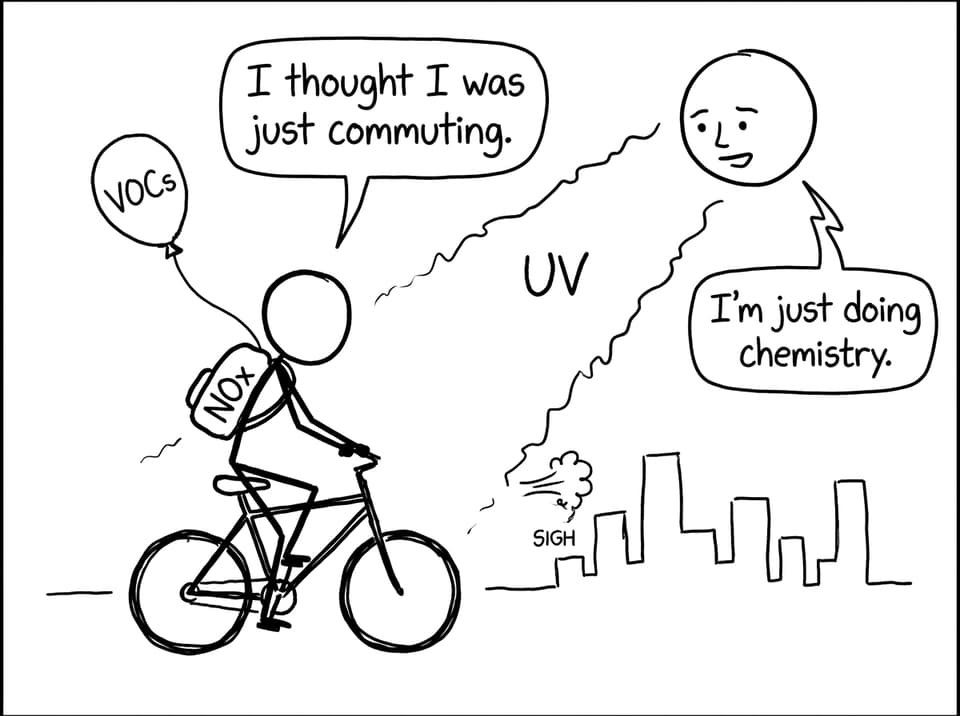
Define smog and name the main precursors (NOx, VOCs, particulates, SO2)
-
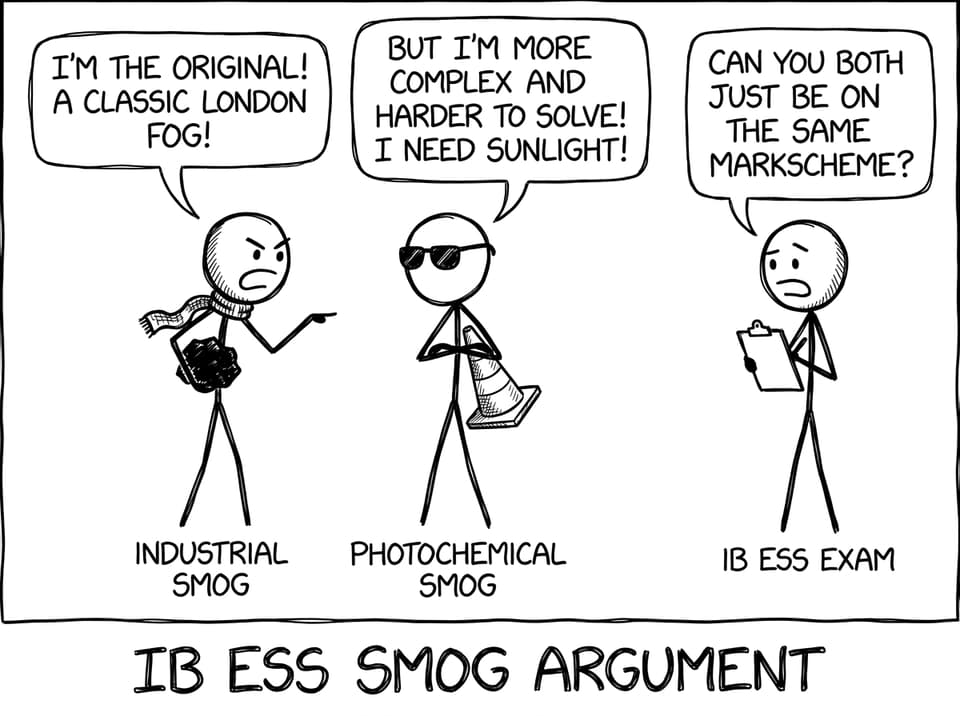
Distinguish photochemical smog vs industrial (sulfurous) smog
-
Explain the role of sunlight (UV) in forming tropospheric ozone
-
Link impacts to health, ecosystems, and economics
-
Memorize 3 mitigation strategies with pros/cons
For the syllabus-aligned version of this topic, anchor your revision with 8.3.D Photochemical smog and tropospheric ozone and the wider Atmospheric Systems & Societies hub.
What causes smog in IB ESS?
In IB ESS, smog is best understood as secondary pollution: the most harmful parts often form in the air, after emissions leave a tailpipe or smokestack. The core ingredients are:
-
Nitrogen oxides (NOx) from vehicle engines and high-temperature combustion
-
Volatile organic compounds (VOCs) from fuels, solvents, and industrial processes
-
Particulate matter (PM) from combustion and dust (plus secondary particles formed in the atmosphere)
-
Sulfur dioxide (SO2) mainly from burning sulfur-containing fuels (especially coal)
Smog becomes likely when these inputs combine with the right conditions: strong sunlight, weak wind, and sometimes a city layout that traps air.
If you want exam-style practice on the exact wording and command terms, use the 6.3 Photochemical smog Questionbank and the broader ESS Questionbank by topic.
Two main types of smog (know both for IB ESS)
Photochemical smog (sun-driven)
Photochemical smog is common in warm, sunny cities with heavy traffic. Sunlight triggers reactions involving NOx and VOCs, creating:
-
Tropospheric ozone (O3) (a lung irritant)
-
PANs (peroxyacyl nitrates) and other oxidants
-
Nitric acid and secondary particles that add to haze
Key idea for IB ESS: sunlight doesn’t “add pollution” -- it transforms it.
Industrial (sulfurous) smog (fuel-driven)
Industrial smog is linked to burning coal or sulfur-rich fuels in cooler, humid conditions. SO2 and particulates mix with water droplets and stagnant air to form dense gray smog. Historically, this was associated with older industrial cities and winter pollution episodes.
To keep the atmosphere context clear, revise the foundations in 6.1 Introduction to the atmosphere and the companion 6.1 notes.
How smog forms (the simple exam explanation)
For photochemical smog, your cleanest explanation is:
-
UV light breaks NO2 into NO + O
-
The free oxygen atom joins O2 to form O3 (ozone)
-
VOCs help recycle NO back into NO2, allowing ozone to keep accumulating
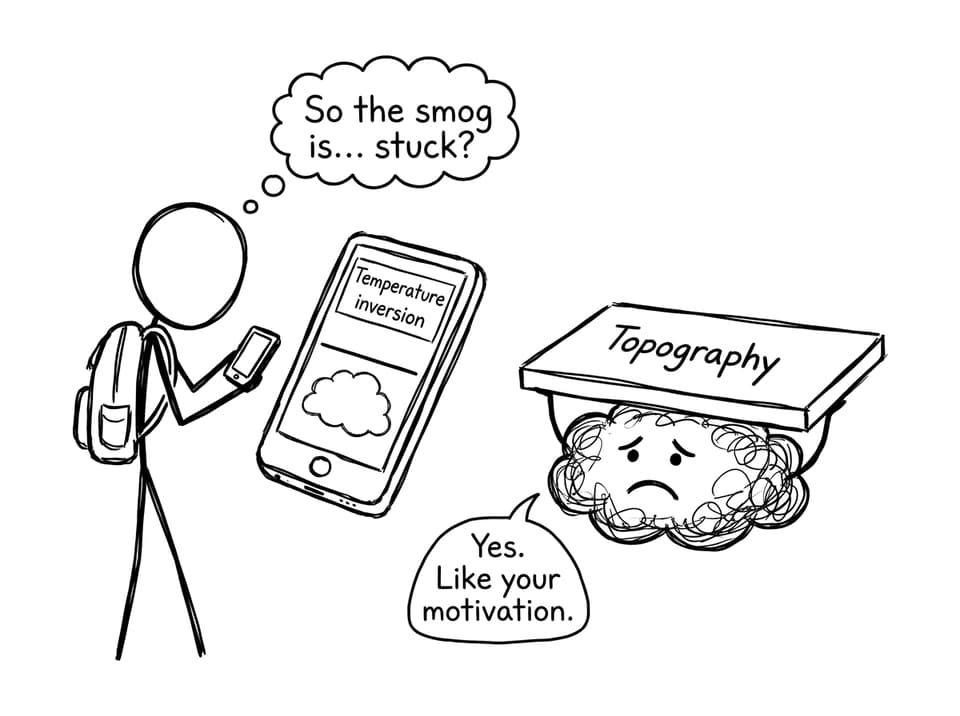
Then add the physics: temperature, wind, and topography control whether pollutants disperse or build up.
Effects of smog (link to ESS systems thinking)
In IB ESS, impacts score best when you show multiple perspectives:
-
Human health: eye irritation, asthma exacerbation, reduced lung function, cardiovascular stress
-
Ecosystems: ozone damages leaf tissue, lowering photosynthesis and crop yields; acid-forming pollutants stress soils and waters
-
Economic costs: healthcare burdens, lost productivity, reduced visibility affecting transport and tourism
Management and prevention (3 strategies to memorize)
-
Cut NOx and VOCs at source: catalytic converters, low-emission zones, fuel standards
-
Shift energy systems: renewables reduce combustion emissions and co-pollutants
-
Urban planning: public transport, congestion reduction, and greener streets reduce exposure hotspots
To turn this into marks, practice evaluation-style responses in RevisionDojo’s Questionbank, then ask AI Chat to point out missing links (cause -> process -> impact -> management). When you want realism, build a timed set using Mock Exams and Predicted Papers, and use Grading tools to tighten your structure.
Final takeaway for IB ESS students
Smog is what you get when emissions meet sunlight and still air: chemistry plus geography plus choices. If you can explain the ingredients, describe the photochemical steps, and evaluate a few realistic management strategies, you’ve basically built the full IB ESS answer.
To lock it in, study the core pages on IB ESS resources, drill targeted sets in the 6.3 Photochemical smog Questionbank, and use RevisionDojo’s Study Notes, Flashcards, AI Chat, Tutors, Coursework Library, Grading tools, Predicted Papers, and Mock Exams to turn understanding into marks.


