

If you have ever stared at an energy question and felt like the word renewable is doing a lot of work, you are not alone. In IB ESS, “renewable resources” sounds comforting, like nature gives you a refill for free. But exams reward a sharper idea: renewable within a human timescale, managed sustainably, and evaluated with trade-offs. Once you see that, the topic stops being vocabulary and becomes an argument you can write under pressure.
Quick checklist for IB ESS answers
Use this mini-structure whenever IB ESS asks you to “describe,” “compare,” or “evaluate” energy choices:
-
Define renewable resources as replenished naturally within a human timescale
-
Give 2--3 examples (energy + biological resources)
-
Add at least one limitation (intermittency, cost, land use, ecosystem impacts)
-
Link to sustainability pillars (environmental, economic, social)
-
Finish with a balanced judgement (the examiner loves the “however”)
For a syllabus-aligned refresher, start with the RevisionDojo hub: IB ESS Resources.
What are renewable resources in IB ESS?
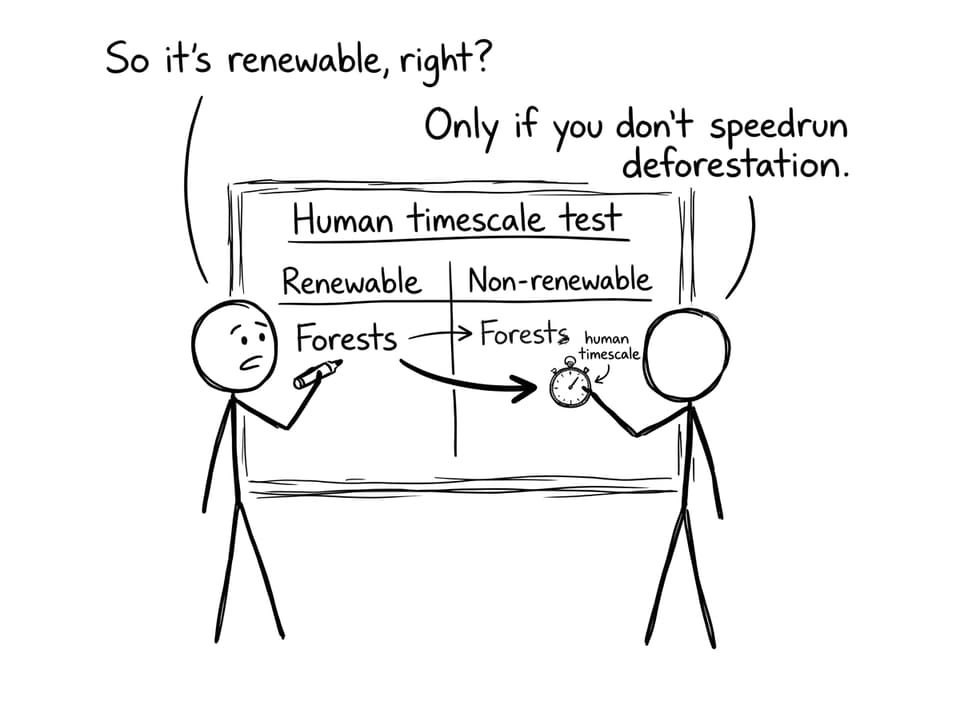
Renewable resources are natural materials or energy flows that can be replenished through natural cycles quickly enough to keep up with use, within a human timescale. In IB ESS, that last clause matters because it forces you to think like a systems student: rates of inputs, outputs, and regeneration.
Common renewable resources you can reference in IB ESS include:
-
Solar energy (sunlight captured by photovoltaic cells)
-
Wind energy (kinetic energy converted by turbines)
-
Hydropower (moving water driving turbines, often via dams)
-
Geothermal energy (heat from Earth’s interior)
-
Biomass (organic matter used as fuel)
-
Tidal and wave energy (predictable ocean movement)
They contrast with non-renewable resources like coal, oil, and natural gas, which form over millions of years and can be depleted far faster than they are created.
To lock down the energy source comparisons in the syllabus topic, use: 7.2A Energy sources, global energy consumption and energy choices.
Advantages of renewable resources (and the marks hidden inside them)
Renewable resources often support long-term sustainability because they reduce dependence on finite fuels and can lower greenhouse gas emissions during operation. In IB ESS, you can earn quick marks by pairing each advantage with a condition.
-
Lower emissions (especially solar, wind, geothermal) but consider life-cycle impacts like manufacturing and land use.
-
Energy security (local production reduces imports) but intermittency can increase reliance on storage or backup systems.
-
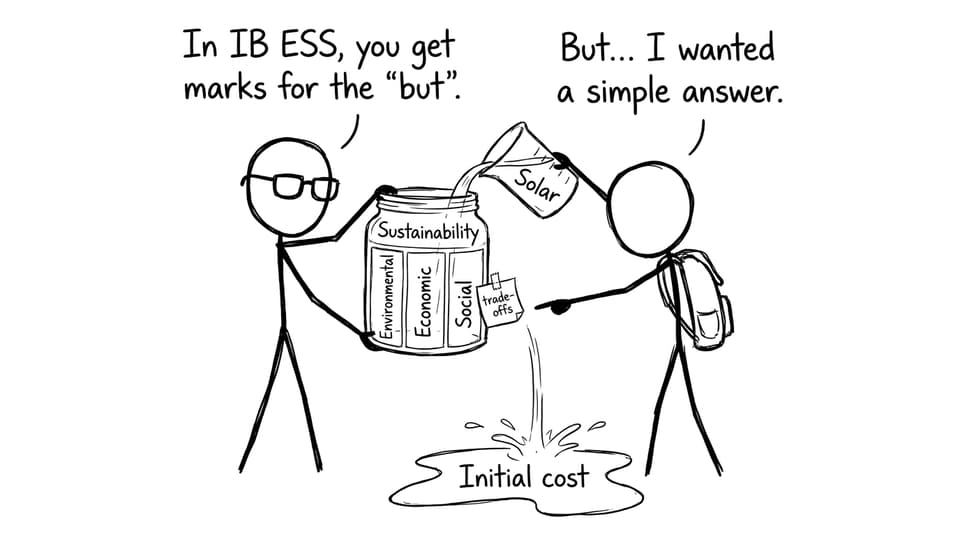
Economic opportunities (jobs and innovation) but initial infrastructure costs can be high.
A good way to revise this as an exam skill is to practise writing short, balanced evaluations. RevisionDojo’s Questionbank is ideal for drilling that “advantage + limitation + judgement” rhythm.
Limitations and challenges you must mention in IB ESS
Renewable does not mean impact-free. IB ESS expects you to evaluate environmental impacts and trade-offs, not just cheerlead.
-
Intermittency: Solar and wind depend on weather and time of day.
-
High upfront cost: Building capacity can be expensive even if long-term running costs are low.
-
Land and ecosystem impacts: Dams can disrupt river habitats; biomass can compete with food production; turbines can affect wildlife.
To connect this to systems thinking, review: Notes for 1.2 Systems. And for broader context on natural resource management, see: Topic 7.1 Natural resources -- uses and management.
Renewable resources and sustainability (the examiner’s favourite link)
Renewable resources sit right in the middle of sustainable development because they touch all three pillars:
-
Environmental: reduced pollution and slower depletion of natural capital
-
Economic: long-term stability and innovation, balanced against upfront investment
-
Social: improved energy access and equity, balanced against land rights and community displacement
In IB ESS, this is where you can add scoring concepts like ecological footprint and biocapacity. A compact link is: if ecological footprint exceeds biocapacity, resource use becomes unsustainable even if the resource is technically renewable. Use this note to sharpen that explanation: Biocapacity notes.
How RevisionDojo helps you revise renewable resources faster
When you are revising IB ESS, the hardest part is not learning the list of renewables. It is practising evaluation under time. RevisionDojo is built for that loop: use Study Notes to clarify, Flashcards to keep definitions alive, the Questionbank for exam-style practice, and AI Chat plus Grading tools to turn mistakes into mark-gaining habits. When you want realism, use Mock Exams and Predicted Papers to test stamina, then return to weak areas with targeted drills.
If you want a quick set of related articles to deepen your ESS exam thinking, browse: All IB ESS Posts and read How Can I Revise Efficiently for ESS Paper 1 and Paper 2?.
Final takeaway for IB ESS students
Renewable resources are not “perfect energy.” They are resources replenished within a human timescale, with real limits that you must evaluate. If you can define them precisely, give examples, and write one calm “however” paragraph, you are already answering like an IB ESS student aiming for top bands.
To practise that style quickly, open RevisionDojo’s 7.2 Energy sources notes, drill targeted sets in the Questionbank, then use AI Chat and Grading tools to tighten your evaluation under time.