
A student can look impressively busy at midnight. Notes cover the desk, three documents remain open, and tomorrow's alarm is already too close. Yet busyness and effective learning are not the same thing.
So, how much sleep do top IB students get? There is no reliable universal figure for high-achieving IB students specifically. For most IB-age teenagers, the healthier target is 8-10 hours per 24 hours, based on guidance from the American Academy of Sleep Medicine. Some ambitious students regularly get less, but that does not make sleep restriction an effective academic strategy.
Sustainable IB student sleep habits are usually simple: maintain a reasonably consistent wake time, protect a sufficient sleep window, revise efficiently, and avoid using midnight to rescue poor planning.
The practical answer at a glance
- Aim for 8-10 hours if you are 13-18 years old.
- Keep bedtime and wake time reasonably consistent.
- Treat frequent nights below eight hours as a warning.
- Finish demanding revision before concentration collapses.
- Use active practice instead of prolonged rereading.
- Put unfinished work into a written plan before bed.
- Seek help if sleep problems persist or disrupt daily life.
The goal is not a perfect number every night. It is a pattern that supports attention, memory, emotional regulation, and steady academic work.
What realistic IB student sleep habits look like
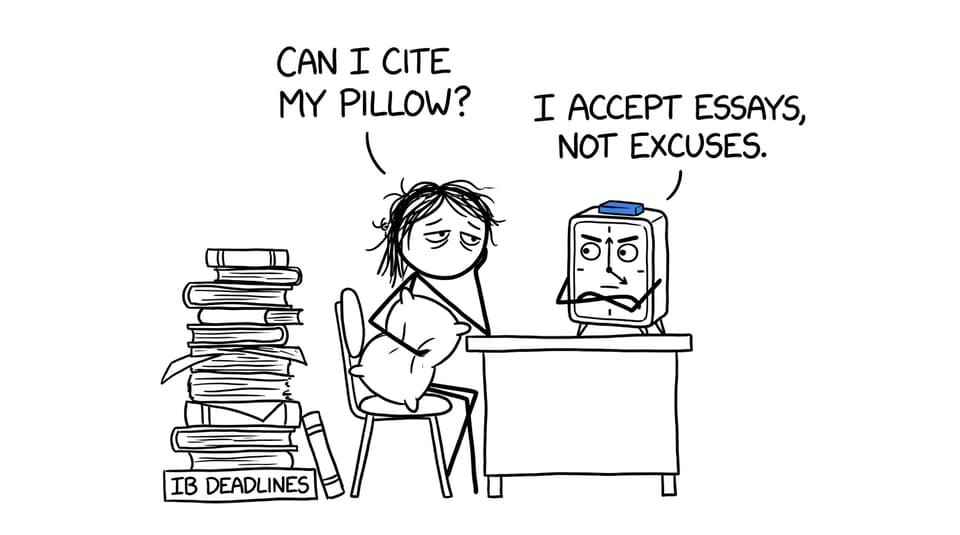
The phrase "top student" can hide very different routines. One student may sleep from 10:30 p.m. to 6:30 a.m. Another may follow a later schedule because family, school, or transport arrangements permit it. A third may survive temporarily on six hours during a deadline crisis and mistakenly present that emergency as the reason for success.
Individual needs vary, and one difficult night does not determine an academic result. The useful question is whether your routine leaves you alert enough to learn, retrieve information, manage stress, and make careful decisions. Regularly rereading the same paragraph, overlooking instructions, or relying heavily on caffeine can indicate that your workload exceeds what your sleep supports.
Duration is not the only consideration. Research reviews on adolescent sleep also associate irregular schedules, poor sleep quality, and daytime sleepiness with weaker academic functioning.
Why another revision hour can produce less learning
Late-night studying feels productive because time is visible. You can count pages and minutes. The cost is quieter.
Sleep supports attention, learning, memory, and emotional regulation. Adolescent sleep research indicates that sleep loss can weaken memory formation and consolidation. Sacrificing rest to cover more material may therefore reduce your ability to retain and apply it.
This matters in the IB, where assessments frequently demand application rather than recognition. You must retrieve ideas, interpret command terms, select methods, and construct arguments under time pressure.
The better trade is often 45 minutes of deliberate practice followed by adequate sleep, rather than two unfocused hours of rereading. RevisionDojo's guide to how sleep affects IB performance examines the relationship further.
Efficient studying protects sleep
A sleep problem is sometimes a planning problem wearing pyjamas. "Revise Biology" has no finish line. "Answer ten genetics questions, review errors, and create three flashcards" does.
Try this focused sequence:
- Use Study Notes to clarify one weak concept.
- Complete 25-35 minutes of targeted Questionbank practice.
- Use Grading tools to identify lost marks.
- Ask AI Chat one precise question if confusion remains.
- Turn recurring errors into Flashcards.
- Write tomorrow's first task, close the laptop, and stop.
Defined outputs make serious work measurable. The RevisionDojo daily IB study schedule provides a fuller routine built around recall, focused practice, and a clear shutdown.
Schedule Predicted Papers and Mock Exams before the final evening, then review mistakes while you can still think carefully. Their purpose is to diagnose weaknesses early, not prove endurance at midnight. This step-by-step IB exam study guide explains the wider revision cycle.
Build a sleep-protective evening
An effective evening has a slope. Cognitive demand gradually falls instead of ending when you collapse into bed.
- Early evening: Complete the hardest analytical task.
- Middle evening: Mark responses and repair one knowledge gap.
- Late evening: Use light retrieval and plan tomorrow.
- Wind-down: Step away from schoolwork and let your mind settle.
Work backwards from your wake time. If you wake at 6:30 a.m. and need roughly eight and a half hours, your sleep opportunity begins around 10:00 p.m. Leave time to wind down rather than treating bedtime as the moment you close a demanding assignment.
Keep your wake time reasonably stable, limit late caffeine if it affects you, and move your phone out of reach when it delays sleep. These boundaries are easier to maintain than an elaborate ritual. The broader IB time-management techniques can help you build a weekly plan with an end time as well as a start time.
Managing deadline and exam weeks
Disrupted weeks happen. An IA deadline moves, a project expands, or several tests arrive together. The goal is to prevent one late night from becoming a permanent pattern.
Rank work by urgency and consequence, reduce low-value polishing before reducing sleep, and break coursework into the next visible action. RevisionDojo's Coursework Library can clarify structure and expectations, while Tutors can resolve confusion before it consumes an evening. The guide to handling IB exam stress offers additional planning and recovery strategies.
Persistent insomnia, severe daytime sleepiness, loud snoring, breathing interruptions, or sleep problems affecting mood and daily functioning deserve attention from a parent, school counsellor, or qualified healthcare professional.
Sleep belongs in the study system
IB student wellness cannot wait until every task is finished because IB work is rarely completely finished. Sleep must become part of the system itself.
Pair a protected sleep window with healthy IB study habits. RevisionDojo's complete collection of IB resources brings together the Questionbank, Study Notes, Flashcards, AI Chat, Grading tools, Predicted Papers, Mock Exams, Coursework Library, and Tutors. Used deliberately, these tools help you identify the next useful task, complete it efficiently, and stop at a reasonable hour.
The strongest students are not necessarily those who stay awake longest. They understand that recovery is not time stolen from learning. It is one of the conditions that makes learning possible.