

If you have ever sat down to study for IB exams and felt your brain open 14 tabs at once, you are not lazy. You are overloaded.
The IB asks you to juggle six subjects plus core deadlines, while still showing up to school like a functional human. The secret is not heroic motivation. It is a daily IB study schedule that is small enough to repeat, and structured enough to reduce decision fatigue.
This guide gives you a realistic day plan you can copy, tweak, and actually sustain.
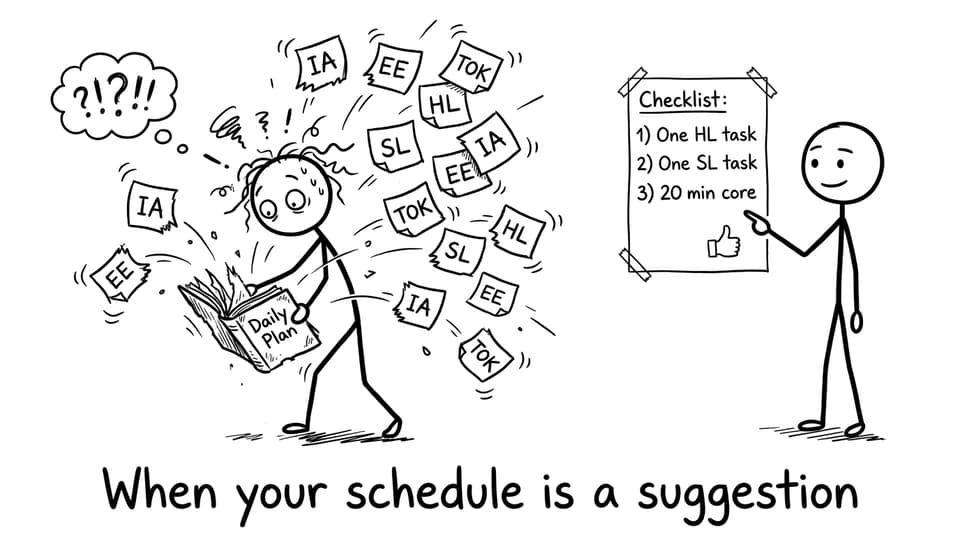
A simple daily IB study schedule checklist
Before we get into time blocks, here is the daily IB checklist that keeps stress low:
-
Do 10-15 minutes of recall (Flashcards) even on busy days
-
Do one focused practice set (topic-specific questions)
-
Do one small core action (EE, TOK, IA, or CAS)
-
End with a 2-minute plan for tomorrow
If you want one place to run this loop, RevisionDojo connects Study Notes, Flashcards, the Questionbank, AI Chat, and feedback so your daily IB work does not scatter.
Helpful reads to pair with this schedule:
Morning: calm momentum (15-30 minutes)
Mornings are for light wins. Not heavy essays.
Your goal: wake your brain up and reduce later panic.
Try this:
-
5-10 minutes: Review IB Flashcards with Spaced Repetition (definitions, formulas, key frameworks)
-
10 minutes: Skim one section of syllabus-aligned notes (no rewriting)
-
2 minutes: Write 2 micro-goals: “One HL task, one SL task”
If you struggle to keep mornings short, the trick is choosing tools that start fast. The Flashcards feature is built for tiny sessions that still count.
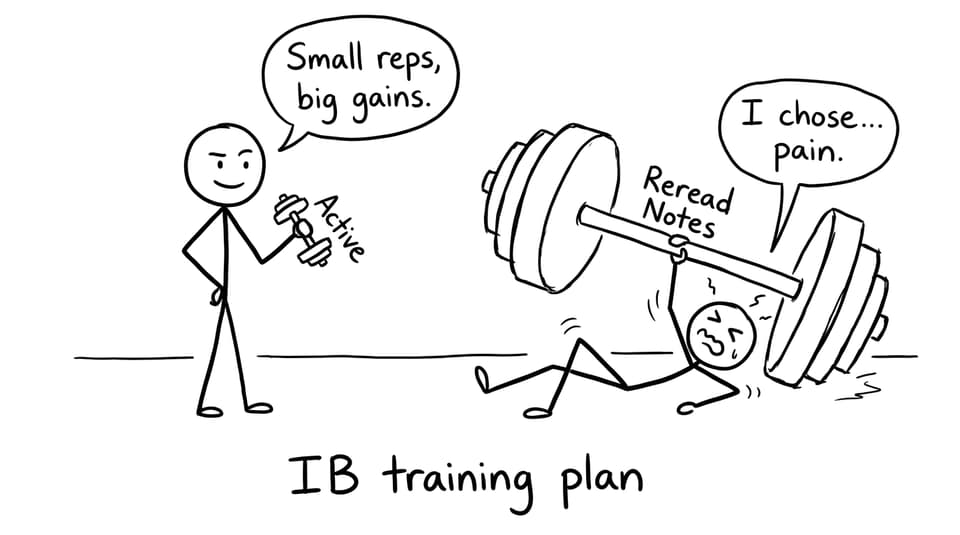
During school: reduce the “relearn tax”
A huge part of IB stress comes from paying twice: once in class, again at home.
Your goal at school: collect clarity.
-
Ask one question per day (even a small one)
-
Mark any topic that felt shaky so you can target it later
-
Use free periods for micro-tasks: outline an IA paragraph, clean up citations, or draft a TOK claim
This is where your evening IB study schedule gets cheaper. You are not starting from zero.
Afternoon: the main IB study schedule block (60-90 minutes)
This is your highest-quality focus window. Treat it like training.
HL focus (35-50 minutes)
Pick one HL and do:
-
10 minutes: Patch understanding with Study Notes
-
25-35 minutes: Practice in the Questionbank
-
5 minutes: Write a mistake log (what went wrong, what rule fixes it)
For a deeper strategy on question practice, keep this nearby:
SL review (15-25 minutes)
Keep SL sessions short and frequent:
-
One mini-topic recap
-
5-10 questions
-
Flag what to revisit tomorrow
This rotation is the core of a sustainable IB study schedule: depth on one subject, maintenance on another.
Evening: core + timed practice (45-75 minutes)
Evenings are where you build long-term calm. Not by doing more, but by making tomorrow easier.
Core progress (15-25 minutes)
Choose one:
-
EE reading and 5 bullet notes
-
TOK: refine one claim/counterclaim
-
IA: one paragraph, one graph, or one data cleanup
-
CAS: brief reflection
Small daily progress prevents the “Sunday night cliff.”
Timed practice (25-40 minutes)
Do one timed section (not a marathon). It can be multiple-choice, structured, or an essay paragraph depending on your subject.
To train this properly, use the mock mindset:
If you are wondering how close you should be to exam conditions, this helps:
Wind-down: protect sleep like it is an IB subject
Your brain files memory while you sleep. In a stressful IB season, that is not a wellness slogan. It is a grade strategy.
Try a 10-minute shutdown:
-
Write tomorrow’s first task (make it tiny)
-
Pack what you need
-
Stop screens 20 minutes before sleep if you can
Consistency beats intensity in the IB because consistency compounds.
Closing: make your IB days boring on purpose
A calm IB study schedule is not exciting. It is intentionally repetitive: recall, practice, review, small core progress, sleep.
If you want your schedule to feel lighter, reduce the friction. Build your daily loop inside RevisionDojo using Study Notes for fast understanding, Flashcards for daily recall, the Questionbank for exam-style practice, AI Chat when you are stuck, Grading tools for feedback, and timed Mock Exams plus Predicted Papers to build confidence.
Start today with one 25-minute block. Then do it again tomorrow. That is how the IB stops feeling like a storm and starts feeling like training.