
Starting IB History can feel like arriving halfway through an argument. The names are familiar, perhaps revolution, conflict, propaganda or conquest, but suddenly facts are not enough. Every source has a context. Every interpretation can be challenged. Every apparently simple question is asking you to make a judgment.
For students beginning IB History first year 2028, the most important fact is that you are following the redesigned course first assessed in May 2028. According to the IB’s official curriculum update, the course is organized around paired case studies, global themes and, at Higher Level, regional in-depth topics. Your exact first-term content depends on your school, but the intellectual work is consistent: using sources, connecting historical examples and evaluating arguments.
This guide explains what that will look like in DP1, what your teacher may cover first and how to build the habits the new course rewards.
Your first-term IB History checklist
By the end of your first term, aim to be able to:
- identify your school’s selected paired case study and global theme
- distinguish a source’s content from its historical context
- write a direct answer to a historical inquiry question
- use precise evidence to support analysis rather than retell events
- recognize command terms such as identify, analyze, examine, discuss and evaluate
- organize notes around questions, concepts and arguments
Teaching order varies, so treat your school’s course outline as the definitive map for your class.
How the first-assessment 2028 course is structured
The new IB History curriculum structure for first assessment 2028 is more flexible than a fixed list of identical national histories taught everywhere. The official IB update says teachers select one paired case study and one global theme. HL students also study two regional in-depth topics from one selected region.
| Course element | Who studies it? | Main historical skill |
|---|---|---|
| One paired case study set | SL and HL | Using and interpreting sources |
| One global theme | SL and HL | Making connections among diverse examples |
| Two regional in-depth topics from one region | HL only | Evaluating historical arguments |
| Historical investigation | SL and HL | Conducting independent historical inquiry |
The regional groupings identified by the IB are Africa and the Middle East, the Americas, Asia and Oceania, and Europe. Two classes can therefore follow the same subject guide while studying different material.
Ask your teacher to name your paired case study, global theme and selected examples. If you take HL, also record the region and two in-depth topics. Keep those labels at the front of your folder to avoid revising interesting history that is not part of your taught course.
What you will probably cover first
Your teacher is likely to begin with either the paired case study or the global theme, although the IB does not prescribe a universal teaching order. Each route develops a different part of historical thinking.
A paired case study and source work
Paired case studies replace what the previous course called prescribed subjects. The word paired matters. You are not studying an isolated episode simply to remember what happened. You are examining related cases through diverse historical sources and learning how evidence helps answer an inquiry question.
An early lesson might use a speech, newspaper extract, photograph or government document. You may need to identify information across two sources, analyze the context surrounding one source or examine perspectives across three sources. These are specific Paper 1 directions described in the IB’s official 2028 update.
When reading a propaganda poster, useful observations go beyond listing its symbols. Ask:
- Who was expected to encounter it?
- What political conditions made its message useful?
- Which groups or experiences does it omit?
- How does its perspective differ from another contemporary source?
- What can it contribute to the framing inquiry question?
Forcing every source into a memorized checklist is risky. The redesigned Paper 1 is intended to connect more closely to authentic historical inquiry. Context, perspective and relevance matter because they help answer the question, not because they fill predetermined boxes.
A global theme and connected examples
Global themes replace the former world history topics. Your class studies one of four global themes, using historical examples selected by the teacher in line with the subject guide. The goal is to make meaningful connections across contexts, not merely place unrelated cases beside one another.
Suppose a lesson examines political control through different states and periods. Weak notes create a factual page for each example. Stronger notes add comparative categories such as methods, audiences, institutional control, opposition, impact and limitations. This structure makes evidence easier to use when a question demands explanation or judgment.
Paper 2 reflects that conceptual focus. The format includes a Section A question on a specified concept. In Section B, students answer a short-response question and an essay-response question on their global theme. You need both concise conceptual thinking and sustained argument.
Use the IB History resources hub to keep topic notes connected to questions, flashcards and practice rather than treating each resource as a separate pile of information.
Regional depth at Higher Level
HL students also study two regional in-depth topics from one region. These develop the ability to evaluate arguments. Your school may introduce this component immediately or establish the common SL and HL material first.
Depth requires chronology and accurate evidence, but also debates about causes, consequences, change, continuity and significance. A useful HL note does not simply state that a historian holds a view. It explains the argument, supporting evidence, limitations and relationship to other interpretations.
The guide to IB History HL regional studies explains why evaluation, rather than quotation collecting, is the central skill.
The assessment map you should understand now
You do not need to prepare for every final task in week one. You do need to know what your lessons are building toward.
- Paper 1, taken by SL and HL students, is source-based and built around the selected paired case study.
- Paper 2, also taken by SL and HL students, assesses conceptual understanding and the selected global theme through short and extended responses.
- Paper 3 applies to HL students and assesses regional in-depth study, emphasizing historical arguments.
- The historical investigation is the internal assessment completed by SL and HL students.
For a fuller breakdown, read IB History assessment explained. Confirm timings, marks, weightings and school deadlines against the official subject guide supplied through your school. Do not rely on technical guidance written for the course assessed through 2027.
The historical investigation may be mentioned during your first term even if formal work begins later. Start noticing narrow, contestable questions and accessible evidence. “The Cold War” is a field, not an investigation question. A focused question identifies a specific issue, place, period and line of debate.
Command terms change what a good answer looks like
A History response can contain accurate facts and still answer the wrong task. The command term tells you what to do with your knowledge.
| Command term | What your response must do | Frequent mistake |
|---|---|---|
| Identify | Select a relevant answer or piece of information | Adding a long narrative instead of answering precisely |
| Analyze | Break the issue into relevant parts and explain relationships | Describing events without explaining how or why |
| Examine | Consider an argument or issue to reveal assumptions and connections | Treating one side as self-evident |
| Discuss | Present a considered review supported by evidence | Listing different views without reaching a conclusion |
| Evaluate | Weigh strengths, limitations or importance and reach a judgment | Saving evaluation for the final sentence |
| To what extent | Judge the degree to which a claim is valid | Answering with a simple yes or no |
Use the definitions in the official IB subject guide provided by your school. Before planning, circle the command term, underline the historical focus and mark any limits on time, place or examples.
A useful paragraph makes a claim, selects precise evidence and explains why that evidence supports the argument. It then adds qualification where needed. This is why new-specification IB History essays reward selective evidence more than uncontrolled factual display.
Common first-term mistakes and how to correct them
Turning notes into transcripts
Copying every slide feels safe because nothing is lost. The cost appears later when everything looks equally important. After each lesson, rewrite the material under three headings: inquiry question, evidence and judgment. Add a chronology only where sequence matters.
Treating a source as a fact container
A source provides information, but historians also ask why it was produced, under what circumstances and from which perspective. Do not make context a detached label. Connect it to the source’s usefulness for the inquiry.
Confusing perspective with dishonesty
A biased source is not automatically useless. A political speech may be poor evidence of private intention but excellent evidence of the public case a government wanted to construct. Specify what the source can and cannot help establish.
Writing before deciding the answer
Many students begin an essay with background because they hope an argument will emerge. Usually, it does not. Write a one-sentence provisional judgment first, then select the evidence needed to test it. The guidance on what IB History examiners look for reinforces the importance of letting relevance and analysis control the evidence.
Revising only with flashcards
Flashcards help with dates, people, terminology and compact evidence. They cannot independently train comparison, source analysis or evaluation. Pair IB History flashcards with timed outlines, source questions and paragraphs that defend a judgment.
Using resources for the previous course
The 2028 course retains familiar historical skills, but its structure and assessments have changed. Check that a resource explicitly refers to first assessment 2028. Be cautious when older advice presents prescribed subjects, world history topics or a mechanical source routine as the current model.
A sensible weekly routine for IB DP1
History improves through repeated decisions, not occasional marathons. Try this cycle:
- After each lesson: reduce the lesson to one inquiry question, five pieces of usable evidence and one unresolved debate.
- Once a week: complete one source task or produce one essay plan from memory.
- Every two weeks: build a comparison grid connecting examples from the global theme.
- At the end of a unit: write one timed response, review it and rewrite the weakest paragraph.
RevisionDojo can support each stage without replacing the thinking. Use Study Notes to repair a content gap, Flashcards to retrieve precise evidence and AI Chat to question a confusing interpretation. Then move into the Questionbank and use Grading tools to test whether your answer is relevant and analytical. Predicted Papers and Mock Exams become more useful once you have enough content to practise under realistic conditions. The Coursework Library and Tutors can help when you begin planning independent investigation, provided all submitted work remains your own.
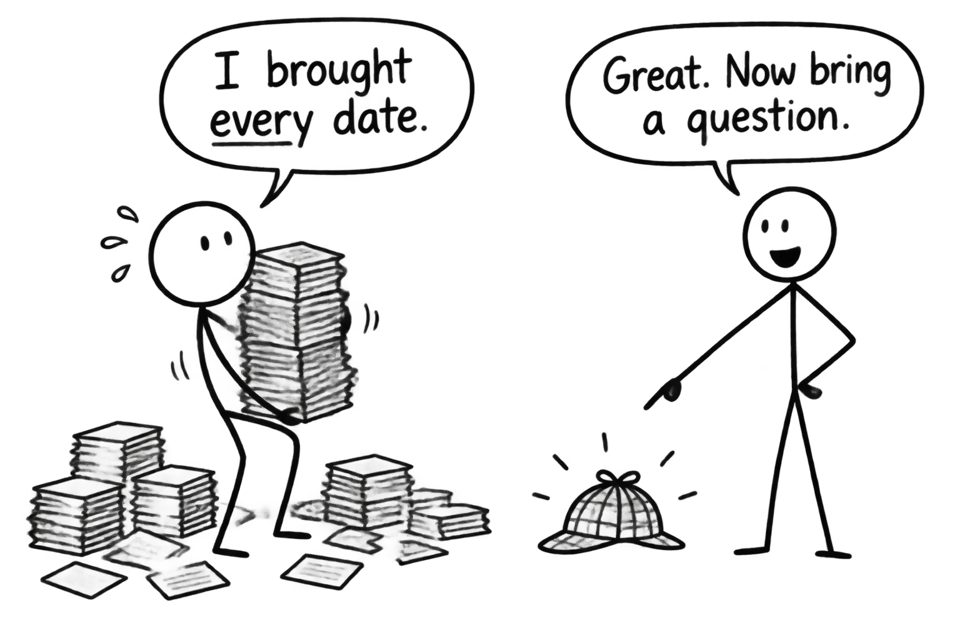
A strong first term is quieter than many students expect. You do not need to know every date. You need to recognize what a question demands, select evidence deliberately and explain why it matters. That habit connects source work, global themes, HL depth and the historical investigation.
Explore the new IB History hub, choose the topic your class is studying and try 10 free questions in the subject Questionbank. Ten careful answers, reviewed properly, will reveal more about your understanding than another hour of passive rereading.