

If you have ever revised for IB History by rereading notes until your eyes blur, you are not alone. It feels responsible. It feels like work. But the first time you meet an exam question that asks you to judge significance or weigh perspectives, you realise something uncomfortable: knowing more facts does not automatically turn into more marks.
From first assessment 2028, the IB DP History curriculum makes that truth harder to ignore. The course is still recognisably IB History, but the structure is now more explicit: your learning is organised to reward inquiry, not information hoarding. When you understand that structure, revision stops being a pile of pages and becomes a system you can steer.
This guide explains the new IB History curriculum structure for FA 2028, how assessment thinking flows from it, and how to use it to revise with purpose.
Quick checklist: what to understand early in IB History
-
The four building blocks of the FA 2028 IB History model
-
What “contexts, concepts, content, and skills” mean in practice
-
How this structure changes revision (and saves time)
-
How to turn topics into exam-ready arguments
-
Which RevisionDojo tools map directly onto the new structure
For a central home base while you revise, keep the IB History resources hub open as you read.
The big idea: IB History is now more obviously concept-led
The FA 2028 model frames IB History as concept-led and inquiry-based. That sounds abstract until you feel it in your work: content is no longer treated as the endpoint. Content is the raw material you use to answer historical questions.
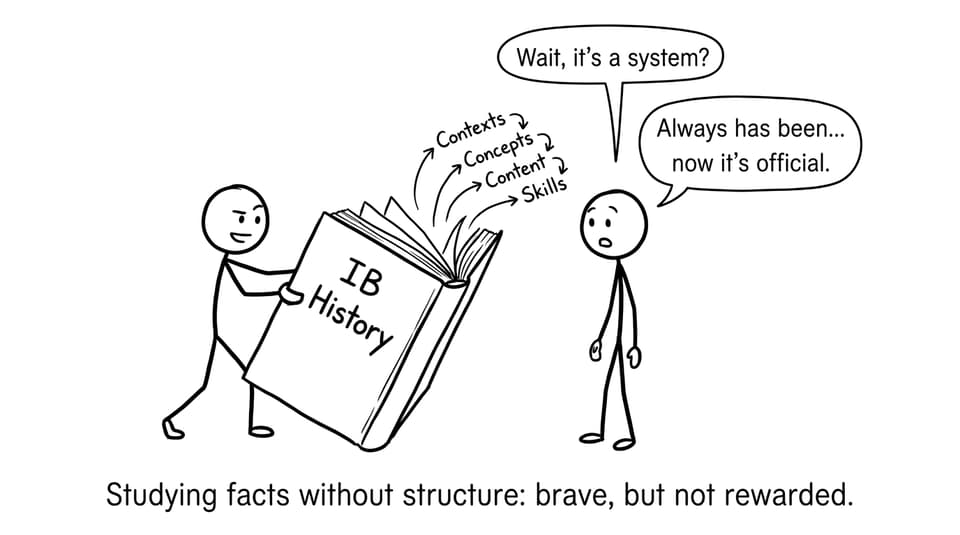
The curriculum is organised around four connected elements:
-
Contexts (the historical setting)
-
Concepts (the thinking lenses)
-
Content (the case studies and knowledge)
-
Skills (what assessment actually rewards)
If your revision ignores one of these, your essays usually start sliding into description: accurate, sometimes impressive, but not targeted.
Want a parallel read on how concepts drive exam performance in IB History? See IB History: The 4 Key Concepts for FA 2028.
Contexts in IB History: the setting that stops you oversimplifying
In IB History, contexts are the conditions surrounding events: the political pressures, economic constraints, social structures, and international circumstances that shape decisions.
Why contexts matter in FA 2028 is simple: context prevents cartoon explanations.
-
It helps you locate events in time and place (scope control)
-
It explains why certain options were realistic for historical actors and others were not
-
It makes long-term developments visible (not just turning points)
-
It gives your argument credibility because it shows you understand constraints
A practical revision move: when you revise a topic, write a “context box” of 5--7 bullets you could use in any essay. Then practise plugging only the relevant bullets into different questions.
To build this efficiently, use Study Notes as your baseline, then test whether you can reproduce the context box from memory.
Concepts in IB History: the lenses that shape every answer
Concepts are not definitions you memorise. In FA 2028 IB History, concepts are tools you apply.
The four core concepts are:
-
Cause and consequence
-
Continuity and change
-
Perspectives
-
Significance
They show up everywhere: essay questions, source evaluation, comparisons, and higher-mark judgement tasks. Most “mysterious” mark losses happen when a student writes around a concept instead of through it.
Here is a simple way to feel the difference:
-
Descriptive: “There were many causes of X…”
-
Concept-driven: “The most decisive short-term cause was __ because __, but it mattered only because the long-term condition of __ made __ likely.”
If you want exam technique help that aligns with this, read Tips for Writing IB History Essays: A Comprehensive Guide.
Content in IB History: evidence is the servant, not the boss
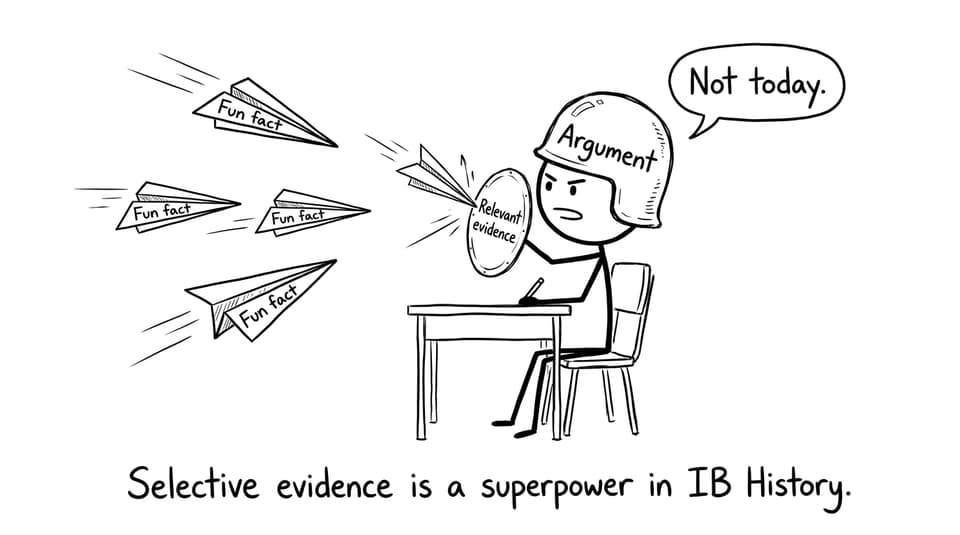
Content is what your school selects: case studies, themes, and depth areas. You still need knowledge. But in FA 2028 IB History, you are rewarded less for volume and more for selection.
Examiners do not grade your ability to narrate. They grade your ability to choose evidence that does a job:
-
supports a claim
-
proves causation or change
-
shows contrast between perspectives
-
demonstrates why something was significant
A strong IB History paragraph often uses fewer facts than you expect, but each fact is explained for meaning.
To make your content usable under time pressure, practise with the IB History Questionbank. It forces you to retrieve evidence in response to a task, not a topic heading.
For topic-specific content practice, you can also use RevisionDojo’s structured topic pages like Paper 1: Conflict and Intervention or Paper 1: The Move to Global War.
Skills in IB History: what the assessment is really measuring
Skills are the engine of FA 2028 IB History. If content is the fuel, skills are the ability to drive.
Across the course, you are repeatedly assessed on:
-
building an argument that answers the question directly
-
selecting and integrating evidence
-
evaluating perspectives (including limitations)
-
comparing and synthesising across case studies
-
communicating clearly under time constraints
This is why students can “know the chapter” and still score lower than expected. Weak skills cannot hide behind memorisation.
If you recognise that pattern, this diagnostic is useful: Why Students Struggle With IB History (FA 2028) -- and How RevisionDojo Helps.
How the four elements connect (and how to revise with them)
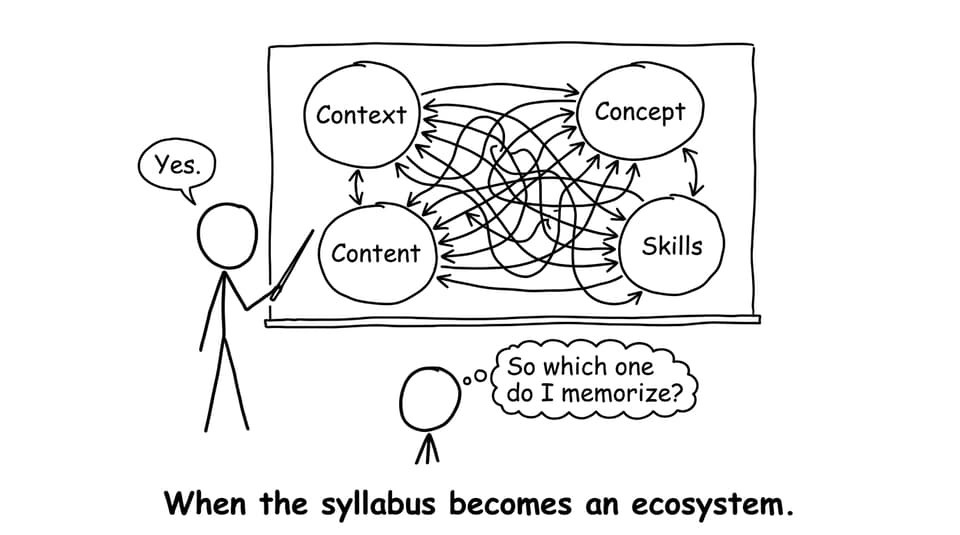
The FA 2028 IB History structure is not four separate boxes. It is one loop.
-
Contexts keep your explanation realistic
-
Concepts tell you what kind of thinking the question wants
-
Content gives you evidence to prove your claims
-
Skills determine whether your proof is coherent, selective, and evaluative
A revision routine that matches this loop looks like:
-
Learn with RevisionDojo Study Notes
-
Convert key points into Flashcards for active recall via IB Flashcards
-
Apply under pressure using the Questionbank
-
Ask targeted “why/how” questions using AI Chat when you get stuck
-
Use Grading tools to see whether your writing is analytical or descriptive
-
Build exam readiness with Predicted Papers and Mock Exams
-
Strengthen coursework confidence using the Coursework Library, especially IB History examples
-
Get personalised help with Tutors when your feedback needs to be human and specific
For additional exam routines, pair this article with Ace IB History Paper 1 + Paper 2: Tips + Free Resources.
Common mistakes students make with the FA 2028 IB History structure
Most mistakes in IB History are not “I didn’t work hard enough.” They are structural.
-
Revising content without practising concepts (so essays become narrative)
-
Writing without a one-sentence argument (so paragraphs compete instead of building)
-
Listing evidence instead of explaining what it shows (so marks cap out early)
-
Ignoring perspective and limitations (so evaluation disappears)
-
Treating skills as optional until the last month (so timing collapses)
If you want a calmer, smarter approach, build skills early with a loop: recall, write, review, repair. This is also the logic behind IB History HL: Best Study Techniques.
FAQ
What actually changes in IB History for first assessment 2028?
The core experience of IB History remains familiar, but the curriculum structure becomes more explicitly concept-led and skills-driven. That means teachers and assessments will more clearly expect you to use contexts, concepts, content, and skills as an integrated system. In practice, you are rewarded less for broad narration and more for targeted argument. You will still study substantial historical material, but the course language pushes you to treat that material as evidence. This shift matters because it changes how you revise: revision is no longer “cover everything,” but “select what answers typical question types.” If you build this mindset early, timed writing becomes more predictable and less stressful.
Do I need to memorise less content in IB History now?
You still need strong content knowledge for IB History, because you cannot argue without evidence. The change is not that content stops mattering, but that relevance matters more than quantity. Think of it like having a smaller set of sharp tools rather than a garage full of random objects. In exams, you rarely lose marks because you forgot an obscure detail; you lose marks because you used the wrong detail or did not explain it. A good goal is to know fewer examples more deeply, with clear links to the four concepts. If you practise retrieval with tools like RevisionDojo Flashcards and the IB History Questionbank, you will remember what you need without trying to memorise entire timelines.
Are concepts more important than facts in IB History?
In IB History, concepts and facts are partners, not rivals. Concepts tell you what kind of reasoning the question is testing, while facts give you the proof that your reasoning is true. If you write only concepts, your essay becomes vague and unconvincing. If you write only facts, your essay becomes descriptive and the examiner has little reason to award higher levels. The highest-scoring answers are concept-driven but evidence-backed: every key point names a lens (cause, change, perspective, significance) and then proves it with carefully chosen content. This is why practising planning and paragraph structure is so powerful under FA 2028.
How can RevisionDojo help me adapt to the new IB History structure?
RevisionDojo is built to match how IB History is assessed: you learn, retain, apply, and refine. You can start with syllabus-aligned Study Notes, then lock in recall through Flashcards so your knowledge is available under time pressure. The IB History Questionbank helps you practise applying content to real question styles, not just rereading. AI Chat can unblock confusion quickly, and Grading tools can show whether your writing is actually analytical or drifting into story mode. When exams get closer, Predicted Papers and Mock Exams help you train timing and stamina in a controlled way. And if you want models for the investigation or extended writing, the Coursework Library gives you strong exemplars to learn from.
Conclusion: learn the structure, and IB History gets calmer
The most reassuring thing about FA 2028 IB History is that it is predictable. The curriculum is telling you, clearly, what to do: ground your answers in context, think through concepts, select content as evidence, and demonstrate skills in how you write.
If you treat that structure as your revision map, you stop revising in circles. You start revising in loops that compound.
Make RevisionDojo your default study home for IB History: begin at the IB History resources hub, practise with the IB History Questionbank, and build the kind of exam-ready confidence that comes from structure, not last-minute panic.