

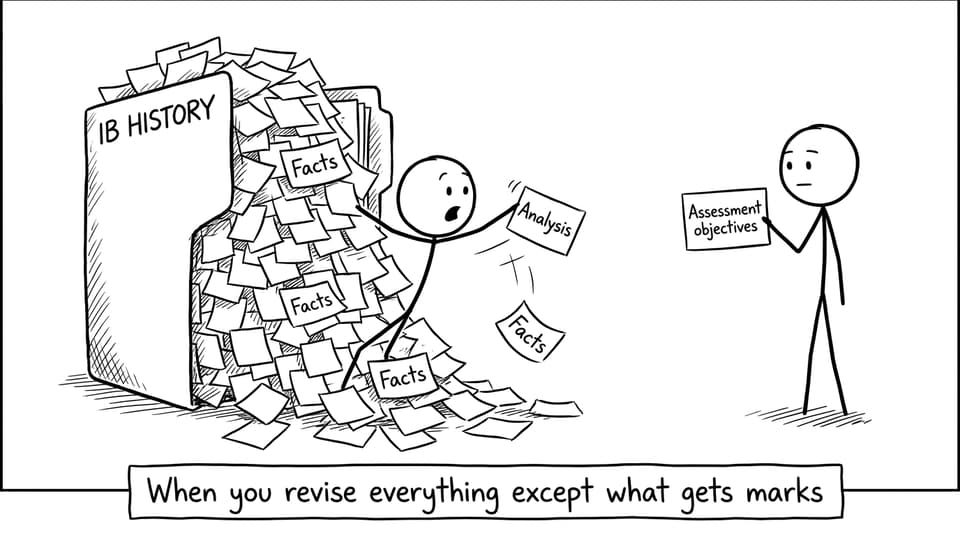
If you have ever walked out of a timed IB History practice thinking, “I knew the content… so why did that feel messy?” you have already met the real challenge of the new course.
Under first assessment 2028, IB History rewards something calmer and harder than memorisation: the ability to think like a historian on demand. When you understand what each assessment component is actually testing, your revision becomes lighter, not heavier. You stop collecting facts like souvenirs and start using them like tools.
Quick checklist: what to know before you revise
-
The full IB History assessment structure for FA 2028 (SL vs HL)
-
What Paper 1, Paper 2, and Paper 3 are designed to measure
-
What the IA is really testing (and what it is not)
-
The mark-winning habits that appear in every component
-
A simple way to turn RevisionDojo practice into steady score gains
IB History assessment overview (First Assessment 2028)
For IB History, assessment is split across exams and coursework:
-
Paper 1 (SL & HL): source-based analysis
-
Paper 2 (SL & HL): concept-driven essays
-
Paper 3 (HL only): depth, synthesis, and evaluation
-
Internal Assessment (IA) (SL & HL): a historical investigation
If you want the clean hub for resources and topic pathways, start with IB History Resources.
Paper 1 in IB History: source analysis under pressure
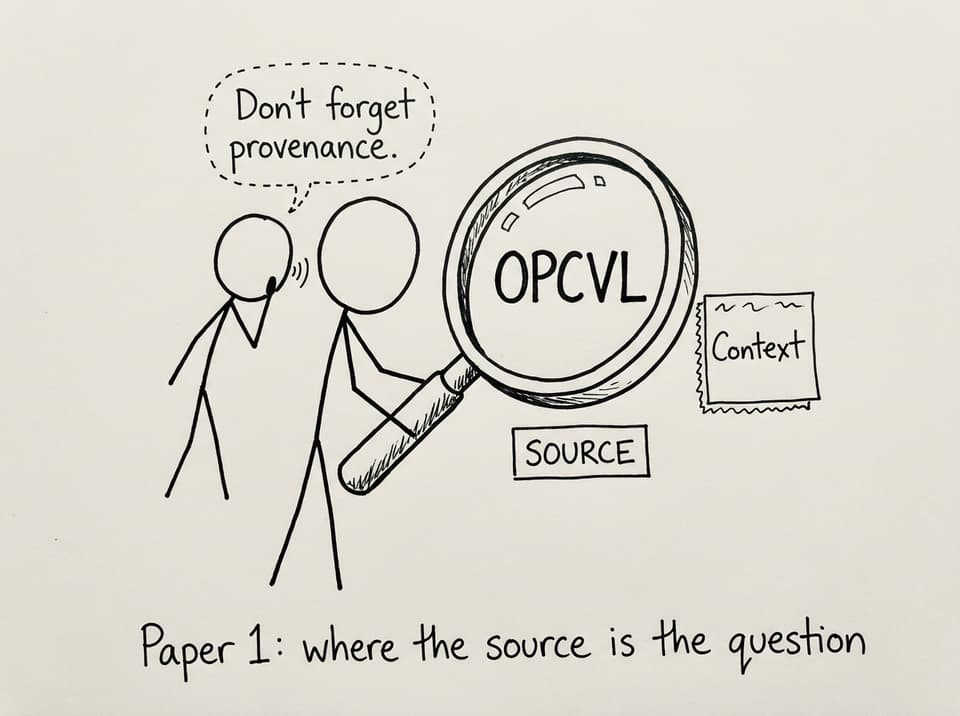
Paper 1 is where IB History becomes less about what you remember and more about what you can read. You are judged on how well you extract meaning from sources, place them in context, and evaluate their usefulness.
Paper 1 tends to reward students who do three quiet things:
-
Answer this question, not a bigger one you wish you were asked
-
Treat provenance (origin and purpose) as evidence, not decoration
-
Write with precision: short, specific, anchored to the sources
If you want a full breakdown of how Paper 1 works in the new course, use IB History Paper 1 Explained: Source Analysis (FA 2028). For a quick refresher on evidence types, What Is a Primary Source? IB History Source Guide is a strong companion.
Paper 2 in IB History: concepts, arguments, and choices
Paper 2 is the essay heart of IB History for both SL and HL. The trick is that the best essays are not the longest or the most detailed. They are the ones that make disciplined choices.
Under FA 2028, Paper 2 essays score well when they:
-
Build a clear line of argument (a judgement, not a narrative)
-
Use historical concepts deliberately (causation, change, significance, perspectives)
-
Select evidence that proves the claim instead of listing everything you know
-
Evaluate: weigh factors, compare interpretations, explain limits
A useful practice path is to plan fast, write one body paragraph well, then upgrade with feedback. RevisionDojo makes that loop easier with Study Notes for quick clarity, Flashcards for retrieval practice, and the Questionbank for exam-style prompts with feedback.
For a targeted Paper 1 + Paper 2 routine, see Ace IB History Paper 1 + Paper 2: Tips + Free Resources.
Paper 3 (HL only): depth and synthesis in IB History
Paper 3 is where HL students feel the ceiling. It asks you to sustain evaluation for longer, handle greater depth, and connect developments across case studies without collapsing into a timeline.
What separates stronger Paper 3 answers in IB History is not just knowledge. It is control:
-
You keep returning to the question focus
-
You compare in a way that produces insight (not just similarities/differences)
-
You use evidence as support for judgement, not as the main event
If you want HL practice that behaves like the real thing, RevisionDojo’s Mock Exams and Predicted Papers help you rehearse timing and stamina, then use the AI Chat to unblock confusion immediately after marking.
The IB History IA: the historical investigation (not a mini-EE)
The IB History IA is a different kind of test. It is sustained inquiry: can you ask a focused question, choose evidence intelligently, evaluate sources, and build a supported conclusion?
Two common IA traps are:
-
Writing a beautiful narrative that never becomes analysis
-
Choosing a question so wide that every paragraph feels vague
To keep your IA sharp, start with IB History Internal Assessment Explained: The Historical Investigation (FA 2028), then refine your research focus using Choose a Strong IB History IA Question (FA 2028).
When you are drafting, RevisionDojo’s Grading tools can save you weeks of guessing: try the IB History IA Grader. For models and structure inspiration, the IB History Coursework Examples are a reliable reference point.
One habit that lifts every IB History component
In IB History, marks are earned when you move from what happened to what it means.
A simple self-check after any paragraph (Paper 1, Paper 2, Paper 3, or IA):
-
Have I made a judgement?
-
Did I prove it with specific evidence?
-
Did I explain why that evidence matters?
If not, your next revision session should not be “learn more content.” It should be “rewrite one paragraph with clearer evaluation.”
FAQ
Do SL and HL students do the same IB History exams?
SL and HL students share Paper 1 and Paper 2, and both complete the IB History IA. HL students also sit Paper 3, which adds an extra layer of depth and extended evaluation. This matters because HL revision must include stamina training, not just content coverage. Many HL students revise as if Paper 3 is “more Paper 2,” then get surprised by how quickly their argument thins out over time. A better approach is to practise building an argument that stays coherent for the full response and keeps weighing evidence rather than describing it. On RevisionDojo, you can support this with timed practice in the Questionbank, then full simulations using Mock Exams and Predicted Papers.
Is the IB History IA easier than the exam papers?
It can feel easier because you control the time, but it is not automatically easier to score well in IB History coursework. The IA demands consistent judgement, careful source handling, and a clear investigative shape. Many students lose marks by treating the IA like a short textbook chapter, where the goal is to cover everything. The actual goal is to answer one focused question with disciplined evidence and explicit evaluation of sources. If you want a fast way to see whether your draft is meeting the criteria, use the IB History IA Grader and compare against high-quality models in the Coursework Examples library.
Can I rely on memorised essays for IB History Paper 2 or Paper 3?
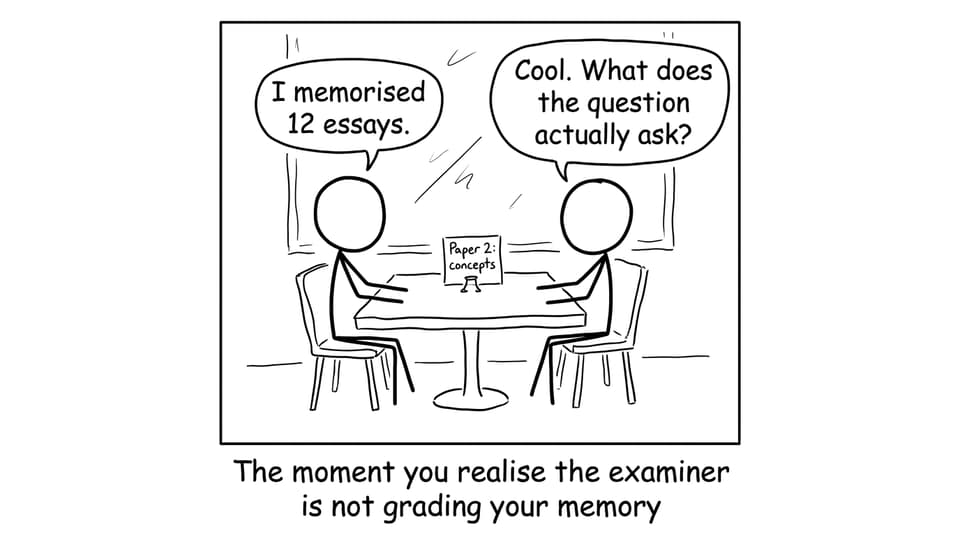
In IB History, memorised essays are risky because questions are designed to reward thinking, not recitation. Even when a prompt looks familiar, the angle often shifts: significance instead of causes, comparison instead of narrative, perspectives instead of summary. Examiners can also tell when evidence is being poured into a pre-written structure that does not match the command term. A safer strategy is to memorise flexible building blocks: a few strong thesis templates, a bank of evidence grouped by concepts, and evaluative sentences that weigh factors. Then practise adapting quickly using exam-style questions. RevisionDojo supports this with Study Notes for fast review, Flashcards for recall, and the Questionbank plus AI Chat to tighten your argument under pressure.
Final thoughts: make IB History feel predictable
The new IB History assessment model (first assessment 2028) is not trying to trick you. It is trying to see whether you can analyse, evaluate, and argue with control.
If you want your next month of revision to feel calmer, build one loop: learn with RevisionDojo Study Notes, lock recall with Flashcards, practise using the Questionbank, get unstuck with AI Chat, check your coursework with Grading tools, and rehearse full performance with Predicted Papers and Mock Exams. That is how IB History stops feeling like a guessing game and starts feeling like a skill you can train.