
IB History can feel like a strange kind of magic trick. You walk out of the exam hall thinking, I knew the topic. I wrote a lot. I stayed calm. Then the result lands and it feels like the examiner saw a different script.
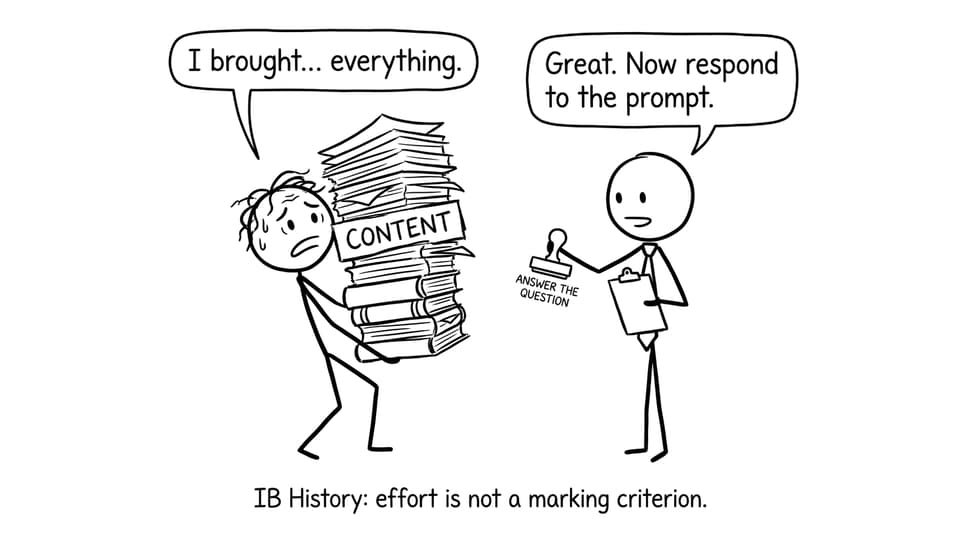
Under the new IB DP History course (first assessment 2028), that gap usually comes from one misunderstanding: examiners are not rewarding how much you know; they are rewarding how well you think with what you know. In IB History, marks follow skills: question focus, analysis, evaluation, and purposeful evidence.
If you want one place to keep open while you fix those skills, start with the IB History Resources hub. It is built around the same logic examiners use.
The examiner checklist (steal this before every practice)
Before you write, make sure your IB History answer will show:
-
A direct response to the exact question and command term
-
Analysis (the “why” and “so what,” not just “what happened”)
-
Evaluation (a judgement with weighing, not a list)
-
Selective evidence that is explained and linked to your line of argument
-
Clear structure so your thinking is visible under time pressure
This is also why students improve fast when they practise with feedback loops, not just rereading. Tools like the RevisionDojo Questionbank make that loop easier to repeat.
What IB History examiners are really marking: focus on the question
Examiners begin with a simple test: did you answer the question that was asked? Not a nearby question. Not the topic you revised most. The exact one.
In IB History, the command term is the steering wheel. “Evaluate” demands weighing and judgement. “To what extent” demands a clear position plus limits. “Compare and contrast” demands both similarities and differences, organised logically.
A useful habit is to translate the question into a one-sentence claim before you write. If you cannot state that claim, you are not ready to draft paragraphs yet. This is where planning matters, and why it helps to rehearse structures like the ones in IB History Essay Structure: Plan Fast, Write Better.
Analysis beats description in IB History (especially in FA 2028)
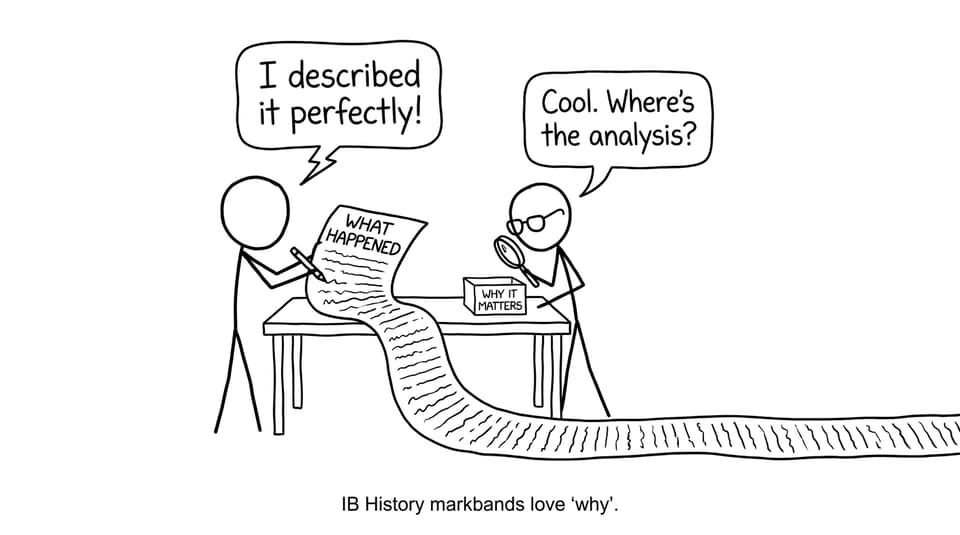
Description feels productive because it is safe. You can write a timeline and it will be accurate. But in IB History, accuracy is the floor, not the ceiling.
Analysis is what moves marks upward:
-
Explaining causes and consequences (and linking them)
-
Showing relationships between factors (how one changes another)
-
Tracking change and continuity across the period in the question
-
Using evidence to prove a point, not to decorate a paragraph
One practical self-check: after each paragraph, ask “Did I explain why this evidence matters for the question?” If not, you are narrating.
For targeted training by paper, the guide How To Ace IB History Paper 1 And Paper 2 Exams breaks down the different “analysis muscles” each paper demands.
Evaluation is the separator: judgement, not just complexity
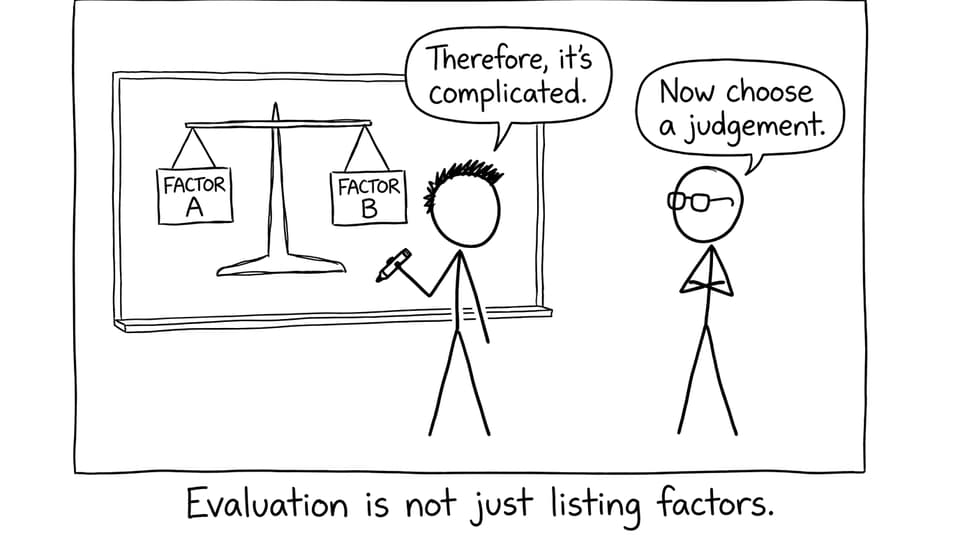
Many students mistake evaluation for adding the sentence “However, it was complex.” Examiners do not award marks for complexity that refuses to choose.
Evaluation in IB History means you weigh factors and make a judgement about importance, supported by reasoning. It can look like:
-
Prioritising one factor over another and explaining why (context, timing, scale)
-
Acknowledging limits (“This mattered less in the short term because...”)
-
Testing an argument against a counterargument, then defending your position
The strongest essays do not dump evaluation at the end. They build it throughout, so the examiner can see your judgement forming in real time.
If you want a broader map of how the course fits together under first assessment 2028, read IB DP History Explained: The New Curriculum Structure.
Evidence should be selective, explained, and tactical
A harsh truth of IB History: a long list of facts can look like uncertainty.
Examiners reward evidence when it is:
-
Relevant to the question’s focus and timeframe
-
Integrated into the argument (not bolted on)
-
Explained (how it proves your claim)
-
Balanced (not one-sided if the question demands weighing)
Think of evidence like seasoning, not the meal. A few precise examples, used well, will almost always beat ten vague ones.
To build that precision quickly, revise from focused materials like the History notes collection and then immediately test yourself with exam-style questions.
Concepts are not decorations; they are the engine
Under FA 2028, conceptual control is not optional. Examiners expect you to think through lenses such as:
-
Cause and consequence
-
Change and continuity
-
Significance
-
Perspectives (who saw events differently, and why)
The mistake is treating concepts like vocabulary words. The win is using them as structure: you organise paragraphs around concepts so your argument has a clear spine.
If thematic thinking feels slippery, IB History Thematic Studies Explained shows how to revise themes without turning them into endless content lists.
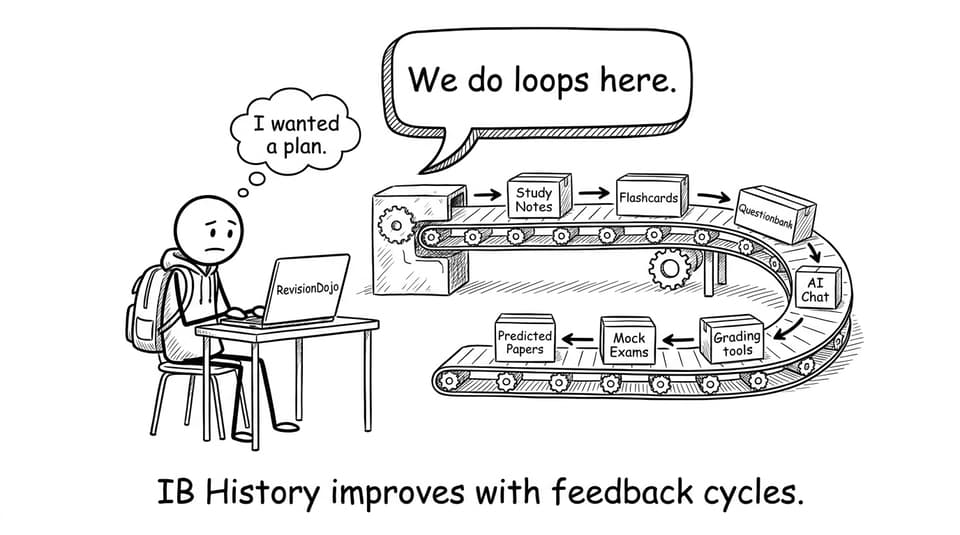
A simple practice loop that matches examiner priorities
Examiners mark skills, so your revision should train skills. A loop that works:
-
Learn one subtopic fast with Study Notes
-
Drill it in the Questionbank (short sets, high focus)
-
Turn mistakes into Flashcards (active recall)
-
Ask AI Chat to explain what your paragraph is missing (analysis vs evaluation)
-
Rehearse timing with Mock Exams and Predicted Papers
RevisionDojo is designed around that compounding cycle, with Study Notes, Flashcards, AI Chat, Grading tools, Predicted Papers, Mock Exams, a Coursework Library, and Tutors when you need human feedback.
For a bigger routine you can run weekly, IB History HL: Best Study Techniques (Study Smarter) connects daily practice to long-term gains.
Closing: make IB History predictable again
IB History becomes stressful when it feels like a guessing game. Under first assessment 2028, it does not have to be. Examiners are consistently looking for answers that stay on the question, analyse causes and consequences, evaluate with judgement, and use evidence with intent.
If you want to turn that into a repeatable routine, open the IB History Resources hub and build your loop: notes for clarity, flashcards for recall, the questionbank for pressure-tested practice, AI Chat plus grading tools for feedback, and timed mock exams and predicted papers for exam-day confidence. That is how IB History stops being mysterious and starts being trainable.