

If you have ever walked out of an IB History practice essay thinking, “That was solid”… and then seen the mark and blinked twice, you are not alone.
The shock usually is not that you misunderstood the topic. It is that IB History does not reward the same kind of “good history writing” most schools train you to produce. Under the new specification (first assessment 2028), that gap gets wider: examiners want sharper question focus, more visible concepts, and evaluation that shows up early and often.
This guide explains what makes IB History essays different now, how to adjust your writing habits, and how to practise in a way that actually moves your marks.
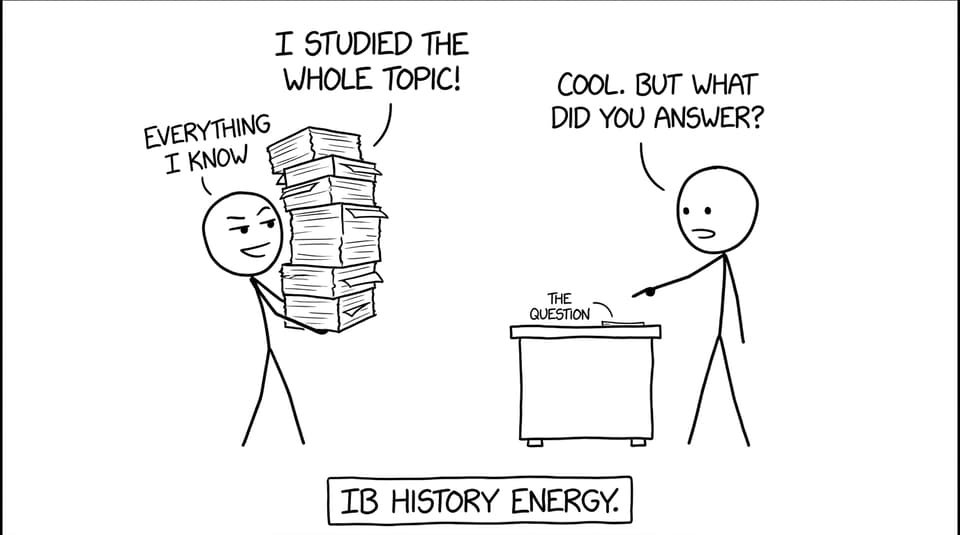
Quick checklist for FA 2028 essay upgrades
Use this before any timed response in IB History:
-
Can I rephrase the question into a one-sentence claim?
-
Did I identify the command term (e.g., evaluate, discuss, to what extent)?
-
Which concept is the engine: causation, change, significance, perspectives?
-
Is every paragraph answering the question, not the unit?
-
Did I evaluate inside paragraphs (not just at the end)?
-
Is my evidence selective and explained, not piled up?
For skill-focused pathways by paper, keep the IB History Resources hub open while you revise.
IB History essays are question-driven, not topic-driven
A traditional school essay often feels like a display cabinet: you show what you know about a topic. IB History essays are more like a courtroom: every point must serve a specific verdict.
Under FA 2028, exam questions are designed so that relevance is a marking skill. That changes how you should write:
-
Topic knowledge matters only if it directly answers the prompt.
-
Paragraphs that drift into “background story” become expensive.
-
The command term shapes what success looks like (analysis vs evaluation vs comparison).
If you struggle with drifting, practise with a structure-first approach from Mastering IB History Essay Structure and Planning. It trains the habit that matters most in IB History: staying married to the question.
Under FA 2028, argument beats information
In IB History, facts are not the product. They are the raw materials.
A high-scoring essay usually has fewer “interesting details” than a mid-scoring one. But it has something better: a clear line of argument that the examiner can follow at speed.
Practical shifts that help:
-
Write a thesis that answers the question directly (not “This essay will discuss…”).
-
Give each paragraph a mini-claim that supports your thesis.
-
Use evidence as proof, then explain what that proof shows.
If you want a paper-by-paper view of where argument matters most, see How To Ace IB History Paper 1 And Paper 2 Exams.
Concepts are no longer optional in IB History
FA 2028 pushes conceptual thinking to the surface. Examiners are watching for students who can use concepts as a tool, not a vocabulary list.
In IB History, that means your analysis should quietly revolve around ideas like:
-
cause and consequence
-
continuity and change
-
significance
-
perspectives and interpretations
The simplest way to make concepts visible is to build them into your topic sentences.
Instead of: “One reason for X was…”
Try: “A long-term structural cause of X was…, but its impact mattered less than…”
That one sentence signals concept plus evaluation, which is basically the currency of IB History essays.
For more clarity on why students miss this under FA 2028, read Why Students Struggle With IB History (FA 2028).
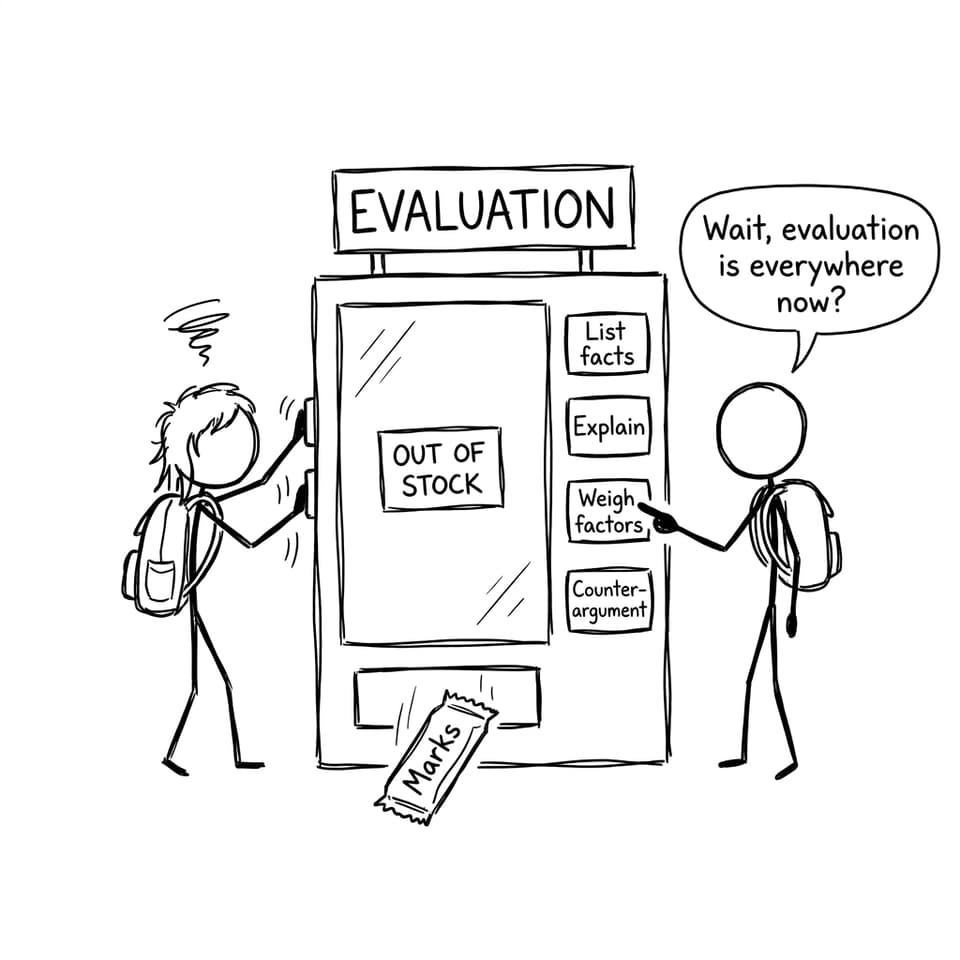
Evaluation must happen throughout, not just in the conclusion
Many students treat evaluation like a dessert: something you add at the end if you have time.
In FA 2028 IB History, evaluation is closer to the main ingredient. You are expected to weigh factors, judge significance, test claims, and acknowledge limits as you go.
A quick method that feels natural:
-
Claim (your point)
-
Proof (select evidence)
-
Explain (how it supports the claim)
-
Weigh (why it matters more/less than another factor)
That final “weigh” sentence is often the difference between description and top-band writing in IB History.
If you need to tighten how you respond to directive verbs, use How to Use IB Command Terms Effectively in Exam Responses alongside your practice.
Evidence must be selective and purposeful
The examiner is not impressed by volume. They are reassured by control.
In FA 2028 IB History, the best evidence is:
-
specific enough to prove a point
-
brief enough to keep momentum
-
followed by explanation (not left hanging)
A good rule is “two pieces of evidence per paragraph, max.” If you have more, you are probably collecting rather than arguing.
For broader exam preparation routines that reinforce this skill, see IB History Exam Prep: A Comprehensive Guide.
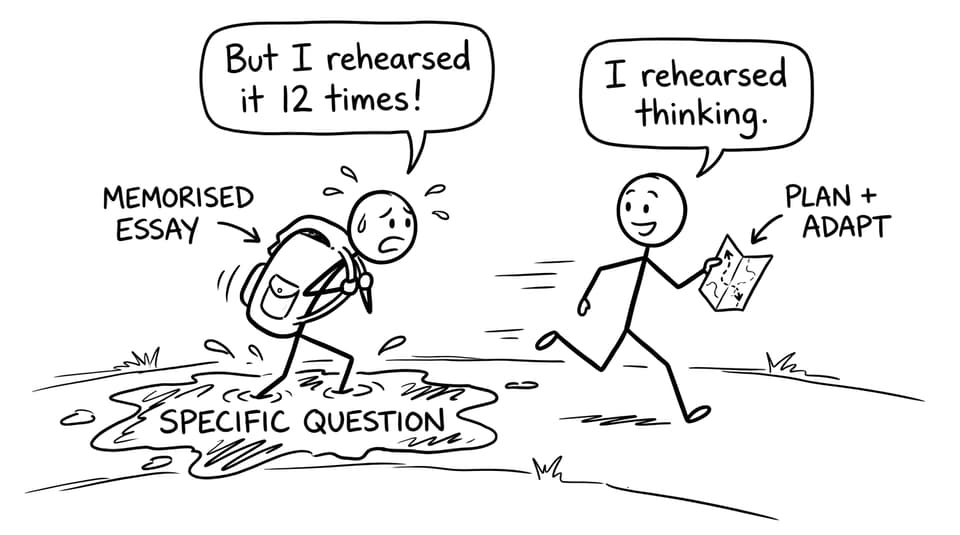
Why memorised essays break under FA 2028
Memorised essays feel safe because they reduce uncertainty. But IB History questions are built to punish that safety.
A rehearsed response tends to:
-
answer the topic, not the exact wording
-
force irrelevant material into paragraphs
-
miss the concept embedded in the prompt
-
sound fluent while being off-task
FA 2028 rewards flexible thinking: planning quickly, choosing the best arguments for that question, and adapting evidence on the spot.
How RevisionDojo turns IB History writing into a repeatable skill
The goal is not to “write beautifully.” It is to write in a way the IB History markscheme can reward.
RevisionDojo helps you practise that deliberately:
-
Questionbank to drill question types and command terms with exam-style prompts
-
Study Notes to learn content by concept (not just chronology)
-
Flashcards to turn weak evidence and key definitions into spaced recall
-
AI Chat to test your argument, challenge your counterargument, and refine your thesis
-
Grading tools to get rubric-aligned feedback when you draft essays and coursework
-
Predicted Papers and Mock Exams to practise timing and adaptability without guessing what matters
-
Coursework Library to see what strong inquiry looks like in real student work (useful for IA skills that transfer into essays)
-
Tutors when you want human feedback on clarity, evaluation, and structure
If you are doing coursework alongside essay practice, the inquiry mindset overlaps strongly with exam writing. This breakdown helps: IB History Internal Assessment Explained (FA 2028). You can also learn from real samples in the IB History Coursework Exemplars.
Closing: write like the course is marking you
FA 2028 does not make IB History essays “stricter” for the sake of it. It makes them clearer about what the course has always valued: question-driven argument, concept-led thinking, and evaluation that proves judgment.
If you train those skills intentionally, your writing stops being a performance and becomes a repeatable system. Use the IB History Resources hub to build that system with targeted practice, feedback, and exam-style routines--and walk into your next IB History essay knowing exactly what the examiner is looking for.