

IB History HL Regional Studies (FA 2028): the part that changes how you think
The night before a timed essay, many HL students make the same bargain with themselves: I’ll just learn a few more dates and everything will click. It feels responsible. It also quietly misses what IB History is actually testing in HL Regional Studies.
Regional Studies are demanding under First Assessment 2028 because they do not reward “more content” in a simple way. They reward control: selecting evidence, building judgment, and sustaining evaluation inside one region for long enough that your argument has weight.
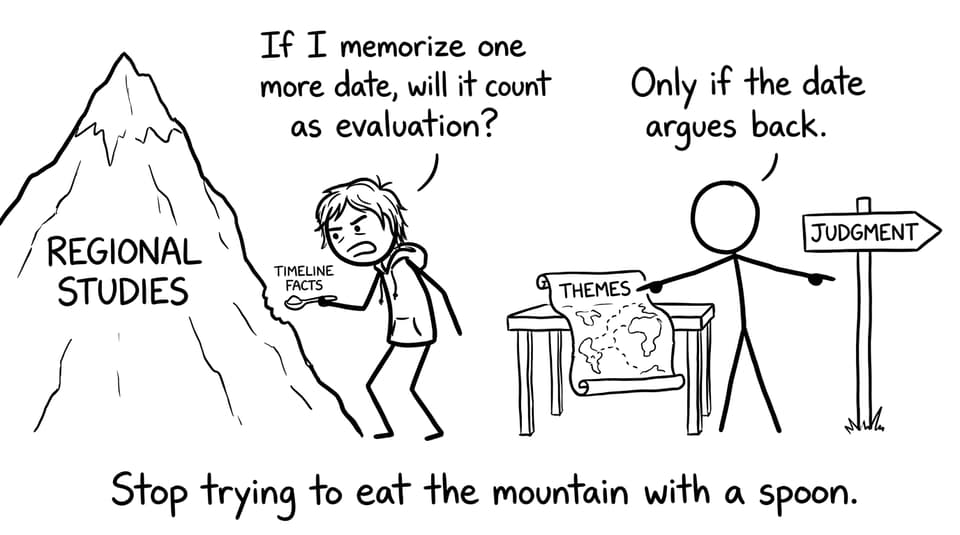
If you treat HL Regional Studies like an extra-large timeline, revision becomes exhausting. If you treat them like a framework for argument, IB History suddenly becomes more predictable.
Quick checklist: what you must understand about IB History Regional Studies
-
Regional Studies are HL-only depth in one region, designed to feed Paper 3
-
The goal is sustained evaluation, not broad coverage
-
“Depth” means causes, consequences, turning points, and perspectives (not just detail)
-
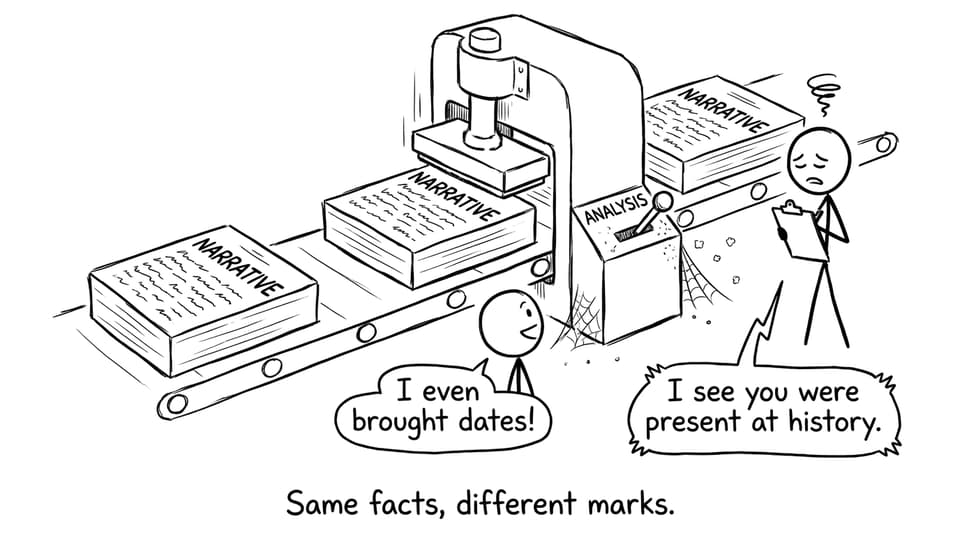
Strong essays sound like historical judgment, not story-time narration
-
Your revision should be built around themes and arguments, then tested with exam-style practice
For a course-level overview, keep the IB History Resources hub open while you plan.
What are HL Regional Studies in IB History?
In IB History HL, Regional Studies are in-depth investigations of historical developments within a defined region. Think of them as the place where you stop sampling and start committing: you build context, track change over time, and learn to explain why historians disagree.
They are designed to help you:
-
Build deep regional context (political, economic, social)
-
Use evidence selectively to support evaluation
-
Make comparisons within a region across case studies
-
Write the kind of sustained essays required for Paper 3
On RevisionDojo, this connects directly to the HL pathway for Paper 3 options, such as Paper 3: History of Asia and Oceania or Paper 3: History of Europe.
Why IB History HL Regional Studies exist (and why they feel harder)
Regional Studies exist because HL is meant to separate “I know what happened” from “I can judge what mattered.” Under FA 2028, that difference is less negotiable.
In IB History, you are rewarded for:
-
Explaining competing causes without flattening complexity
-
Weighing significance (what mattered most, and why)
-
Handling continuity and change across longer arcs
-
Acknowledging perspective and interpretation without losing focus
If you want a clean explanation of the conceptual shift, read IB History: The 4 Key Concepts for FA 2028. Those concepts are the invisible skeleton of great Regional Studies essays.
Regional Studies vs Focused and Thematic Studies in IB History
Students often revise the wrong way because they blend the study types together.
Focused Studies
Focused Studies are tight and case-driven. You go deep, but in a narrower lane.
Thematic Studies
Thematic Studies are built for comparison across contexts. You practice patterns: similarity, difference, and change.
Regional Studies (HL)
Regional Studies in IB History HL require sustained depth within one region, with enough breadth to synthesise across developments, but not so much that you become descriptive.
That synthesis is why Regional Studies are the backbone of IB History Paper 3 strategies.
What “depth” means in IB History HL Regional Studies
Depth is not the same as detail.
In IB History, depth looks like:
-
You can explain mechanisms (how a policy, ideology, or institution produced outcomes)
-
You can trace consequences over time (short term vs long term)
-
You can evaluate trade-offs (stability vs repression, growth vs inequality)
-
You can use a historian’s view as a tool, not a decoration
A useful test: if someone removed your dates, would your paragraph still make sense? If the answer is yes, you likely have analysis. If the answer is no, you likely have a timeline pretending to be an essay.
How IB History HL Regional Studies are assessed (Paper 3 reality)
Regional Studies show up most clearly in Paper 3 (HL only). This is where the examiner is asking: can you build three sustained arguments under pressure, using evidence that is relevant and weighed?
Use these as your anchor pages:
And when you want topic-specific depth, RevisionDojo’s Study Notes help you build clean, structured understanding, like Paper 3: History of the Americas Notes.
The most common IB History Regional Studies mistakes (and the fix)
Mistake: revising “everything”
Fix: revise a smaller set of case studies, but attach them to multiple themes (causation, change, significance, perspective).
Mistake: narrative essays
Fix: start each body paragraph with a claim that answers the question, then prove it with evidence.
Mistake: hiding from evaluation
Fix: add a “however” sentence in every paragraph that weighs limits, trade-offs, or alternative explanations.
Mistake: practicing too late
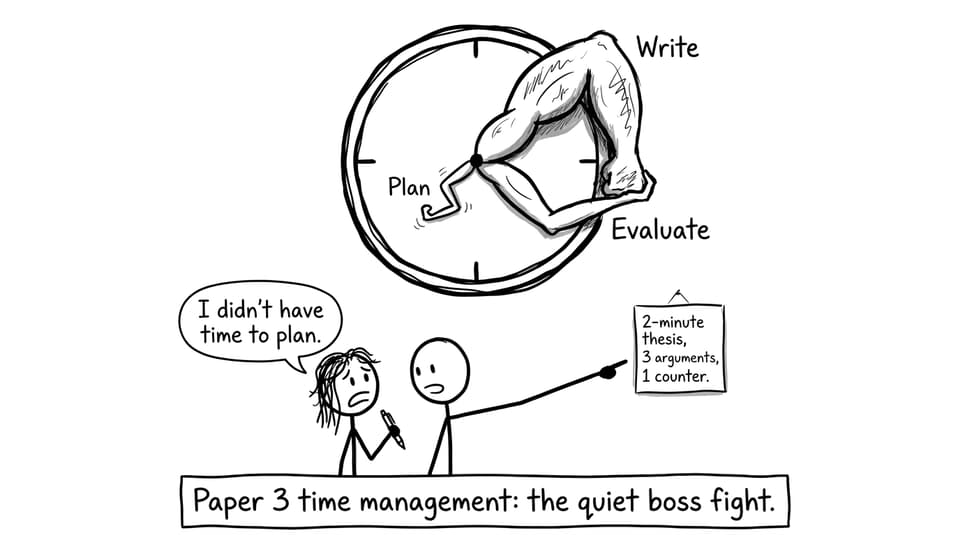
Fix: use short loops: plan (2 minutes), write (10), review (5), then repair.
To systemise practice, combine IB History Essay Structure: Plan Fast, Write Better with RevisionDojo’s Questionbank and Grading tools.
A simple revision approach for IB History HL Regional Studies
Here is a practical weekly routine that keeps IB History Regional Studies manageable:
-
Build: read and condense one theme using RevisionDojo Study Notes
-
Lock: convert it into Flashcards (turning points, debates, definitions)
-
Apply: do 10--15 Questionbank prompts focused on that theme (not random)
-
Write: one timed plan or one timed essay
-
Review: use AI Chat + Grading tools to spot missing evaluation and weak relevance
If you need a broader exam map (Paper 1 to Paper 3), use IB History Exam Prep: A Comprehensive Guide.
FAQ: IB History HL Regional Studies (FA 2028)
Are HL Regional Studies harder than Thematic Studies in IB History?
They are usually harder in a different way. In IB History, Thematic Studies can feel broad because you compare across contexts and need flexible examples. HL Regional Studies feel heavy because you must sustain depth inside one region for long essays. The challenge is not “more content” but “more control.” You have to decide what matters most, and defend that judgment clearly. If you revise with themes and arguments, Regional Studies become predictable rather than overwhelming. If you revise as a timeline, they become endless.
Do I need to compare countries within my region for IB History Paper 3?
Often, yes, and it is usually a strength even when not explicitly demanded. In IB History, comparison helps you show you understand patterns, not just isolated stories. It also gives you a natural way to evaluate: you can weigh why one policy succeeded in one context and struggled in another. That said, comparison should serve the question, not hijack it. Use it like seasoning: enough to sharpen the argument, not enough to change the whole dish. RevisionDojo’s Paper 3 resources and Study Notes make this easier by keeping case studies clearly separated and theme-tagged.
Can I score highly in IB History HL Regional Studies without memorising huge amounts of detail?
Yes, and many top students do exactly that. IB History rewards relevant evidence used for evaluation, not maximal recall. A few precise examples, attached to clear claims, will usually outperform pages of narrative. The key is to memorise “high-leverage” evidence: turning points, key policies, and a couple of historians’ interpretations you can deploy quickly. Then practise using that evidence in timed plans so selection becomes automatic. Tools like RevisionDojo Flashcards, Questionbank, and AI Chat help you keep evidence sharp without drowning in notes.
Final thoughts: make IB History Regional Studies your advantage
HL Regional Studies are where IB History stops being about coverage and starts being about judgment. Under First Assessment 2028, that shift is the point.
If you want the calm version of HL revision, build a system: Study Notes for clarity, Flashcards for retention, Questionbank for application, Mock Exams and Predicted Papers for realism, Grading tools for feedback, AI Chat when you stall, and Tutors when you need a human to tighten your argument.
Start with the IB History Resources hub, then practise one theme at a time until evaluation becomes your default.