
Starting IB DP1 changes the meaning of an ordinary Tuesday evening. One moment, you are checking a message. The next, you remember there is Biology vocabulary to learn, a Mathematics problem set to finish, and an English passage to annotate.
Your phone can help with all three. It can also make all three disappear beneath notifications, videos, and tabs you never intended to open.
The answer is not to abandon your phone. If you want to study on phone effectively, give every session one small purpose, remove the obvious escape routes, and use active tasks rather than passive scrolling. For a new IB student, a focused 15-minute mobile session can be more useful than an unfocused hour surrounded by open apps.
This guide shows you how to build that habit before DP1 becomes crowded.
Your phone study checklist
Before opening any study resource, decide what success will look like.
- Choose one subject and one topic.
- Set a task that can be completed in 10-25 minutes.
- Turn on Focus mode or Do Not Disturb.
- Use Flashcards, questions, or recall prompts rather than rereading alone.
- Record mistakes somewhere you can revisit.
- Stop when the task is complete.
That final point matters. Mobile study works best when it is bounded. You are not trying to turn every spare minute into schoolwork. You are creating a reliable way to review one idea when a laptop or desk is unavailable.
If the Diploma Programme still feels unfamiliar, start with what to expect during the first few weeks of DP1. A study tool becomes much easier to use once you understand the rhythm it needs to support.
Give each phone session one job
The problem with saying “I will revise Chemistry” is not laziness. It is scale. Chemistry is too large to begin, so the mind reaches for something smaller and easier, usually a notification.
Replace the subject-level intention with a visible action:
- Recall five definitions from cell biology.
- Complete three algebra questions without notes.
- Identify two authorial choices in one English extract.
- Review the causes of one historical event.
- Explain one economic diagram aloud.
A useful phone session begins with a finish line. This is especially important in IB DP1, when students are still learning how much depth each subject requires. The goal is not to “finish revision.” It is to complete one loop of learning.
RevisionDojo is designed around that loop. You can use Study Notes to clarify an idea, Flashcards to retrieve it, the Questionbank to apply it, and AI Chat to investigate the point where your reasoning breaks down. Instead of moving between unrelated websites, each tool supports the next decision.
For a broader system, see how RevisionDojo supports IB DP1 students.
Remove distraction before relying on discipline
A notification is a decision arriving uninvited. Even if you ignore it, you have briefly considered it. That is why a good mobile study routine changes the environment before the session begins.
Use this setup:
- Turn on Focus mode or Do Not Disturb.
- Allow calls only from people who may genuinely need you.
- Hide social and entertainment apps from the first home screen.
- Close unrelated browser tabs.
- Place the study app beside your timer.
- Keep the phone out of your hand when reading a longer explanation.
You can also use a separate study home screen containing only RevisionDojo, a calendar, a timer, and any school platform you need. The change is small, but it removes several invitations to drift.
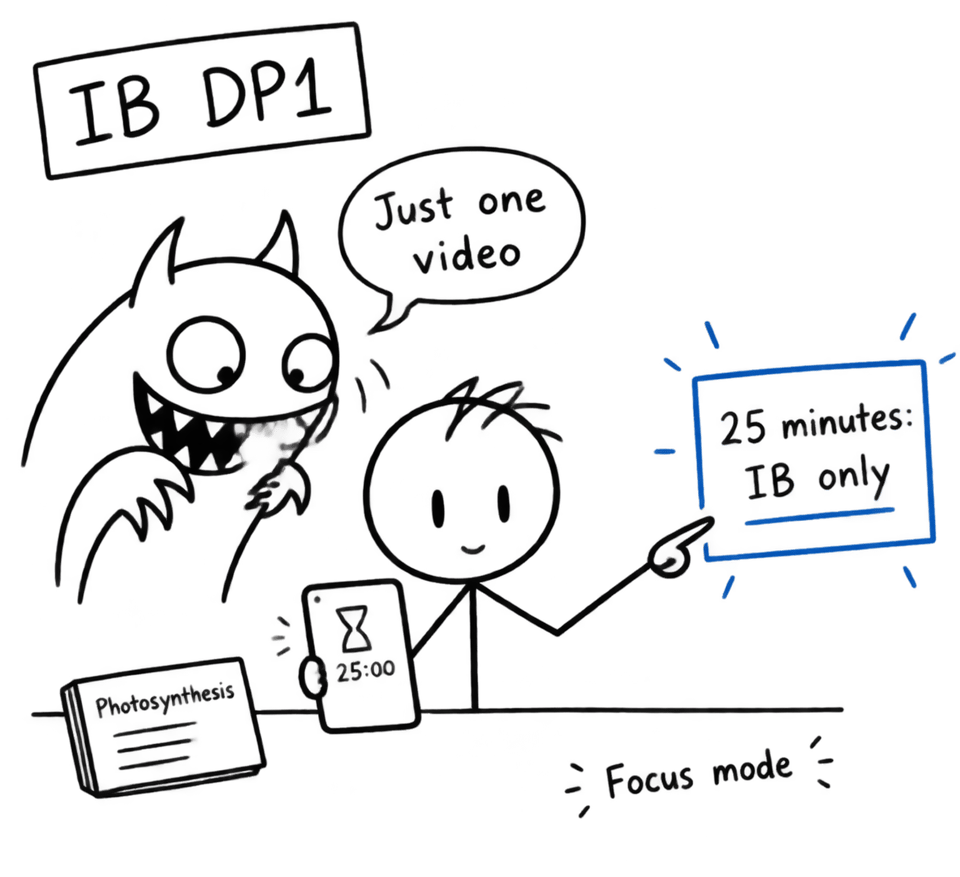
The deeper principle is simple: do not ask self-control to solve a problem that settings can solve first. Discipline is useful, but friction is more dependable. Make distracting apps slightly harder to reach and the correct action slightly easier.
Use active study methods on a small screen
Phones are excellent for short interactions. They are less effective when they encourage endless reading. The difference is whether your mind must produce an answer.
Retrieve before revealing
When using IB Flashcards and spaced repetition, read the prompt and pause. Say or type the answer before turning the card over. If you reveal it immediately, familiarity can feel like knowledge even when you could not have recalled the idea independently.
Keep cards narrow. “Explain photosynthesis” is too broad for one card. A better prompt might ask, “Where do the light-dependent reactions occur?” Specific prompts make mistakes easier to diagnose.
RevisionDojo’s guide to using flashcards for effective revision offers a fuller method for building this habit.
Turn notes into questions
Study Notes and topic Flashcards serve different purposes. Notes help you understand an explanation. Questions reveal whether you can reconstruct it.
After reading a short section, close it and ask:
- What was the central claim?
- Which term could I define precisely?
- What example would demonstrate the idea?
- Which step would I forget under pressure?
For IB English, you might read a short explanation of tone and then identify tonal shifts in a paragraph. For Economics, sketch a diagram from memory on paper before checking the labels on your phone. For Mathematics, read a worked method, hide it, and reproduce the steps yourself.
Apply knowledge with questions
Retrieval tells you whether an idea is available. Application tells you whether you can use it.
Complete a small Questionbank set and inspect why each incorrect answer failed. AI grading tools can provide another layer of feedback when you practise a structured response, but feedback is useful only if it changes the next attempt. Save the error, rewrite the weak step, and test it again later.
As DP1 progresses, this same system can expand into Predicted Papers and Mock Exams under timed conditions. Those longer tasks usually belong at a desk, not on a bus. The phone is better used to prepare the knowledge and review the errors that those assessments expose.
Match the device to the task
Studying on your phone does not mean doing everything on your phone. Good IB study depends partly on choosing the right surface.
| Use your phone for | Move to a desk for |
|---|---|
| Flashcard review | Full timed responses |
| Short Study Notes | Extended essay drafting |
| Small Questionbank sets | Multi-step calculations |
| Reviewing saved errors | Detailed data analysis |
| Asking AI Chat a focused question | Coursework editing and source management |
| Planning the next session | Complete Mock Exams |
This distinction prevents convenience from becoming compromise. A phone is useful for starting, reviewing, and checking. Complex writing often needs more space, sustained attention, and easier comparison between sources.
RevisionDojo’s Coursework Library and Tutors become particularly helpful when a task requires models, structured guidance, or human explanation. Use mobile study to identify the difficulty, then move to the appropriate tool rather than squeezing a major assignment into a tiny screen.
A stable physical setup still matters too. The guide to building a DP1 study space that lasts explains how desk study and flexible study can support each other.
Build phone study into the IB week
New IB students often make one of two mistakes. They either wait until an assessment creates urgency, or they build a schedule so ambitious that it survives for three days.
A better plan attaches short phone sessions to moments that already exist:
- On the journey home: review one Flashcard deck.
- Before homework: read the Study Notes for the topic.
- After class: save one confusing idea for AI Chat or your teacher.
- While waiting: complete three focused questions.
- Before bed: plan tomorrow, but avoid turning bedtime into an unbounded revision session.
These sessions should support your main study, not replace it. If you are unsure how mobile review fits into the larger week, how much to study outside class in DP1 provides a more balanced starting point.
Track completed tasks rather than vague hours. “Reviewed Topic 2 flashcards and corrected three mistakes” tells you something useful. “Studied for 40 minutes” does not reveal what changed.
A 20-minute routine you can start today
Choose one topic from a lesson you had this week. Then follow this sequence:
- Minutes 0-2: Turn on Focus mode and write one outcome, such as “recall the stages of mitosis.”
- Minutes 2-7: Read the relevant Study Notes, stopping after each short section to summarize it mentally.
- Minutes 7-13: Review the topic Flashcards. Answer before revealing each card.
- Minutes 13-18: Complete two or three Questionbank questions.
- Minutes 18-20: Save mistakes and write the first task for your next session.
If a concept remains unclear, ask AI Chat one precise question. Avoid asking for an entire topic to be explained when the real difficulty is one term, assumption, or calculation step.
Then stop. A routine becomes sustainable when completion feels normal, not heroic.
Let the phone be a doorway, not a destination
The best IB study tips are rarely dramatic. They remove uncertainty. They help you know what to open, what to do, and when to finish.
Your phone can become a distraction machine or a dependable revision tool. Often, the difference is one notification setting and one clearly defined question.
RevisionDojo brings the IB process into one connected place, from Study Notes, Flashcards, the Questionbank, and AI Chat to Grading tools, Predicted Papers, Mock Exams, the Coursework Library, and Tutors. You do not need every feature in every session. You need the right one for the next learning decision.
To begin, choose a topic you studied this week and open RevisionDojo’s Flashcards. Save that topic deck to your free account. It will give tomorrow’s phone session a clear starting point, which is often the most useful advantage a study system can provide.