



The practical answer is about 8-12 focused academic hours per week outside class during the first term of DP1, including assigned homework, review, and assessment preparation. Start near the lower end in September. Add time only when deadlines, results, or unfinished work show that you need to.
That number is a starting point, not an IB rule. The IB recommends 240 teaching hours for each Higher Level subject and 150 hours for each Standard Level subject, but it does not prescribe universal weekly homework hours. Schools organise the programme differently, and students bring different subjects, commutes, activities, and prior knowledge.
The better question is not simply how long you studied. It is whether your routine kept current work under control while preserving enough energy to learn tomorrow.
Your DP1 fall term checklist
Use this September-to-November baseline:
- Schedule 8-12 focused hours outside class each week.
- Include assigned homework within that total.
- Give each HL subject slightly more time than each SL subject.
- Review material within 24-48 hours of learning it.
- Reserve a weekly block for TOK, CAS administration, or early coursework.
- Keep one evening mostly free and protect your sleep.
- Review the plan every Sunday using deadlines and feedback.
The RevisionDojo guide for DP1 students offers a useful starting system.
Why there is no perfect number
Two students can both study for ten hours and have completely different weeks. One may spend eight hours rewriting notes. The other may spend four learning, four applying knowledge, and two reviewing mistakes. The clocks agree, but the learning does not.
DP1 also arrives unevenly. Mathematics may demand consistent problem practice, while a language needs shorter, frequent contact. An essay-based subject can remain quiet and then produce substantial reading or writing. Your timetable should reflect that unevenness.
A sensible initial allocation looks like this:
| Area | Suggested weekly time in early DP1 |
|---|---|
| Three HL subjects | 4-6 hours combined |
| Three SL subjects | 2.5-4 hours combined |
| TOK and early coursework actions | 0.5-1 hour |
| Weekly review and planning | 0.5 hour |
| Flexible deadline buffer | 0.5-1 hour |
These are planning ranges, not entitlements. If compulsory work already fills your available time, your reality overrides the table. Speak with teachers or your DP coordinator if the workload repeatedly makes sleep, attendance, or recovery impossible.
How much should you be studying outside class each day?
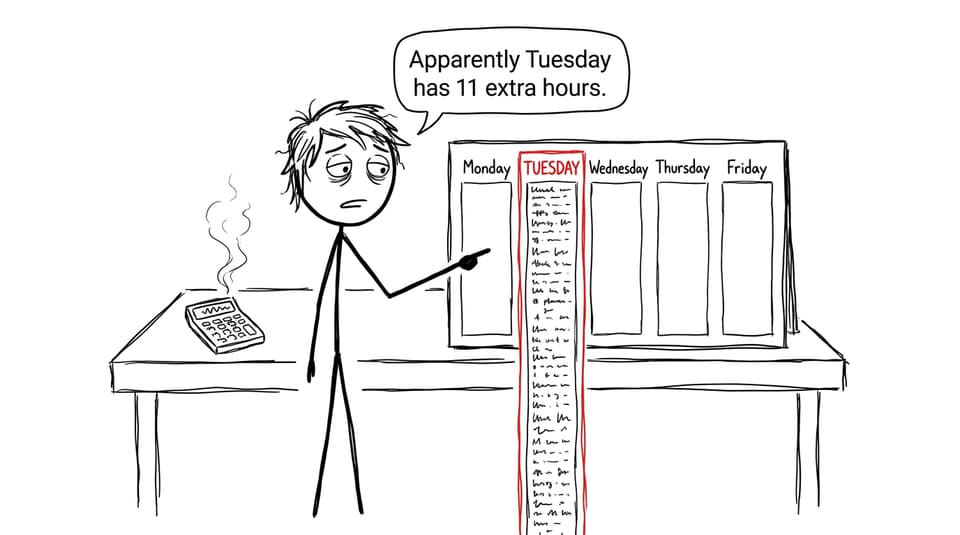
For most new DP1 students, the weekly total matters more than studying the same amount daily. A practical week might contain 60-90 minutes on four weekdays, a short Friday review, and 2-3 deeper weekend blocks.
| Day | Study pattern |
|---|---|
| Monday | 45 minutes HL practice, 20 minutes recall |
| Tuesday | 45 minutes assigned work, 30 minutes SL review |
| Wednesday | 60 minutes HL work, then stop for an activity |
| Thursday | 45 minutes questions, 30 minutes corrections |
| Friday | 20-30 minutes recall and weekly tidy-up |
| Saturday | Two 60-minute focused blocks |
| Sunday | One 60-minute block and 20 minutes of planning |
This totals roughly 8-9 hours. A deadline-heavy week might require another two or three blocks.
For more examples, use RevisionDojo’s balanced IB study schedule or organise movable tasks with the IB Study Planner.
Adjust the plan from September to November
September: build the machinery
September is not the month to prove how much exhaustion you can tolerate. Establish where deadlines live, how teachers assess work, and which subjects need frequent practice.
Begin with 7-9 focused hours if your assigned workload allows it. Use one calendar and review each new topic during the same week. The goal is to prevent confusion from becoming backlog.
Use IB Flashcards with spaced repetition for definitions, formulas, vocabulary, processes, and quotations. Ten minutes of retrieval across several days is more useful than a long session making decorative notes.
October: respond to evidence
By October, early tests and teacher comments reveal what your timetable could not predict. Move toward 8-11 hours if needed, but add time selectively.
If Chemistry questions are slow, add Chemistry practice. If your History knowledge is secure but your essays lack judgement, practise planning arguments instead of rereading chapters. Feedback should change your next action.
RevisionDojo’s Questionbank, Study Notes, Flashcards, and AI Chat create a connected loop. Clarify a point in Study Notes, retrieve it, apply it to a targeted question, and use AI Chat to investigate a misunderstanding. The guide to using an IB Questionbank effectively explains how to make practice diagnostic.
November: prepare for workload collisions
November often feels different because tasks overlap. A test, presentation, CAS administration, and early research conversation may appear in the same week.
Move toward 10-12 hours when deadlines justify it, using a buffer block instead of sacrificing sleep. Teenagers generally need 8-10 hours of sleep per day. A timetable that regularly depends on midnight work needs revision.
RevisionDojo’s time management tools for IB students can turn broad intentions into specific blocks.
Make each hour produce evidence
A focused hour should leave evidence: completed questions, recalled information, an improved paragraph, corrected errors, or a clearer explanation. “Read Biology” is not an outcome. “Answer eight cell respiration questions and correct every error” is.
Try this 60-minute structure:
- 10 minutes: retrieve the topic without notes.
- 15 minutes: use Study Notes to repair precise gaps.
- 25 minutes: complete relevant Questionbank practice.
- 10 minutes: check feedback and record the next step.
Later in DP1, RevisionDojo’s Grading tools and Coursework Library can support criterion-based draft improvement. Predicted Papers and Mock Exams become valuable after you have covered enough content for timed practice. If a misunderstanding survives several attempts, Tutors can identify whether the problem is knowledge, technique, or planning.
The RevisionDojo app workflow for IB preparation connects understanding, recall, application, feedback, coursework support, and timed practice in one system.
Signs that your study total needs changing
Add one or two weekly blocks when:
- assignments are repeatedly finished at the last minute;
- you understand lessons but cannot answer questions independently;
- old topics disappear from memory within weeks;
- feedback identifies the same weakness repeatedly;
- an assessment or formal deadline is approaching.
Reduce or redesign the workload when:
- you regularly lose sleep to routine homework;
- hours increase but completed work does not;
- most study consists of passive rereading;
- you cannot maintain activities, meals, or downtime;
- exhaustion makes classroom learning less effective.
Sometimes the solution is more time. Often it is a clearer task. The ultimate daily IB study schedule can help separate light recall from focused work.
A sustainable start matters more than a dramatic one
In the IB DP1 fall term, 8-12 focused hours outside class is a reasonable starting range for many students. Your assignments, subjects, and performance should decide where you sit within it.
Plan the week, complete specific tasks, inspect the evidence, and adjust calmly. RevisionDojo supports that process through its Questionbank, Study Notes, Flashcards, AI Chat, Grading tools, Predicted Papers, Mock Exams, Coursework Library, and Tutors.
You do not need to win DP1 in September. Build a routine that still works in November and remains strong enough to carry you into everything that follows.