

The first few weeks of DP1 rarely feel as dramatic as students expect. September may even seem manageable. Teachers introduce courses, deadlines remain distant, and your new folders are still organized.
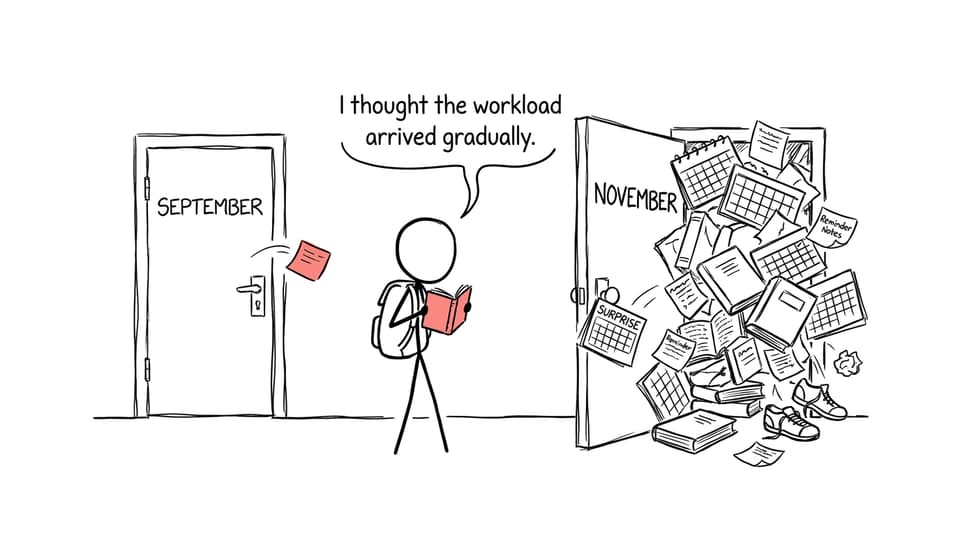
Then October arrives. One test goes badly, several subjects accelerate, and CAS begins competing with ordinary homework. By November, the problem is usually not one impossible task. It is the accumulation of ten small responsibilities that were easy to postpone.
That is what nobody tells you about the first few weeks of DP1: workload does not always look like workload. It begins as reading, unfamiliar terminology, administrative decisions, and minor unfinished tasks. Your priority from September to November is not maximum intensity. It is building a system that catches small problems before they become expensive ones.
Your DP1 fall term checklist
By the end of November, aim to have:
- Confirmed every subject and level, including university prerequisites
- Recorded tests, deadlines, CAS commitments, and core milestones in one calendar
- Learned how teachers apply command terms and assessment criteria
- Established a short weekly review for every subject
- Started one sustainable CAS routine
- Created an error log for assessments and practice questions
- Asked for help with recurring foundational gaps
- Protected enough sleep, movement, and unstructured time to remain functional
You do not need a color-coded plan for the next two years. You need a dependable next week.
September is for calibration, not proving yourself
The Diploma Programme combines six subjects with Theory of Knowledge, the Extended Essay, and Creativity, Activity, Service. Students ordinarily take three or four subjects at Higher Level, with the remainder at Standard Level. This breadth creates a trap: every class can feel equally urgent during the first month.
Use September to learn the shape of each course. Find out how frequently you will be assessed, which response types appear, how teachers organize resources, and where HL expectations differ from SL. The complete guide to IB classes can help you map the programme, but your school calendar and teachers remain the authority for local requirements.
Create one page for each subject with five fields:
- Current topic
- Next assessed task
- Most confusing concept
- Common command terms
- One action for this week
This is also the moment to question a subject choice that feels structurally wrong. Difficulty alone does not prove that you chose badly. However, a missing university prerequisite, persistent lack of foundational knowledge, or serious mismatch with your goals deserves a prompt conversation with your coordinator. Waiting makes a possible change more disruptive.
Early grades are information, not identity
Your first DP1 assessment can be unsettling because IB-style questions often reward something more precise than general understanding. You may know the topic yet fail to answer the command term, show a method, develop an argument, or use evidence effectively.
A disappointing grade can therefore carry two different messages. You might have a knowledge gap, or you might not understand how knowledge must be expressed in that subject. Treating both as “I am bad at this” wastes useful information.
Sort lost marks into four categories:
- Knowledge: You did not know or recall the content.
- Interpretation: You misunderstood the prompt or command term.
- Method: You understood the idea but used the wrong process.
- Communication: Your reasoning, evidence, units, or structure was unclear.
Then make one repair. Use Study Notes for a content gap, Flashcards for retrieval, or the Questionbank for targeted application. RevisionDojo’s guide to building a DP1 study system explains how to connect these tools without turning every evening into a revision marathon.
October exposes weak systems
September rewards enthusiasm. October rewards repeatability.
By this point, novelty has faded and subjects are moving at different speeds. Students often respond with a punishing timetable that looks impressive on Sunday and collapses by Wednesday.
Build a smaller routine instead. On most school days, complete 10-15 minutes of retrieval for one or two subjects. Several times each week, pair a short explanation with focused questions. Once a week, inspect your mistakes and calendar. The IB time-management guide recommends defining study blocks through observable outcomes rather than vague intentions.
“Study biology” has no finish line. “Explain membrane transport from memory and answer five related questions” does.
A practical RevisionDojo loop looks like this:
- Understand: Clarify one concept with Study Notes or AI Chat.
- Retrieve: Close the explanation and recall it with Flashcards.
- Apply: Attempt a small Questionbank set without assistance.
- Diagnose: Use feedback or Grading tools to identify why marks were lost.
- Revisit: Return to the weakness later instead of immediately rereading everything.
Predicted Papers and full Mock Exams become valuable when you have enough content and assessment knowledge to use them meaningfully. In early DP1, topic-level practice is generally more useful than testing material you have not been taught.
The core feels optional until it does not
TOK, the Extended Essay, and CAS can seem less urgent because they do not resemble ordinary lessons. Yet all are required diploma components. TOK and the Extended Essay can contribute up to three additional points together, while CAS does not add points but must be completed.
Your school may introduce these components on its own schedule, so do not invent milestones your coordinator has not assigned. Build low-friction habits instead.
For CAS, choose experiences that fit your life and record evidence or reflections while details are fresh. The calm guide to CAS offers a useful starting point. For TOK, collect specific examples that make you question how claims are justified. For the Extended Essay, follow your school’s timeline while noticing subjects you might investigate through genuine evidence.
The guide to IB core requirements explains how these pieces fit together. Later, the Coursework Library can help you examine structure and expectations, while Tutors can support persistent problems. These resources should guide your thinking, never replace your own work or your school’s academic-integrity rules.
November makes accumulation visible
By November, a small backlog begins charging interest. An unclear algebra technique affects the next unit. Missing notes make a test harder to prepare for. An unrecorded CAS experience becomes difficult to reflect on accurately.
Do not try to catch up on everything at once. Run a weekly reset:
- List every unfinished task.
- Mark what has a real deadline or blocks future learning.
- Select the three most consequential actions.
- Give each action a first step lasting 25-45 minutes.
- Ask for help when the list remains unmanageable.
This is triage, not failure. The guide to handling IB Year 1 overwhelm can help distinguish a temporary busy week from a routine that needs redesigning.
A calm DP1 is built one week at a time
You do not become organized before DP1 begins. You become organized by noticing the consequences of disorganization and adjusting early. Confidence follows the same pattern. It often arrives after repeating a useful process, not before.
Keep one calendar. Learn in small units. Retrieve before rereading. Apply knowledge through questions. Review mistakes without turning them into a verdict on your ability. Keep the core moving through modest, school-aligned actions.
RevisionDojo can hold that system together as the ultimate IB resource: Study Notes and AI Chat for clarity, Flashcards for recall, the Questionbank for application, and Grading tools for feedback. As your courses progress, Predicted Papers, Mock Exams, the Coursework Library, and Tutors can support the next stage.
That is how a calm DP1 begins. Not with control over the entire two-year journey, but with a reliable way to take the next step.