



Setting up study space works when the space makes useful actions easier. For a new IB Diploma student, that means creating somewhere comfortable enough for regular work, simple enough to reset quickly, and flexible enough for six subjects, the DP core, and changing deadlines.
You do not need an expensive desk or a room worthy of a productivity video. You need a reliable place where you can begin without spending 20 minutes finding a charger, moving clutter, or deciding what to study.
The best time to build that system is during the IB DP1 fall term. September reveals your routine. October exposes friction. November gives you enough evidence to improve the setup before heavier assessments and coursework arrive.
Your two-year study space checklist
Start with these essentials:
- A consistent location that is available most days
- A stable surface with room for one active task
- A chair that supports a comfortable, neutral posture
- Lighting that illuminates paper without screen glare
- Frequently used materials within easy reach
- A permanent home for your phone during focused work
- One calendar for deadlines and study blocks
- A tray or folder for unfinished tasks and loose papers
- A weekly five-minute reset
- A backup location for disrupted days
If you are organizing the wider transition into Diploma study, use RevisionDojo’s guide to preparing for the transition from MYP to DP. Your desk and routine should develop together.
Why setting up study space works around behavior
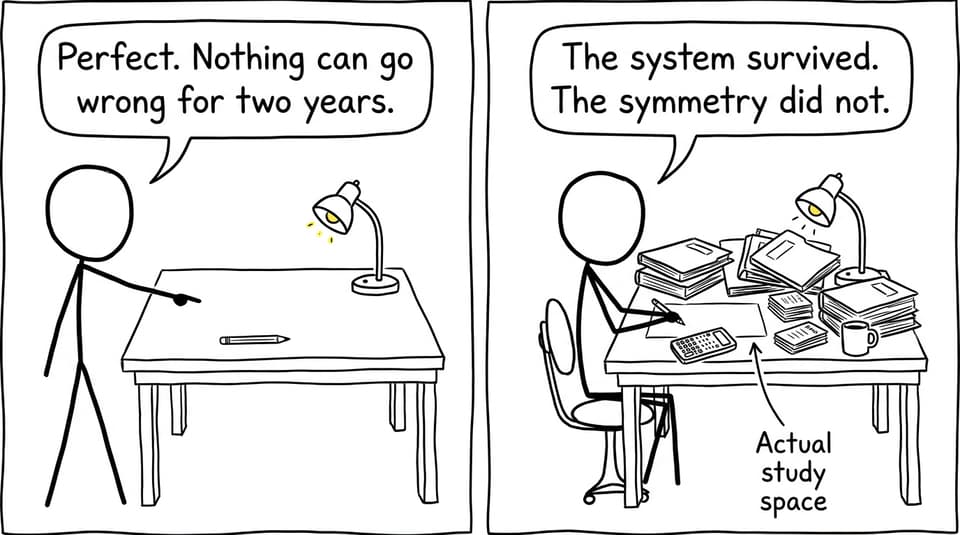
A study space is not successful because it always looks tidy. It succeeds because starting feels obvious.
Imagine arriving home after a long Wednesday. One desk requires you to remove laundry, find a calculator, open several platforms, and choose among six subjects. Another has a clear working area, a visible task, and the correct book nearby. The second desk has not created motivation. It has simply asked less of your tired brain.
Use the same location when possible, then establish a short starting ritual:
- Put your phone in its assigned place.
- Open only the material needed for the task.
- Define the intended output, such as “answer five genetics questions.”
- Complete one focused block.
- Record errors or the next action before leaving.
Adapt the methods in RevisionDojo’s IB time-management guide. A defined output is more useful than an open-ended instruction to “study Biology.”
Make comfort adjustable, not complicated
You may spend hundreds of hours at this workspace across DP1 and DP2. Small discomforts deserve attention early.
Support your lower back, keep your feet on the floor or a stable footrest, relax your shoulders, and place frequently used items within comfortable reach. Position your screen directly in front of you at a distance that allows you to read without leaning forward. Its top should generally sit around eye level or slightly below it.
Raising a laptop on books or a basic stand can improve screen height, although longer typing sessions may then require a separate keyboard and mouse. Test the setup before buying accessories, then change one limitation at a time.
September daylight can hide problems that November evenings reveal. Use an adjustable lamp that lights the page evenly, and position screens to avoid direct reflections. Change position regularly and walk between demanding blocks. Persistent pain, headaches, or eye discomfort should be discussed with a parent, guardian, teacher, or relevant health professional.
Divide the space into three zones
An IB desk may hold a mathematics problem set today, literature annotations tomorrow, and an Internal Assessment draft later. Three simple zones prevent those activities from colliding.
The active zone
Protect the area directly in front of you for the current task, necessary tools, and perhaps water. A large desk is unnecessary. One clear rectangle is enough.
The reference zone
Keep one book, formula booklet, note page, or digital resource beside the active area. Limiting references prevents every question from becoming another open tab.
The holding zone
Use one tray, folder, or shelf for materials that need later attention. During the weekly reset, file, schedule, or discard each item rather than letting worksheets occupy the active zone.
RevisionDojo’s IB study space setup guide offers further ideas for adapting a bedroom corner, shared table, or library routine.
Build a digital study space too
Physical order cannot compensate for digital noise. Notifications and unnecessary task switching create repeated invitations to abandon difficult work. Make those distractions slightly harder:
- Put your phone out of sight and reach during focused blocks.
- Allow calls from essential contacts if necessary.
- Disable nonessential computer notifications.
- Keep one task tab and one reference tab open.
- Capture unrelated thoughts on a “later” list.
- Check messages between blocks rather than during them.
Digital filing should be equally plain. Create one top-level folder for each subject, plus folders for TOK, the Extended Essay, and CAS. Follow your school’s naming conventions and include dates in important filenames so that “final,” “final2,” and “actualfinal” do not become a two-year archive.
A planner works when it separates fixed deadlines from the sessions required to meet them. The RevisionDojo guide to choosing an IB study planner explains how to connect a calendar with specific revision tasks.
Test the setup from September to November
Do not treat the September setup as permanent. Treat it as version one.
| Period | What to observe | What to change |
|---|---|---|
| September | Where and when you naturally begin work | Choose a primary location and starting routine |
| October | Which items, sounds, apps, or people interrupt you | Remove recurring friction and establish boundaries |
| November | Which assignments require different tools | Add storage, a longer-work option, and a backup location |
During September, prioritize availability. A modest desk you can use reliably is more valuable than a beautiful room that is rarely quiet.
During October, notice patterns instead of blaming yourself. If you repeatedly leave for stationery, store it nearby. If family interruptions are common, agree on a visible focus signal. If difficult tasks trigger avoidance, make the first action smaller and more concrete.
During November, prepare for variety. Flashcard reviews require a different environment from a timed essay or sustained coursework draft. Identify a library, classroom, or quiet household location that can serve as your backup.
Connect the desk to an IB study loop
A desk becomes valuable when every session has a next step. RevisionDojo, the ultimate IB resource, keeps that sequence within one connected ecosystem.
Begin with Study Notes to clarify a concept. Use Flashcards for retrieval, then move into the Questionbank for application. Ask AI Chat about a precise misunderstanding rather than requesting a complete answer. Grading tools can help you inspect written responses, while Predicted Papers and Mock Exams support realistic timed practice as your course progresses.
Later, the Coursework Library can help you examine effective structure without replacing your own thinking. Tutors provide human explanation and accountability when independent attempts are not resolving the problem. Explore this workflow through the RevisionDojo app guide for IB preparation.
The sequence matters more than session length: understand, retrieve, apply, check, and revisit. RevisionDojo’s guide to proven study techniques for IB students explains how active recall and targeted practice fit together. The guide to using Flashcards effectively can also keep daily reviews short and purposeful.
Build for the student you will become
The workspace you need in September will not be the one you need near the end of DP2. Coursework will occupy longer blocks, subjects will become more demanding, and timed practice will require deeper concentration.
Build an adjustable system rather than a monument to productivity. Start with a clear surface, comfortable posture, usable light, controlled notifications, and one defined task. Review the setup in November and whenever your workload changes. With RevisionDojo supplying practice, feedback, coursework support, and human guidance, your desk can remain what it was meant to be: a dependable place to begin.