RevisionDojo logoRevisionDojo logo
FeaturesSubjectsPricingSchools
Back to all posts
  1. Home
  2. /Blog
  3. /IB Time Management: Math IA vs Final Exam Prep

IB Time Management: Math IA vs Final Exam Prep

IB
RevisionDojo Team
•Last updated: 19 Jul 2026•10 min read
ShareShare on XShare on WhatsAppShare on LinkedInShare on Facebook
Add as a preferred source on Google
IB Time Management: Math IA vs Final Exam Prep

Join 650k+ students breezing through the IBReady to breeze through the IB?

Footer

General

  • Download apps
  • For parents
  • For schools
  • Pricing
  • Gift RevisionDojo
  • Tutoring
  • IB syllabus
  • MYP syllabus
  • Blog
  • Student Questions

Features

  • Question Bank
  • Test Builder & Exam Mode
  • Predicted Papers
  • Past Papers
  • Study Notes
  • Interactive Lessons
  • Flashcards
  • Jojo AI Tutor
  • Coursework Studio
  • View all features

Research

  • All research
  • Jojo AI vs leading AI study tools
  • 2026 State of Learning Survey
  • 2025 State of Learning Survey
  • IB Moderation Analysis
  • Jojo AI vs ChatGPT
  • Jojo AI vs Gemini
  • Jojo AI vs Perplexity
  • Jojo AI vs Claude
  • Jojo AI vs Poe

Platform

  • About RevisionDojo
  • RevisionDojo vs Others
  • Content philosophy
  • Trustpilot
  • Join usWe're hiring
  • Student Ambassador
  • Help center
  • Contact us
  • Terms of Service
  • Data & privacy
  • Privacy policy
  • Cookie policy
  • Trust Center

IB Subjects

  • Arabic A
  • Arabic A Lit
  • Arabic ab initio
  • Arabic B
  • Biology
  • Business Management
  • Chemistry
  • Chinese A Lang & Lit
  • Chinese B
  • Computer Science (CS)
  • Computer Science (First Exam 2027)
  • Design Technology (DT)
  • Design Technology (First Exam 2027)
  • Digital Society (DS)
  • Economics
  • English A Lang & Lit
  • English A Lit
  • English B
  • Environmental systems and societies (ESS)
  • French A
  • French A Lit
  • French ab initio
  • French B
  • Geography
  • German A
  • German A Lit
  • German ab initio
  • German B
  • Global Politics
  • History
  • History (First Exam 2028)
  • Mathematics Analysis and Approaches (AA)
  • Mathematics Applications & Interpretation (AI)
  • Philosophy
  • Physics
  • Psychology
  • Psychology (First Exam 2027)
  • Spanish A
  • Spanish A Lit
  • Spanish ab initio
  • Spanish B
  • Sports, exercise and health science (SEHS)
  • Theory of Knowledge (TOK)
  • World Religions

MYP Subjects

  • MYP Biology
  • MYP Chemistry
  • MYP Design
  • MYP English Lang & Lit
  • MYP Extended Mathematics
  • MYP History
  • MYP Individuals & Societies
  • MYP Integrated Sciences
  • MYP Physics
  • MYP Standard Mathematics
  • MYP Biology
  • MYP Chemistry
  • MYP Design
  • MYP English Lang & Lit
  • MYP Extended Mathematics
  • MYP History
  • MYP Individuals & Societies
  • MYP Integrated Sciences
  • MYP Physics
  • MYP Standard Mathematics
RevisionDojo logo

© 2022 - 2026 RevisionDojo (MyDojo Inc)

RevisionDojo was developed independently of the IBO and as such is not endorsed by it in any way.

Download on the App StoreGet it on Google Play
GDPR compliant

Related Articles

DP1 Reassurance & Mindset · Oct 21, 2026 · 11 min read

What I Wish I Knew: IB DP1 Lessons That Matter

What I wish I knew IB students understood sooner: a reassuring DP1 guide to study systems, deadlines, feedback, CAS, rest, and starting this week.

DP1 Reassurance & Mindset · Oct 21, 2026 · 11 min read

Switch From IB Diploma to Courses: Is It Failure?

Switch from IB Diploma to courses without shame. Compare credentials, university implications, warning signs, and practical next steps for DP1 students.

DP1 Reassurance & Mindset · Oct 21, 2026 · 11

Straight-A Student Struggling in IB? A DP1 Reset

Straight-A student struggling in IB? Learn why DP1 feels different, reset your study system, and take practical steps to regain confidence this week.

DP1 Reassurance & Mindset · Oct 21, 2026 · 12

Why IB Teachers Grade Harsh in DP1, and What to Do

IB teachers grade harsh in DP1 for several reasons. Learn how marking works, check whether feedback is fair, and build a practical study plan this week.

DP1 Reassurance & Mindset · Oct 21, 2026 · 12

IB October Burnout: Why DP1 Feels the Worst

IB October burnout can make DP1 feel unmanageable. Learn why the dip happens and use a realistic one-week reset to regain energy, focus, and control.

DP1 Reassurance & Mindset · Oct 21, 2026 · 10

Good First Semester IB: What Progress Looks Like

Good first semester IB progress is not perfection. Learn what DP1 students should understand, organize, practise, and improve during their first term.

If you have ever opened your Math IA document, glanced at the calendar, and felt your stomach drop, you are not alone. For many IB students, the hard part is not the Math IA or the final exams by themselves. It is the overlap: two kinds of thinking, two sets of deadlines, and one brain that still needs sleep.

This guide is a practical way to manage time between Math IA progress and final exam prep without living in panic mode. The goal is simple: keep your IA moving forward while your IB exam skills keep compounding, week after week.

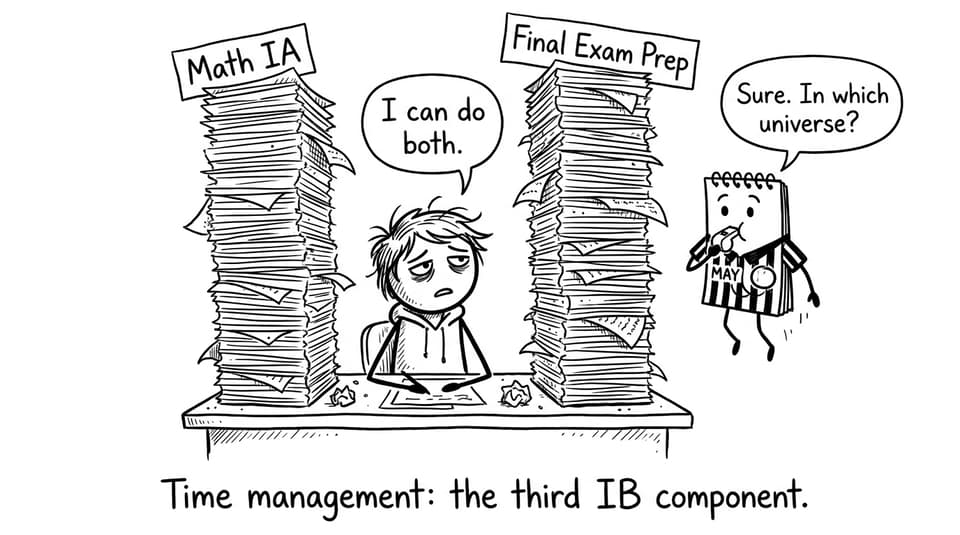
Stressed IB student balancing Math IA and exam prep

A quick IB checklist before you plan anything

When IB time management breaks down, it is usually because the plan is vague. Use this checklist to get specific fast:

  • Write down every Math IA milestone (topic lock, draft, feedback, final polish)

  • Write down every exam milestone (topic coverage, timed sets, full papers)

  • Decide your weekly ratio between IA and exams (you will adjust it later)

  • Choose 2-3 non-negotiable habits you can sustain on busy weeks

  • Put recovery on the calendar first (yes, first)

If you want one place to keep your system tight, start inside RevisionDojo: use the platform as your home base for Study Notes, Flashcards, Questionbank drills, AI Chat, Grading tools, Predicted Papers, Mock Exams, the Coursework Library, and Tutors when you need a human to step in.

min read
min read
min read
min read

A useful companion read is How to Write a Top-Scoring Math IA (2025 Guide), especially if you are still unsure what “good progress” looks like.

Why Math IA and IB exam prep collide so badly

Math IA work is slow-cooking thinking. You explore, model, rewrite, reflect, and polish. Final exam prep is different: it is repetition under pressure, fast recall, and accuracy with mark-earning method.

The trap is treating them like the same kind of work.

When you do that, you either:

  • “Revision” endlessly because it feels easier than writing reflection, or

  • Grind the IA late at night and lose the next day to brain fog, which hurts IB exam prep more than you notice

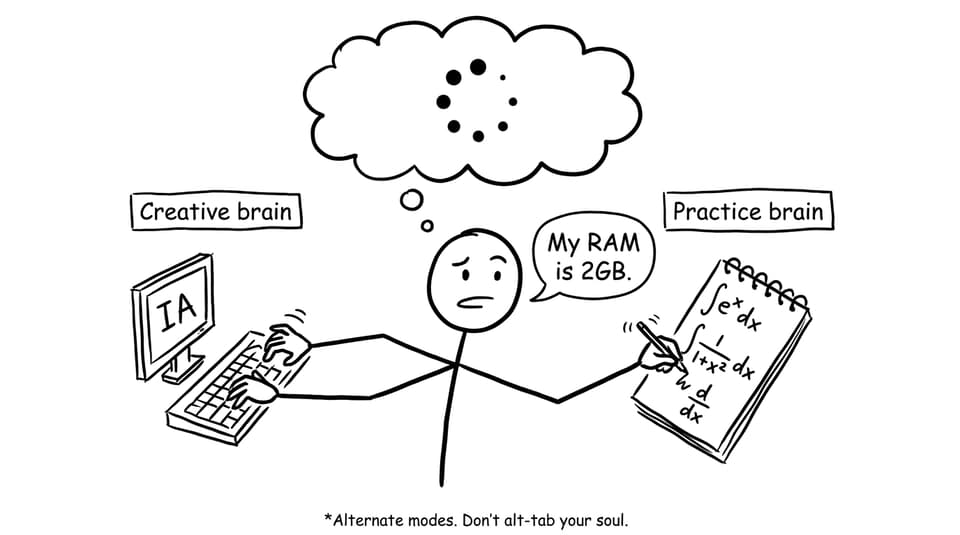
A calmer strategy is to deliberately alternate modes. You are not trying to do everything daily. You are trying to keep both lanes moving weekly.

Multitasking joke about creative vs practice brain

Build one timeline (not two) for IB deadlines

The most underrated study skill in the IB is seeing your time visually. Put your Math IA milestones and exam preparation blocks on one timeline so you stop negotiating with yourself every day.

Use three layers:

Non-movable dates

  • School-set IA deadlines

  • Feedback return dates

  • Mock windows

  • IB exam dates

Movable milestones

  • “Draft 1 complete” (even if it is rough)

  • “Math analysis done”

  • “Reflection rewritten after feedback”

Weekly exam rhythm

  • 3-5 short exam practice blocks

  • 1 longer timed block

  • 1 review session for errors

To keep your IA structure strong while you plan, skim A Step-by-Step Guide to IB Math AI Internal Assessment and borrow its stage-by-stage checkpoints.

Split the Math IA into phases that fit real weeks

A Math IA feels heavy because it is one big document. Make it smaller by treating it like five separate projects:

  • Topic and research question

  • Data collection or model setup

  • Mathematical exploration and calculations

  • Interpretation and evaluation

  • Editing, presentation, and final reflection

Now match each phase to what your week can handle.

When you need examples to reduce uncertainty, use Maths AI IA Examples and Using IA/EE Exemplars to Improve Your IB Math IA. The point is not to copy. The point is to see what “finished” looks like so you stop overthinking formatting and tone.

The 60-30-10 rule for peak overlap (and why it works in IB)

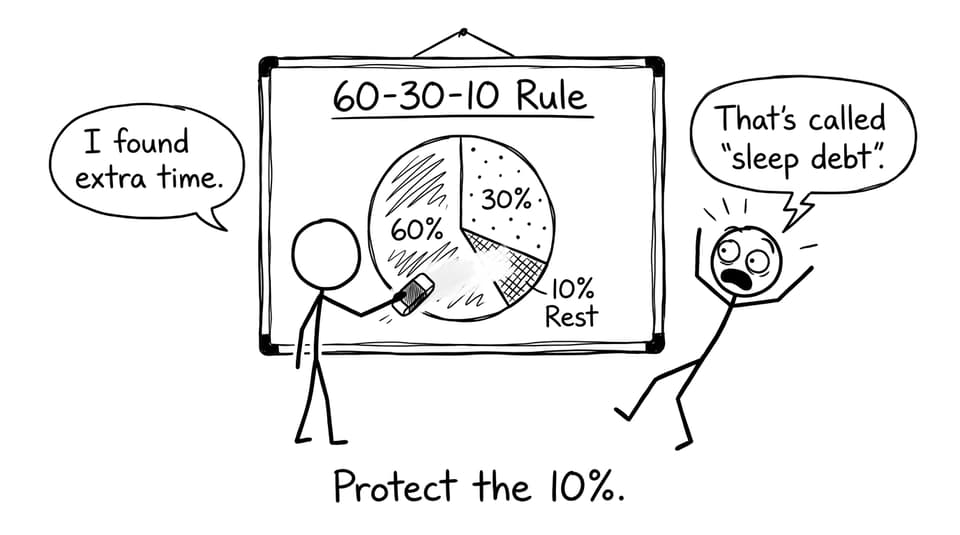
When the overlap is intense, use a simple ratio:

  • 60% Math IA (until submission week)

  • 30% IB exam prep

  • 10% rest and reset

This works because exam skills decay quietly. If you disappear from exam practice for three weeks, you will not notice until you do a timed set and your timing collapses.

After IA submission, flip it:

  • 70% IB exam prep

  • 20% review and consolidate IA learnings into exam topics

  • 10% rest

60-30-10 rule comic with rest being erased

Daily time blocks by energy, not by guilt

A reliable IB schedule respects energy.

High-energy blocks (45-90 minutes)

  • IA writing and reflection paragraphs

  • complex modeling, derivations, and justification

  • timed exam sections (the kind that spike stress)

Medium-energy blocks (25-45 minutes)

  • targeted Questionbank sets by topic

  • rewriting one IA subsection for clarity

  • reviewing feedback and turning it into action items

Low-energy blocks (10-20 minutes)

  • Flashcards for formulas and definitions

  • correcting one mistake pattern from your error log

  • formatting graphs, citations, and presentation

On RevisionDojo, this becomes straightforward:

  • Use RevisionDojo App: The Smarter Way to Prep for IB Exams to keep everything in one workflow

  • Use You're Not Lazy: Your IB Study Method Is Broken as a reminder that structure beats motivation

Micro-revision: the secret to staying exam-ready during IA weeks

If you only do one thing during IA-heavy weeks, make it micro-revision. Small, consistent recall is how IB content survives stress.

Try this minimum baseline:

  • 10 minutes Flashcards daily

  • 15 minutes Questionbank practice every other day

  • 30 minutes of timed work once per week

Then use AI Chat like a diagnostic tool, not a comfort tool. Ask it to spot patterns: “Where did I lose marks and what is the rule to avoid it next time?” That is how you turn practice into improvement.

For smarter practice choices (especially close to exams), read IB Predicted vs Specimen Papers: What They Mean and then rehearse realistically with IB Predicted Papers by IB Examiners (Free) or subject-specific sets like Mathematics Applications & Interpretation Predicted Papers (Free).

Use transition days so you do not drag IA stress into exam mode

The day after a major IA draft or final submission is emotionally weird. You feel lighter, then guilty, then restless. That is normal.

Schedule a transition day on purpose:

  • Sleep properly

  • Do one light review block (Flashcards or a short topic recap)

  • Plan your first full exam week before you start it

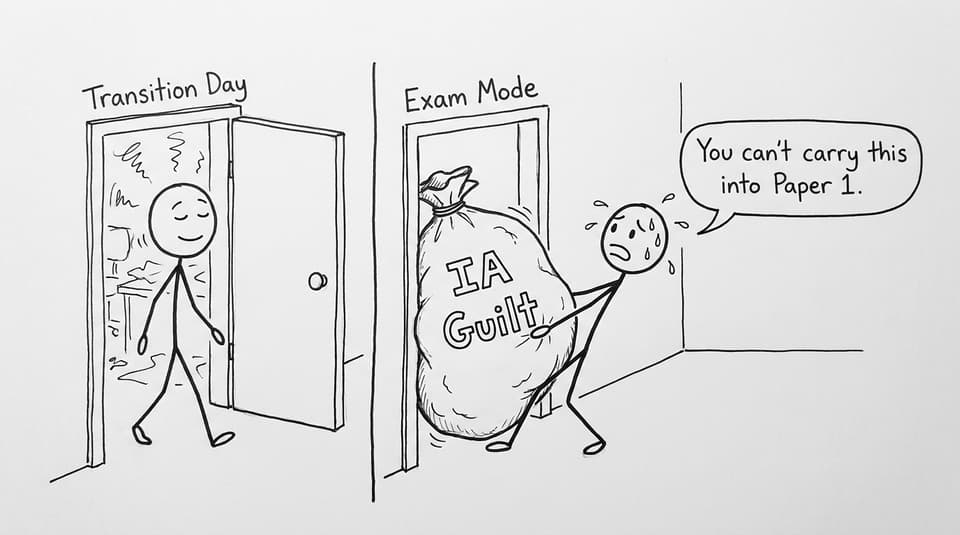
The point is to change gears cleanly. Your IB performance improves when your mind is not trying to carry unfinished IA worry into timed practice.

Transition day comic leaving IA guilt behind

Common IB time management mistakes (and the quick fixes)

You wait for “a free weekend” to do the IA

Fix: do 30 minutes a day for five days. Momentum beats marathons.

You stop exam prep entirely during IA weeks

Fix: keep micro-revision alive. Your future self will feel it immediately.

You over-plan and under-execute

Fix: plan one week at a time and review weekly. Your schedule is a tool, not a promise.

You do practice without feedback

Fix: use Grading tools and AI Chat to understand why you missed marks, then redo similar questions within 48 hours.

Closing: one IB season, one plan

There is a quiet advantage in the IB for students who treat time like a system, not a feeling. Your Math IA needs steady progress. Your final exam prep needs repeated exposure and feedback. You do not have to choose one identity: “coursework person” or “exam person.” You can be both, as long as you plan for the overlap instead of being surprised by it.

Build one timeline, use the 60-30-10 rule when it gets crowded, keep micro-revision alive, and schedule a transition day when the IA chapter closes.

When you are ready to make it all feel simpler, put your whole routine in RevisionDojo: Study Notes for clarity, Flashcards for daily recall, Questionbank practice for precision, AI Chat and Grading tools for fast feedback, Predicted Papers and Mock Exams for rehearsal, a Coursework Library for examples, and Tutors for the moments you need a human edge. That is how IB time management turns from stress into confidence.
How helpful was this article?
Add as a preferred source on Google

Continue studying with RevisionDojo

  • IB Coursework GraderCheck an IA, EE, or TOK draft against IB assessment criteria.
  • IB Coursework ExamplesLearn from high-scoring coursework across IB subjects.
  • IB Grade CalculatorEstimate an IB grade using session-specific boundaries.
  • IB Grade BoundariesExplore historical grade boundaries by subject and session.

Frequently Asked Questions