
A strange thing happens when you start an IB Math AI Internal Assessment: the math isn’t the scary part.
The scary part is the blank page. The feeling that your idea has to be original, your graphs have to be perfect, and your “reflection” has to sound like you’ve been thinking about regression since childhood.
But the best IB Math AI IA is usually built from something smaller: a real curiosity, a clean plan, and the patience to explain your choices like you’re teaching them to a future version of yourself.
Why the IB Math AI Internal Assessment matters
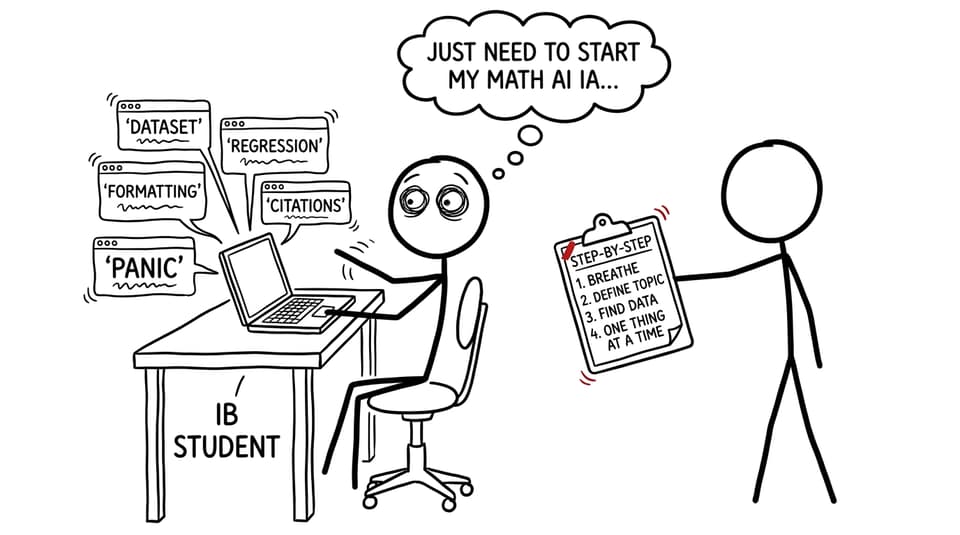
Your IB Math AI Internal Assessment (IA) is one of the few parts of the IB where you control the pace. It’s not about speed. It’s about clarity.
It also matters because it’s assessed internally and moderated externally, and it contributes 20% of your final grade. That number is big enough to change an outcome, but small enough that smart planning beats last-minute intensity.
If you want a rubric-aligned roadmap, start with IB Mathematics Applications & Interpretation (AI) IA Guide. It’s built to keep your decisions aligned to what IB examiners actually reward.
Quick-start checklist (save this before you begin)
Use this checklist to keep your IB Math AI Internal Assessment moving.
-
Read the core expectations in the IA/EE Guides hub.
-
Skim a full structure walkthrough in How To Structure An IB Math IA Effectively.
-
Choose a topic with measurable variables and realistic data access.
-
Outline your sections: intro, exploration, interpretation, reflection, conclusion.
-
Schedule 3-4 weeks minimum for drafting, revision, and formatting.
-
Do targeted skill refreshers from Math AI Notes.
Step 1: Choose a topic that’s genuinely “yours” (and still IB-friendly)
The strongest IB Math AI Internal Assessment topics feel personal, but not private. You want something you can explain in one sentence and model in two or three techniques.
A good rule: if you can collect or source the data in a weekend, it’s probably feasible.
Examples that tend to work well:
-
Sleep hours vs reaction time (correlation, regression, residuals)
-
Temperature vs electricity use (time series thinking, modeling, limitations)
-
Playlist tempo vs running pace (data cleaning, model comparison)
If you’re stuck, browse ideas in The Best IB Math IA Topics for 2025. Read it like a menu: you’re not picking the fanciest dish, you’re picking the one you can cook consistently.
Step 2: Turn your idea into a focused research question
In IB Math AI, a research question is a promise. It tells the examiner what you will measure, what relationship you’ll test, and what math tools you’ll use.
Avoid questions that sound philosophical or vague:
- “How does data affect performance?”
Prefer questions that are measurable:
-
“To what extent does a linear model explain the relationship between weekly running distance and resting heart rate for a group of students?”
-
“Which model (linear vs exponential) best describes the relationship between outside temperature and daily electricity consumption in my city?”
A practical checkpoint: if you cannot already imagine your scatterplot, your question is still too foggy.
Step 3: Collect (or source) data you can defend
Most IB Math AI Internal Assessment projects succeed or fail here. Not because students can’t find data, but because they don’t prepare it.
Aim for 30-60 data points. Fewer points can work, but your analysis becomes fragile, and your reflection becomes harder.
When you gather data, document:
-
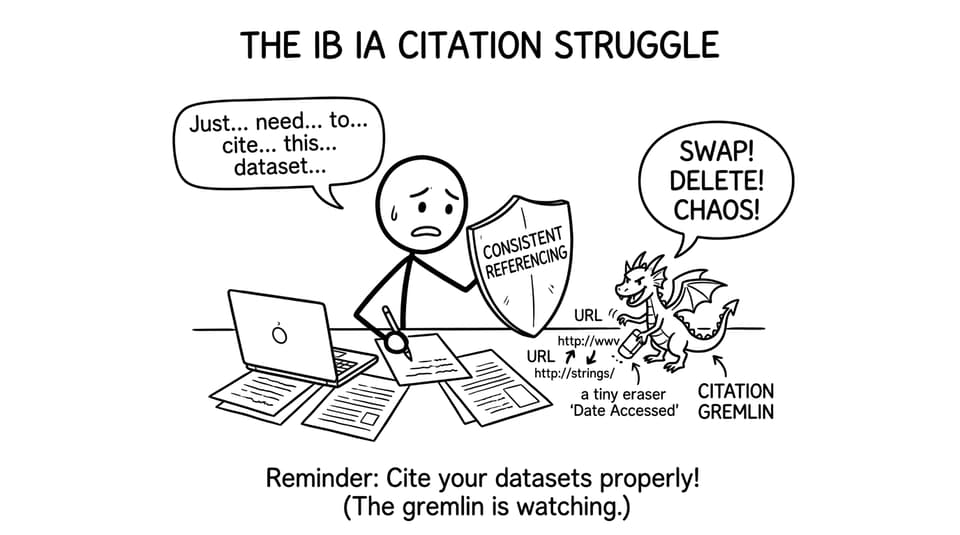
Where it came from (with proper citations)
-
Units and measurement method
-
Any cleaning choices (outliers, missing values, rounding)
If your IA uses regression, you’ll sound sharper when you acknowledge reliability limits. This article gives strong wording ideas: Why Regression Predictions Become Less Reliable Over Time.
Step 4: Pick mathematical tools that match your question (not your ego)
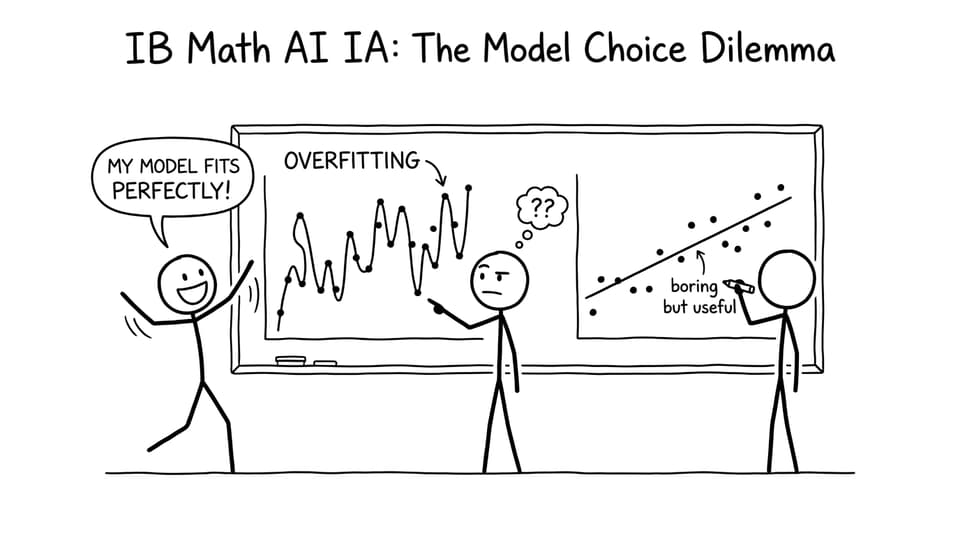
An IB Math AI Internal Assessment doesn’t earn marks for being complicated. It earns marks for being appropriate, correct, and explained.
Commonly strong tools in AI include:
-
Descriptive statistics (mean, standard deviation, spread)
-
Correlation and regression
-
Residual analysis and model diagnostics
-
Non-linear models when justified (quadratic, exponential, power)
-
Probability distributions when your question is built around uncertainty
If you need a quick refresher on core content, use Statistics and Probability notes for Math AI. For non-linear modeling, this is useful when your data curves: Non-linear regression (AHL 4.13).
Step 5: Analyse and model your data with “show your thinking” energy
This is where many IB students accidentally write a calculator report: numbers, graphs, outputs, next output.
Instead, aim for a repeating rhythm:
-
What you did
-
Why you did it
-
What the result suggests
-
What could be misleading
For regression-based explorations, don’t stop at the equation. Examiners love students who test whether the model deserves trust. A great guide for this mindset is Why Residual Analysis Is More Important Than the Regression Equation.
Step 6: Write reflection like an IB student, not like a motivational quote
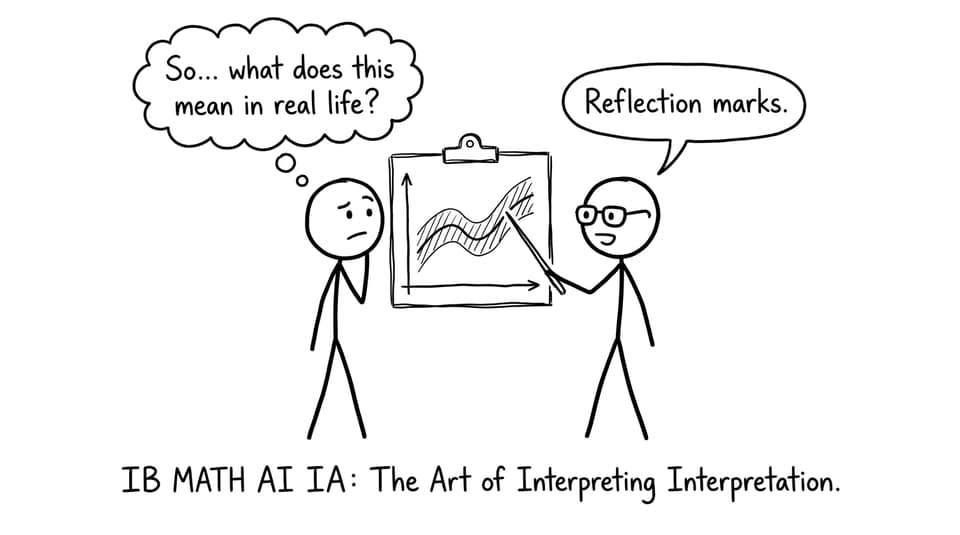
Reflection is where your IB Math AI Internal Assessment becomes more than a set of steps. It’s you proving you understand what your math can and can’t claim.
Strong reflection includes:
-
limitations (sample size, measurement error, confounding variables)
-
assumptions (linearity, independence, normality where relevant)
-
improvements (better sampling, different model, more variables)
-
extensions (new question that builds naturally from your result)
If you want your reflection to sound grounded, talk about uncertainty and context. This pairs well with tech-based interpretation: How to Interpret Data in IB Math AI Using Technology.
Step 7: Structure and presentation (where easy marks hide)
Presentation is not decoration. In IB, it’s a communication skill: can someone follow your exploration without re-reading every paragraph?
A clean structure usually looks like:
-
Introduction (context + research question)
-
Data and method (what you collected, what tools you’ll use)
-
Mathematical exploration (calculations, models, graphs)
-
Interpretation and discussion (what it means)
-
Reflection and evaluation (limits + improvements)
-
Conclusion (answer your question directly)
For formatting details that can save hours, use How to Format and Present Your IB Math IA Professionally.
Step 8: Polish using RevisionDojo like a serious IB student
The final edit is where you convert “good work” into “examiner-friendly work.”
Here’s a simple way to do it with RevisionDojo:
-
Use Study Notes to confirm definitions and correct notation.
-
Drill any weak techniques using the Questionbank on the IB Math AI hub.
-
Build timed practice with Mock Exams and Predicted Papers to keep exam readiness moving alongside IA work.
-
Ask AI Chat to stress-test wording: “Is my conclusion answering the research question?”
-
Use Grading tools to get rubric-style feedback on reflection and communication.
-
If you’re stuck, the Tutors and Coursework Library can help you unblock quickly without rewriting your whole IA.
If you want an additional step-by-step resource, this pairs well with the guide above: How to Write a Top-Scoring Math IA (2025 Guide).
Conclusion: make your IB IA a calm, controlled project
A strong IB Math AI Internal Assessment is built the way good habits are built: one clear step, repeated.
Pick a topic you care about. Ask a question you can actually answer. Use math that fits. Reflect like a critical thinker. Then polish with tools that reduce guesswork.
When you’re ready to turn your plan into a final submission, open the IB Mathematics Applications & Interpretation (AI) IA Guide and use RevisionDojo’s Questionbank, Study Notes, Flashcards, AI Chat, Grading tools, Predicted Papers, Mock Exams, Coursework Library, and Tutors to keep your IA and your exams moving forward together.