


You're not lazy: your IB study method is broken
There's a moment most IB students know too well.
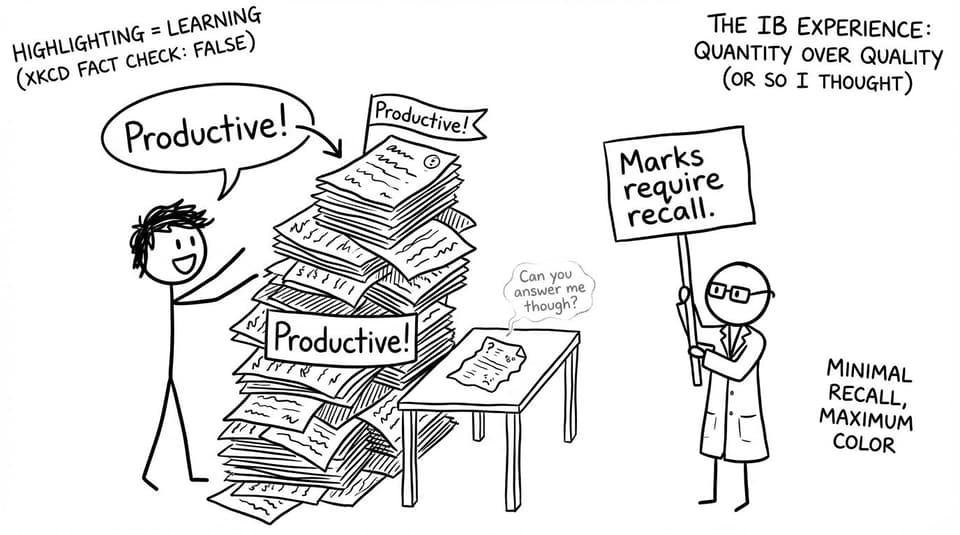
You sit down determined. You open your laptop. You look at your notes. You highlight a paragraph, then another. The colors pile up like proof of effort. Two hours later, you feel tired, slightly guilty, and weirdly unsure what you actually learned.
So you do the most human thing: you blame yourself.
"Maybe I'm lazy."
But laziness rarely looks like this. Laziness doesn't make you show up, re-open the same topic, and quietly worry about May.
What you're describing is more like a broken system: a study method that feels busy, looks academic, and fails the one thing the IB exam rewards: performance under time.
If you want a calm kind of confidence, your job isn't to become a different person. Your job is to swap the method.
The 60-second checklist: the IB method that actually works
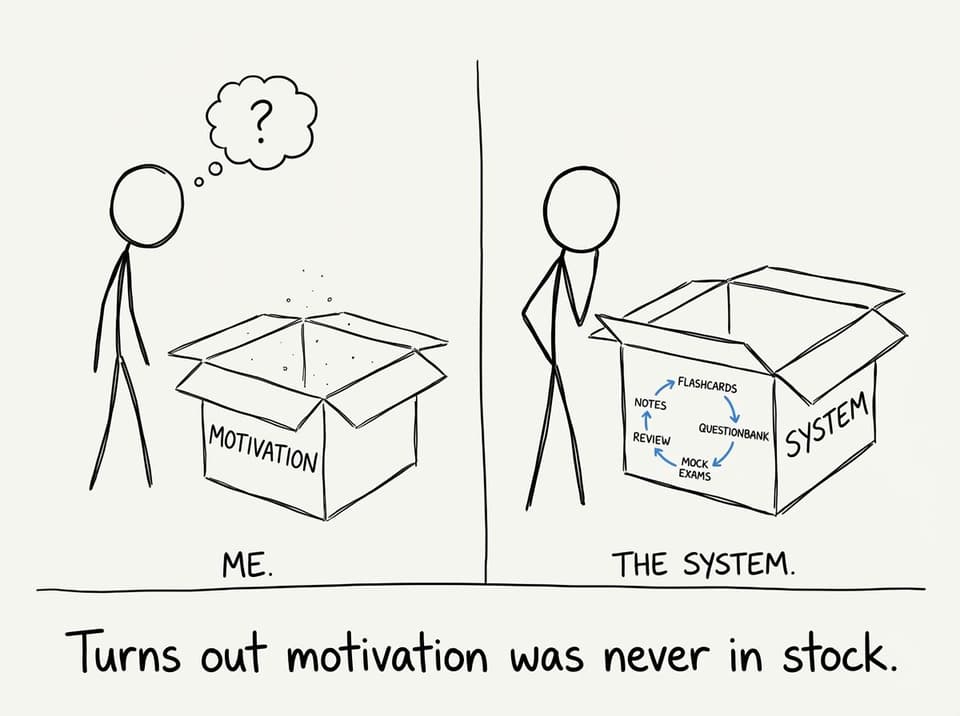
Keep this simple loop on your desk. It is the backbone of almost every high-scoring IB routine:
- Understand (short, targeted) with Study Notes
- Recall daily with Flashcards
- Apply with a Questionbank by topic and difficulty
- Train timing with Mock Exams and full-paper rehearsals
- Review mistakes and write an error log
- Repeat until the exam feels familiar
RevisionDojo is built around this loop: Study Notes, Flashcards, Questionbank, AI Chat, Grading tools, Predicted Papers, Mock Exams, a Coursework Library, and Tutors when you need a human diagnostic.
If you want a step-by-step structure for the whole season, borrow the framework from How to Study for IB Exams: Step-by-Step Guide.
Why your IB study method breaks (even when you're working hard)
Most IB students aren't struggling with effort. They're struggling with a mismatch between what feels like studying and what the exam actually measures.
Here are the three common "good student" traps.
The recognition trap: "I understand it when I see it"
Reading notes creates familiarity. Familiarity feels like understanding. But IB questions ask you to produce, not recognize: define, explain, analyse, evaluate.
When you only reread, you train your brain to be good at recognizing the page, not retrieving the idea.
That's why you can "know" a topic at home and blank under pressure.
A better approach is active recall and spaced repetition. If you want the science and tactics, see The Science Behind Effective IB Revision: How to Study Smarter.
The comfort trap: "If it's painful, I must be doing it wrong"
Real learning has a particular discomfort. Not panic. Not burnout. Just the mild strain of retrieving something you might forget.
IB revision that moves grades usually feels slightly annoying because it exposes gaps.
That annoyance is information.
The no-feedback trap: "I did the work, so I should improve"
If you don't check your answers against markscheme logic, you can repeat the same mistake for months.
In IB, improvement is not effort. It's feedback loops.
That's why tools like a topic-filtered Questionbank plus marking support matter so much.
IB studying is not reading; it's training
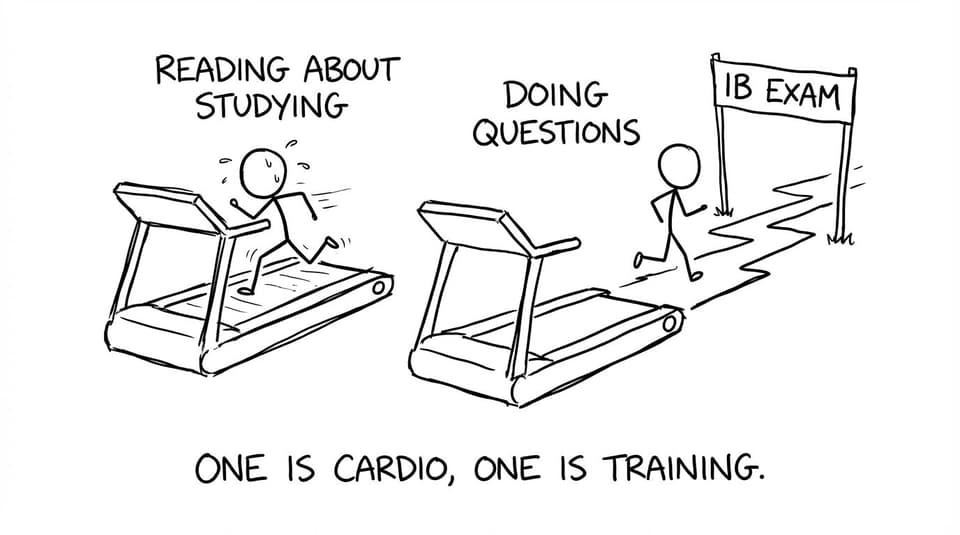
Picture two athletes.
One watches fitness videos for two hours a day. The other does short, specific workouts, checks form, and tracks progress.
Both are "working." Only one is training.
That's the difference in IB. You don't win because you spent time near the syllabus. You win because you trained the exact outputs the exam wants.
If you want a library of study methods tailored to IB, skim 10 Proven Study Techniques for IB Students.
The fix: build an IB system that doesn't rely on motivation
Motivation is the most unreliable study resource because it's sensitive to sleep, stress, weather, and one bad quiz.
Systems are calmer. They work on average days.
Here's a clean IB system you can run starting today.
Step one: pick one paper, then one skill
Most students plan in "subjects." High scorers plan in "papers."
Instead of "IB Biology," choose "Paper 2 data-based questions," or "English Paper 1 commentary," or "Math Paper 2 calculator methods."
Then choose one skill:
- command terms
- definitions
- method steps
- evaluation structure
- time budgeting
This prevents the most dangerous kind of procrastination: vague work.
Step two: notes as a map, not a mattress
Notes are for clarity, not comfort.
Use notes to answer:
- What is the definition the IB credits?
- What is the mechanism or chain of reasoning?
- What common mistake loses marks?
Then switch quickly into recall or questions.
If your notes are messy or you're drowning in documents, use IB Study Material Organization: 15 Pro Tips and consider Digital IB Study Notes: Access Anywhere, Anytime for quicker navigation.
Step three: daily recall (small, non-negotiable)
Ten minutes of Flashcards beats two hours of rereading because it forces retrieval.
Keep it boring and consistent:
- 7-15 minutes a day
- mixed topics
- don't pause to "relearn" during the deck; mark it, move on
If you need a clear Flashcards strategy, start with IB Flashcard System: Active Recall for Better Memory and the Flashcards feature.
Step four: questions are where IB points are made
Your grade moves when you practice producing answers.
Use a Questionbank in a disciplined way:
- filter by topic
- start untimed to learn patterns
- move to timed sets (15-25 minutes)
- mark and annotate mistakes
RevisionDojo's Questionbank makes this easy because it's organized by syllabus sections and question style (for example: B2.2 Organelles and compartmentalization - IB Questionbank).
Pairing questions with recall is especially powerful; see Flashcards vs Practice Questions for IB Revision.
Step five: train timing with mock exams (confidence comes from reps)
In IB, knowing the content is not enough. Pacing is a separate skill.
A simple ladder:
- timed mini-sets
- timed sections
- full Mock Exams
If you've never had a real mock routine, use Ultimate Guide to IB Mock Exams or Online IB Mock Exams: Practice Anywhere, Anytime.
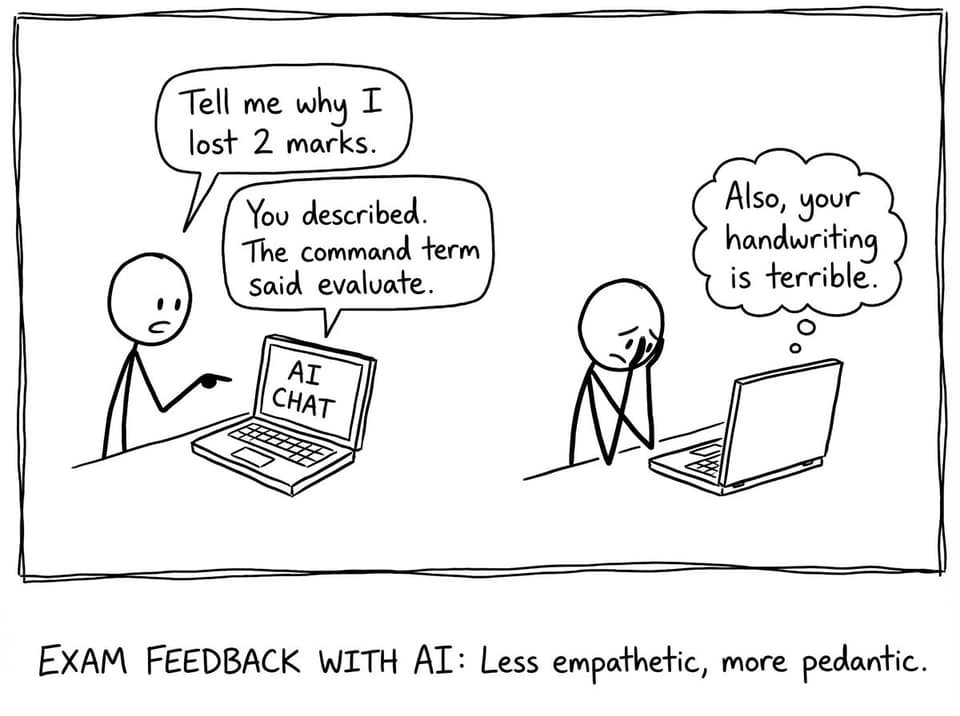
Step six: use AI Chat for precision, not reassurance
Most students ask AI for explanations. Better students ask for diagnosis.
Good prompts for IB improvement:
- "Here is my 6-mark answer. Grade it and tell me exactly how to gain the last 2 marks."
- "Quiz me with 8 short questions on my weak subtopic. Increase difficulty."
- "Did I actually evaluate, or did I just describe? Rewrite my conclusion."
That's where AI Chat becomes a tutor-like feedback tool rather than another reading source.
A weekly IB schedule that feels realistic (and repeatable)
Here's a structure that fits real student life. Adjust minutes, keep the shape.
The daily baseline (30-60 minutes)
- Flashcards (10-15 min): retrieval
- One targeted block (20-45 min): notes then questions on the same topic
Twice a week (45-90 minutes)
- Timed Questionbank set (or a full section)
- Review errors immediately
Once a week (90-150 minutes)
- Mock Exam or full-paper rehearsal
- Use Grading tools to mark
- Write an error log: 5 patterns, 5 fixes
If distraction is your main enemy, use How Do You Study Efficiently for IB Without Getting Distracted?.
Closing: the IB doesn't reward suffering: it rewards a loop
The quiet truth is that most "lazy" IB students are just stuck in a method that can't cash out effort into marks.
Fix the method, and your work starts paying you back.
Build a system you can repeat: Study Notes for clarity, Flashcards for daily recall, a Questionbank for exam-shaped practice, AI Chat for fast diagnosis, Grading tools for feedback, Predicted Papers and Mock Exams for timed rehearsal, a Coursework Library to reduce background stress, and Tutors when you need a human to raise the bar.
That's the RevisionDojo advantage: one connected loop that makes IB revision simpler, sharper, and calmer.
Open your next paper. Do one timed set. Review the mistakes. Repeat tomorrow.
That's not laziness.
That's training for IB.