
A blank page is loud.
It stares back and asks a question you can’t answer with a formula: What am I actually trying to say?
That’s why the IB Math IA feels so different from revision. It’s not speed. It’s not even difficulty. It’s the slow work of making your thinking visible. And because the IA is worth 20% of your final IB Mathematics grade (AA or AI), that visibility matters.
The reassuring part is this: a top-scoring IB Math IA is not a magic trick. It’s a sequence of decisions that line up with the rubric. Make those decisions deliberately, and you give an examiner what they can reward.

IB Math IA quick-start checklist (save this)
Use this to keep your IB Math IA moving when you feel stuck:
-
Choose a topic you’d willingly talk about for ten minutes.
-
Read the rubric language, then translate it into a plan.
-
Lock a focused research question with measurable variables.
-
Decide your mathematical tools early (model, method, technology).
-
Collect or source data you can explain and justify.
-
Build a simple timeline: draft, refine, reflect, format.
-
Leave time to edit for mathematical communication and presentation.
If you want a rubric-aligned roadmap, start with RevisionDojo’s coursework guidance at IB IA Guides and the subject-specific pages for IB Math AA IA Guide or Math AI coursework guide.
Why the IB Math IA matters (and what examiners actually reward)
The best way to think about the IB Math IA is as a conversation with an examiner who has limited time. They’re not hunting for genius. They’re scanning for evidence: clarity, correct mathematics, and honest reflection.
The five criteria don’t change, and your IB Math IA lives or dies by how clearly you signal them:
-
Presentation: Is the exploration easy to follow, with a logical flow?
-
Mathematical communication: Is your notation correct, consistent, and readable?
-
Personal engagement: Do your choices feel like your choices, not a copied template?
-
Reflection: Do you evaluate assumptions, limitations, and meaning?
-
Use of mathematics: Is the math appropriate, accurate, and developed enough?
RevisionDojo’s Coursework Library is helpful here because it keeps you close to the criteria while you work. You can pair that with practice-based confidence building using the Questionbank mindset: identify what you don’t understand, fix it, and test again.
Choose an IB Math IA topic you can defend
A high-scoring IB Math IA topic has a quiet quality: it creates decisions. Decisions create justification. Justification creates personal engagement.
A topic doesn’t need to be groundbreaking. It needs to be workable, mathematical, and explainable. If you can’t explain why your model is suitable, your IA becomes a list of steps instead of an exploration.
Good directions (with flexible difficulty):
-
Regression and model comparison on real data (sleep vs productivity, training load vs performance, temperature vs energy use)
-
Optimization with constraints (packaging, architecture, minimizing cost)
-
Probability and simulation (queueing, game mechanics, risk)
-
Calculus modeling (rates of change, area/volume, approximations)
When you want ideas that match the course and your level, use a curated list like The Best IB Math IA Topics for 2025. Then pressure-test each idea: Can I measure something? Can I compute something? Can I interpret something?
Turn your idea into a focused IB research question
Many IAs start with a big, vague curiosity and end with a small, vague conclusion. The fix is a research question that forces mathematics.
Weak:
- “How can I use math in basketball?”
Strong:
-
“How accurately does a quadratic model predict the range of a basketball shot given launch angle and initial velocity?”
-
“Which regression model best predicts study time from spaced-repetition accuracy over four weeks?”
Here’s the test: if your IB research question can be answered with a paragraph and no math, it’s not ready.
As you refine, keep your variables visible. Define what you will measure, how you will measure it, and what mathematical tool will turn it into insight. If your question is too big, reduce scope. If it’s too small, add comparison (two models, two scenarios, two constraints).
Plan the mathematics before you write the story
A top-scoring IB Math IA often feels like a story, but it’s built like an engineering plan.
Before you draft, outline:
-
Data: source, reliability, sample size, cleaning decisions
-
Method: regression, calculus, geometry, probability, simulation
-
Technology: calculator, spreadsheet, Desmos, statistical tools (and what they do)
-
Validation: error analysis, residuals, reasonableness checks
-
Interpretation: what the parameters mean in context
If you need content refreshers while planning, RevisionDojo’s subject hubs make it easy to plug gaps quickly: IB Mathematics Analysis and Approaches Resources and IB Mathematics Applications & Interpretation Resources. For AI students, the Math AI Data Booklet is a calm anchor when your symbols start blurring together.
Structure your IB Math IA like a clear walkthrough
Examiners reward writing that respects their attention.
A practical structure that works for almost any IB Math IA:
-
Introduction and aim: motivation, context, research question
-
Definitions and assumptions: variables, units, assumptions
-
Mathematical exploration: method step-by-step with explanation
-
Results and interpretation: what you found and what it means
-
Evaluation and reflection: limitations, improvements, extensions
-
Conclusion: answer the research question directly
If your draft feels messy, you’re not alone. Most students discover structure after they write. RevisionDojo’s guide on How to Structure the IB Math IA for Maximum Clarity helps you reorganize without rewriting everything.
Win easy marks with IB mathematical communication
In an IB Math IA, communication is not decoration. It’s correctness.
Small fixes that raise scores:
-
Define every variable the first time it appears.
-
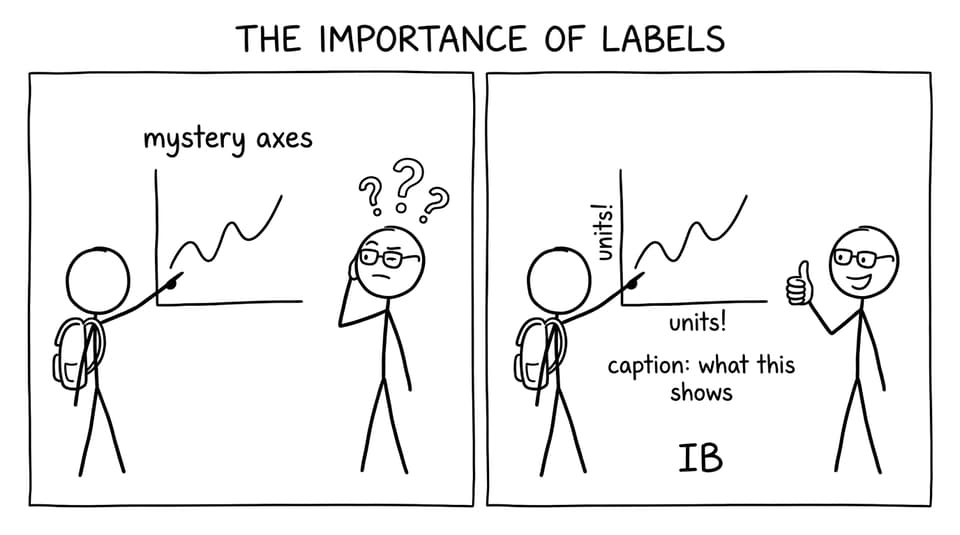
Put units on axes and in tables.
-
Use consistent notation (don’t alternate between k and c).
-
Caption graphs with what they show and why they matter.
-
Reference technology outputs: explain what the tool calculated.
Formatting matters because it reduces friction for the examiner. If you want a professional finish, follow a checklist like How to Format and Present Your IB Math IA Professionally.
Reflection: the part most IB students underwrite
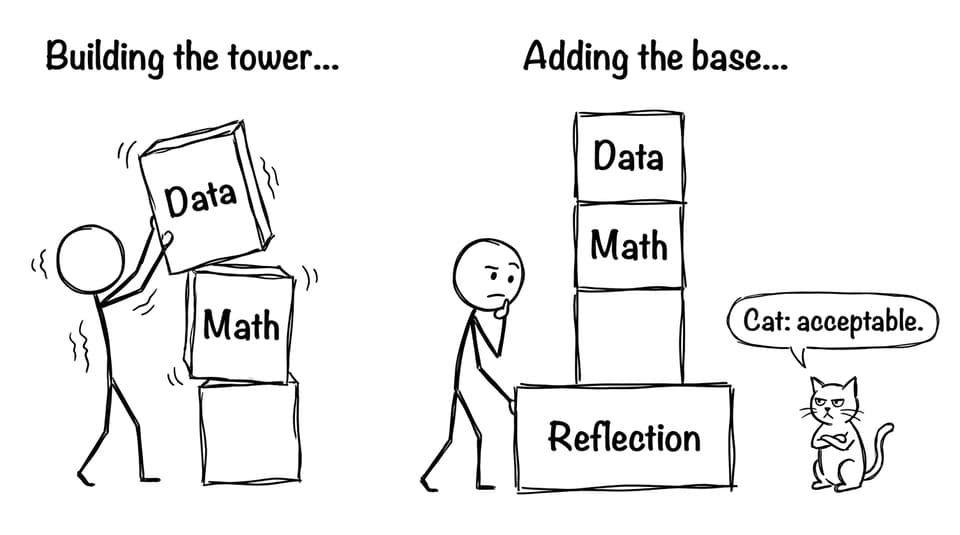
Reflection is where good projects become convincing ones.
Many IB students write reflection like an apology: “My model isn’t perfect.” That’s not reflection. Reflection is analysis of decisions.
Use prompts like:
-
Which assumption matters most, and what happens if it fails?
-
Why did I choose this model over alternatives?
-
What does a parameter mean in real terms?
-
Where did error enter the process (measurement, rounding, sampling)?
-
If I had more time, what extension would add depth?
A strong reflection section reads like a student who understands trade-offs. That voice is rare. It stands out.
Use RevisionDojo tools to build a smarter IB workflow
A secret advantage in the IB is momentum. When momentum disappears, your IA turns into a weekend panic.
RevisionDojo is built to keep momentum:
-
Study Notes to quickly relearn the math you need (IB Notes hub)
-
Flashcards for formulas, definitions, and method triggers (especially useful when you’re balancing multiple subjects)
-
Questionbank to practice the exact methods your IA depends on
-
AI Chat to clarify steps, check reasoning, and generate alternative approaches to compare
-
Grading tools to stress-test clarity and criterion alignment before submission
-
Coursework Library for exemplars and guidance that show what top work looks like
-
Tutors when you need a human to sanity-check your scope and depth
-
Mock Exams and Predicted Papers to keep exam prep running alongside your IA (see IB Predicted Papers)
If your IA is stealing time from revision, protect your schedule with a routine that’s realistic. This guide helps: The Ultimate IB Math Study Routine for Busy Students.
Conclusion: write the IB Math IA you’d want to read
A top-scoring IB Math IA is built from small, patient moves: a focused question, mathematics you can explain, communication that removes confusion, and reflection that proves you understand what you did.
If you want a smoother path, open RevisionDojo and treat your IA like a project with tools, not a document with stress. Start with the IB IA Guides, pull the math you need from Notes and the Questionbank, and use the Coursework Library and grading tools to polish until it reads clean.
Your IB examiner can only reward what they can see. Make your thinking visible, and let the marks follow.