
The night before a big IB exam, your brain does a strange thing: it starts hunting for certainty.
Not understanding: certainty.
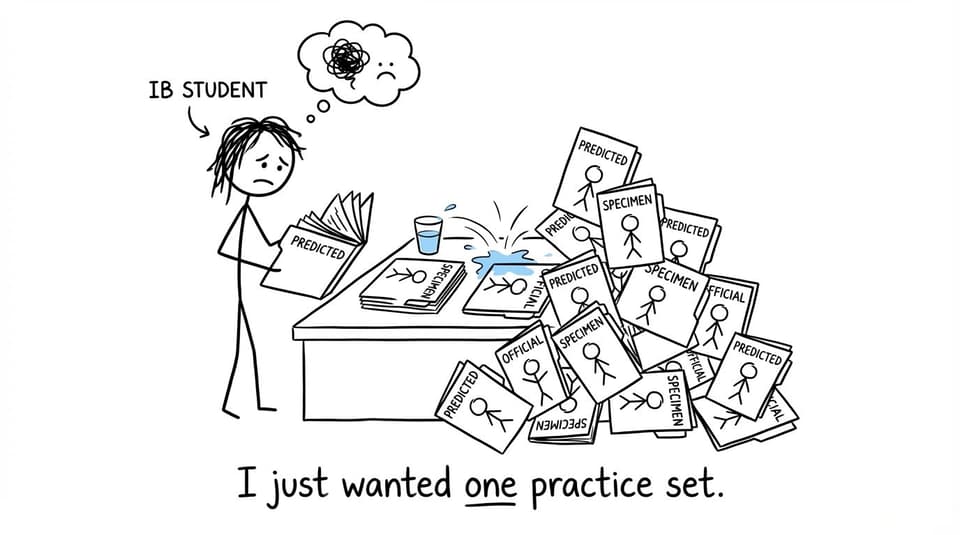
So you type the same trio of words into search bars and group chats: predicted papers, specimen papers, and the thing everyone whispers about like it's forbidden magic.
If you're an IB student preparing for exams, you're not wrong to want practice materials. You're wrong only if you expect any one set of papers to predict your future. The IB rewards skill, not clairvoyance.
This guide explains what predicted papers and specimen papers actually mean in the IB world, how they differ, and how to use them without falling into the common trap of "practice" that is really just anxiety with a printer.
Quick checklist: what to use and why (IB exam prep)
If you just want the practical answer for IB revision, use this as your default:
- Specimen papers: use to learn the official IB format and command-term style, especially after syllabus changes.
- Predicted papers: use to rehearse timing, stamina, and topic coverage in realistic exam form.
- Questionbank practice: use to target weak topics and repeat mistakes until they stop repeating you.
- Mock exams / exam mode: use to simulate pressure and learn pacing.
- Markscheme-aligned feedback: use to learn how IB marks are actually awarded.
A strong system blends all of the above, which is exactly why RevisionDojo exists: one place to move from learning to practice to feedback without losing weeks to "resource hunting."
What are IB specimen papers?
In the IB ecosystem, specimen papers are official sample examinations released to show what an assessment will look like. Think of them as the IB saying, "Here is the structure, the style, and the standard we're aiming for."
Specimen papers matter most when:
- a syllabus changes (new first assessment years),
- the paper format changes (question styles, sections, mark allocations),
- students and teachers need clarity on command terms and expectations.
For IB students preparing for exams, specimen papers are valuable because they reduce ambiguity. They teach you the "shape" of the assessment: the rhythm of questions, how long sections tend to feel, and what the markscheme seems to reward.
But specimen papers have a limitation: they are not designed to provide endless variety. They're a reference point, not a full training program.
If your preparation begins and ends with specimen papers, you may learn format without building the deeper IB skill: flexible application across unfamiliar prompts.
What are IB predicted papers?
Predicted papers are practice exams created by educators or platforms to simulate what an upcoming IB exam could feel like.
The healthiest way to understand predicted papers in IB prep is this:
- They are not an official window into the future.
- They are structured guesses that try to mirror common patterns: syllabus weighting, typical question types, recurring themes, and examiner logic.
When they're well made, predicted papers do something powerful for IB students preparing for exams: they turn vague revision into a timed rehearsal.
That's why RevisionDojo builds predicted papers to behave like real exam sittings, including full-paper structure and realistic question distribution. For example, you can see subject-specific predicted sets such as Mathematics Applications & Interpretation (Math AI) Papers or IB Computer Science Predicted Papers.
And because practice without feedback is just effort, RevisionDojo pairs predicted papers with grading support and fast improvement loops.
The phrase you searched for (and what we can't call it)
Many students use the term "past papers" as shorthand for "real previous exams." In IB culture, that phrase often carries two assumptions:
-
that doing lots of old exams is the best way to study, and
-
that repeating enough of them will reveal what's "likely" to appear.
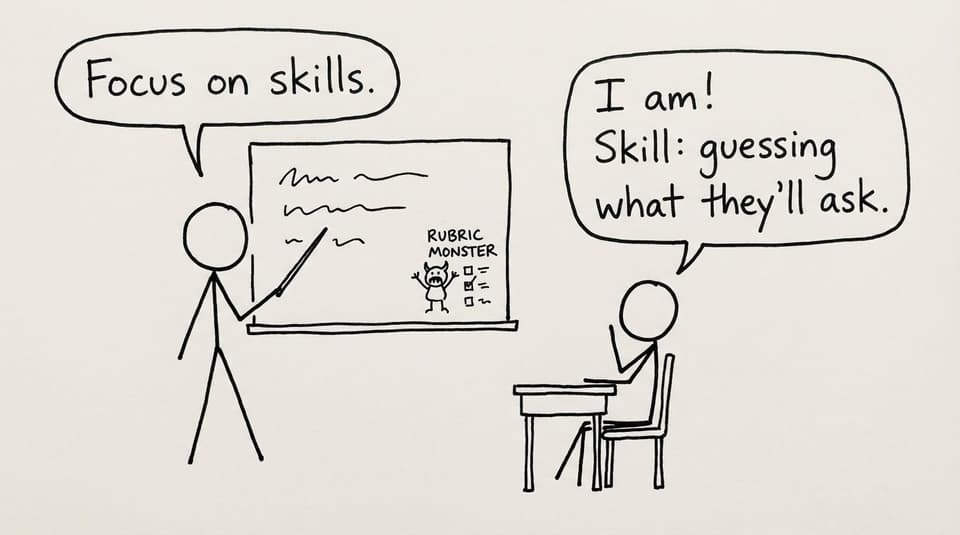
Here's the calmer truth: in IB, what repeats most reliably is not a specific question. It's the skills underneath the question.
That's why RevisionDojo leans into exam-style practice and feedback loops: you train the transferable moves, not a specific memory.
If you're building your study plan, anchor it around skill-building resources like the Questionbank and timed simulations, then use predicted papers as your weekly "pressure test."
IB predicted papers vs specimen papers: the real difference
Authority vs simulation
- Specimen papers show what the IB intends the assessment to look like.
- Predicted papers simulate what an IB assessment tends to reward, based on patterns.
Purpose
- Use specimen papers to learn format, command terms, and the "feel" of official wording.
- Use predicted papers to build timing, stamina, and decision-making under pressure.
When to use each (IB students preparing for exams)
- Early in revision: specimen papers help you stop studying blindly.
- Mid to late revision: predicted papers help you stop panicking about performance.
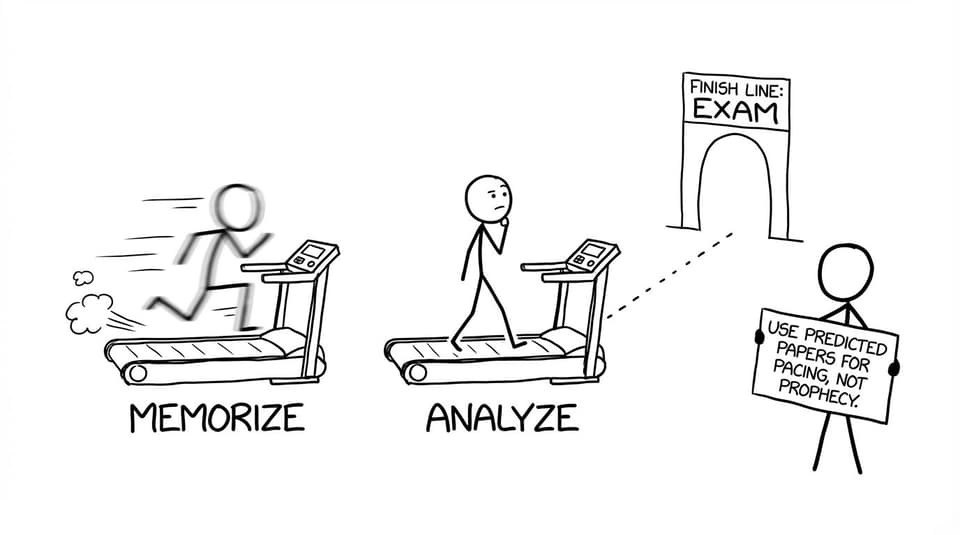
A practical approach is to use specimen papers as your map and predicted papers as your training run.
How to use IB predicted papers without wasting them
Predicted papers become useless when students treat them like lottery tickets: "If I learn this exact set, I'm safe."
Instead, treat predicted papers like a flight simulator.
Run them like a real IB exam
- Sit in silence.
- Use allowed tools only.
- Follow official timing.
- Don't pause.
If you want a structured method, follow Online IB Mock Exams: Practice Anywhere, Anytime and the broader workflow in How to Study for IB Exams: Step-by-Step Guide.
Mark for patterns, not pain
After the sitting, don't just count lost marks. Ask:
- Did I misread command terms?
- Did I run out of time in one section repeatedly?
- Did I lose marks to the same concept family (not just one topic)?
This is where RevisionDojo's ecosystem matters. You can take a predicted paper, then immediately drill weaknesses with the Questionbank, review missing ideas via Study Notes, and lock in recall with Flashcards.
If you need a "why this works" explanation, see RevisionDojo App: The Smarter Way to Prep for IB Exams.
Convert mistakes into a 48-hour loop
The IB punishes one-time understanding. It rewards repeatable performance.
Try this loop:
- Day 1: Sit one predicted paper (or section).
- Day 1 review: list 5 mistake patterns.
- Day 2: do targeted Questionbank sets on those exact patterns.
- Day 3: retake a mini-section under time.
That's how predicted papers become a feedback system, not a stack of PDFs.
Where RevisionDojo fits (and why it's built for IB)
Most students don't struggle because they lack resources. They struggle because their resources don't connect.
RevisionDojo connects them:
- Study Notes to understand concepts quickly
- Flashcards to keep daily recall alive
- Questionbank for high-volume exam-style practice
- AI Chat (Jojo) to get unstuck without losing an hour
- Grading tools to learn how marks are awarded in written responses
- Predicted Papers and Mock Exams to simulate exam conditions
- Coursework Library to reduce background stress from IA/EE/TOK uncertainty
- Tutors when you need a human to diagnose what's holding you back
If you're building a timetable, pair this article with Countdown to IB Exams: A Guide to Effective Studying so your practice papers land at the right time in the season.
Closing: use IB papers as training, not prophecy
The quiet advantage in IB exam season belongs to the student who stops chasing certainty and starts building evidence.
Specimen papers give you the official blueprint. Predicted papers give you a realistic rehearsal. And the IB rewards the student who can repeat good decisions under time.
If you want that loop to feel simpler, build it inside RevisionDojo: use Study Notes to clarify, Flashcards to retain, Questionbank to drill, AI Chat to unblock, and Predicted Papers plus Mock Exams to make the real IB exam feel familiar.
Your goal isn't to find the perfect paper.
Your goal is to become the kind of IB student who doesn't need one.