
Most IB Math IAs don’t fail because the student “can’t do the math.” They fail because the student never saw what a strong IB Math IA looks like when it is finished.
You can read the rubric ten times and still feel lost. Because a rubric is abstract. It says “reflection” and “communication” and “use of mathematics,” but it does not show you how those ideas live on a page, how the argument flows, where graphs belong, how assumptions are handled, and what a calm, examiner-friendly voice sounds like.
That’s why IB exemplars are so powerful. Not as templates to imitate, but as mirrors that reveal what your draft is missing.
RevisionDojo makes this practical with its IA/EE Exemplars in the Coursework Exemplars Hub, including dedicated collections for IB Maths AA IA Examples and IB Maths AI IA Examples. When you pair those with RevisionDojo’s Study Notes, Flashcards, AI Chat, Grading tools, Questionbank practice, Predicted Papers, Mock Exams, Coursework Library, and Tutors, you get something rare in the IB world: clarity you can act on.
A quick checklist to use exemplars the right way in IB
Use this mini-workflow anytime you’re planning, drafting, or polishing your IB Math IA:
-
Pick two exemplars: one close to your topic, one in a different area for perspective (AA vs AI, stats vs calculus, modeling vs pure).
-
Read the first exemplar in one sitting, without taking notes. Just notice the “shape.”
-
On the second read, highlight evidence of criteria: math choices, interpretation, reflection, communication.
-
Build a “steal-this-structure” outline for your own IA (headings + what each section must accomplish).
-
Rewrite one section of your draft to match the standard, then move on.
If you want a starting point, begin at IB Coursework Examples: IA, EE and TOK Exemplars and filter down to your course.
What IA/EE exemplars teach you about the IB standard
A good IB exemplar does something quietly brutal: it removes your ability to say, “I didn’t know.”
When you read a high-scoring IA, you start seeing patterns that are hard to unsee:
-
The research question is narrow enough to answer, but interesting enough to justify.
-
The math is selected because it fits the problem, not because it looks advanced.
-
Graphs and tables are not decoration; they are part of the argument.
-
Reflection is embedded throughout, not dumped at the end.
On RevisionDojo, the exemplar libraries help you spot these patterns fast, especially when you browse multiple levels and scores. For example, scan a grade 6 collection for Maths AI IA exemplars to calibrate what “good” looks like when it is consistently executed.
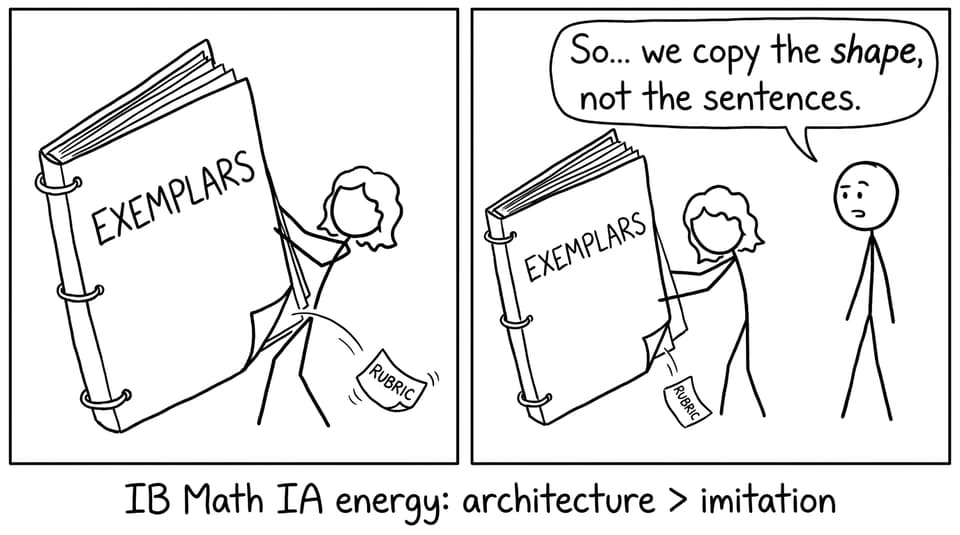
Use IB exemplars to copy structure, not content
The safest and most effective way to use IB exemplars is to copy architecture.
Here is a structure that shows up again and again in strong IB Math IAs:
A tight introduction that earns attention
Strong introductions do three things quickly:
-
Name the personal context (why this topic).
-
State a clear research question.
-
Preview the math methods you will use.
You can practice writing this kind of intro by studying how strong students phrase choices and scope, then drafting your own version and testing it with RevisionDojo’s AI Chat (ask one precise question like: “Is my research question measurable and narrow enough for an IA?”).
A mathematical exploration with visible decisions
Exemplars make decisions visible: why this model, why these variables, why this transformation, why this interval. In the IB, method marks often live in your justification.
If you’re fuzzy on the tools your exploration needs, use RevisionDojo’s subject hubs to refresh methods before you write. For AA, the IB Mathematics Analysis and Approaches Resources are a clean map of what you’re expected to know.
Analysis that interprets, not just computes
The exemplar difference is rarely “more calculations.” It’s more meaning.
You’ll see students explain parameters, test model fit, discuss residuals, or comment on sensitivity and limitations. That interpretive voice is extremely IB.
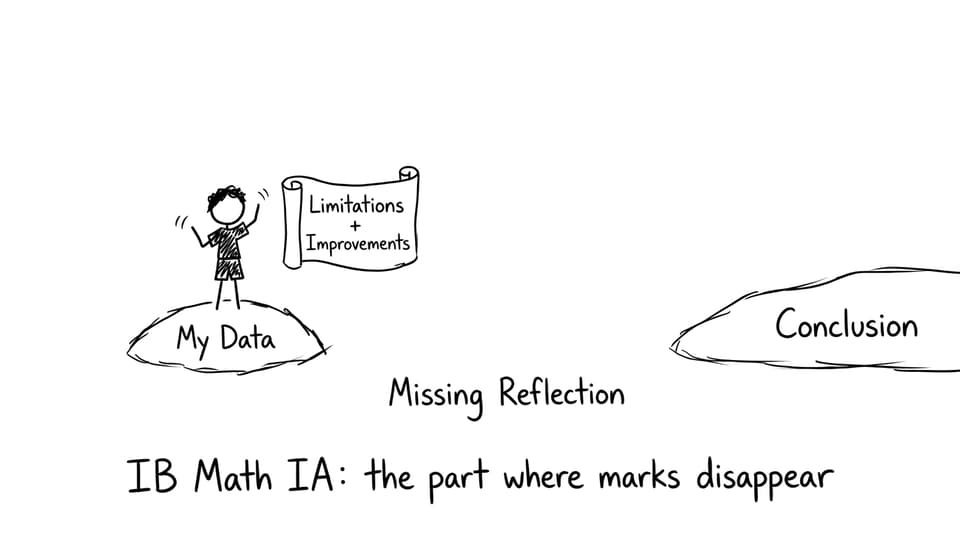
Reflection that sounds like a thinker, not a narrator
Many IB students write reflection like a diary: “I learned a lot.” Examiners reward reflection that changes the work: assumptions, errors, improvements, scope limits.
A useful prompt is: “What would I change if I had one more week, and how would that change affect reliability?” If you want a simple reflection framework, use How to Reflect on Challenges in Your IB IA or EE.
Use exemplars to level up math depth (without forcing complexity)
A classic IB trap is thinking “harder math” automatically means “higher marks.” Exemplars teach the opposite: appropriate math, used well, wins.
What depth often looks like in practice:
-
You define variables clearly and use consistent notation.
-
You validate a model (compare alternatives, check fit, explain why one is better).
-
You interpret parameters in context.
-
You connect results back to the research question.
If you’re in AI and your IA uses statistics, calibrate your technique with topic pages like Statistics & Probability (even AA students benefit from reviewing how results are interpreted and communicated).
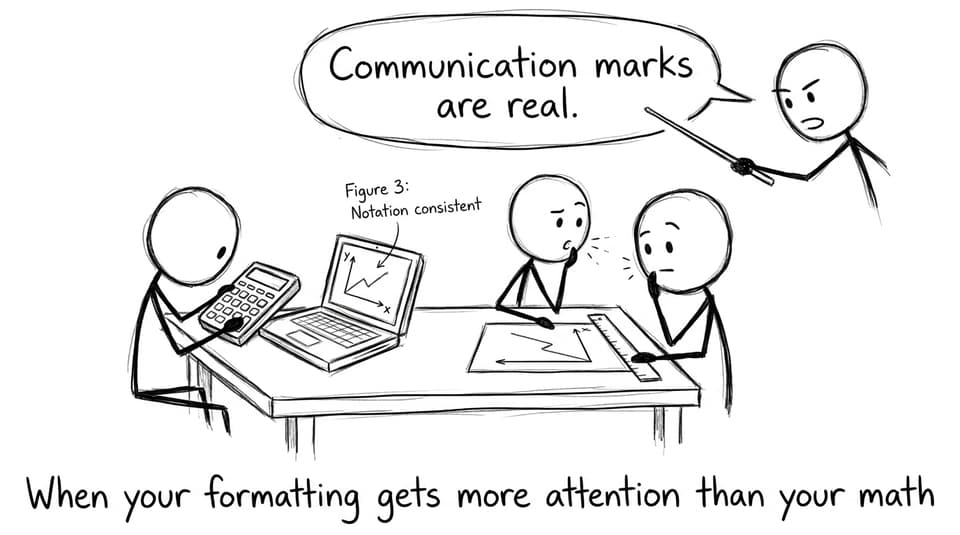
Presentation: the easiest IB marks to stop losing
Exemplars also teach a painful truth: some marks vanish for avoidable reasons.
Strong IB IAs typically:
-
Label every figure and table meaningfully.
-
Use one notation system consistently.
-
Round sensibly and state units.
-
Keep graphs readable and referenced in the text.
This is where RevisionDojo’s Grading tools help. Upload a draft to IB Coursework Grader for criterion-aligned feedback, then fix what moves marks first (not what feels easiest).
A practical “compare and revise” loop for IB students
Exemplars become powerful when you use them as a repeatable loop, not a one-time read.
Pick one exemplar and one section to upgrade
Don’t try to rebuild your whole IA in a night. Pick one section (often reflection or analysis) and match the exemplar’s standard.
Get fast feedback, then drill the skill
RevisionDojo works best when coursework improvement doesn’t steal all your exam time. Use the platform like connected gears:
-
Study Notes to refresh the method
-
Flashcards to lock in definitions and conditions
-
AI Chat to sanity-check decisions and phrasing
-
Grading tools to see what the rubric actually rewards
-
Questionbank to protect exam performance while the IA is in progress
If you need an exam rhythm that survives IA season, keep a lightweight plan like the one in How to Revise IB Math AA and AI Effectively.
Use a second exemplar for creativity, not comparison
After you fix structure and criteria alignment, use a second IB exemplar to expand your thinking: different modeling choices, different ways to evaluate reliability, different visualization styles.
For topic inspiration, Examples of Successful IB Math IA Topics can help you see what tends to work.
Final thought: the calmest way to write an IB Math IA is to stop guessing
The best IB students aren’t always the ones with the most advanced math. They’re the ones who can see what the rubric wants, then build toward it without drama.
IA/EE exemplars let you see the target. RevisionDojo helps you hit it, with a Coursework Library full of exemplars, Grading tools that translate criteria into edits, AI Chat for stuck moments, and exam resources (Questionbank, Study Notes, Flashcards, Predicted Papers, Mock Exams, and Tutors) so your IB grades keep rising while the IA gets polished.
If you want the fastest next step, open the IB Coursework Examples: IA, EE and TOK Exemplars, pick one strong IB Math exemplar, and rewrite just one section of your draft today. That one upgrade often changes the whole IA.