
For IB students sitting exams in May 2028 who started DP1 in August 2026.
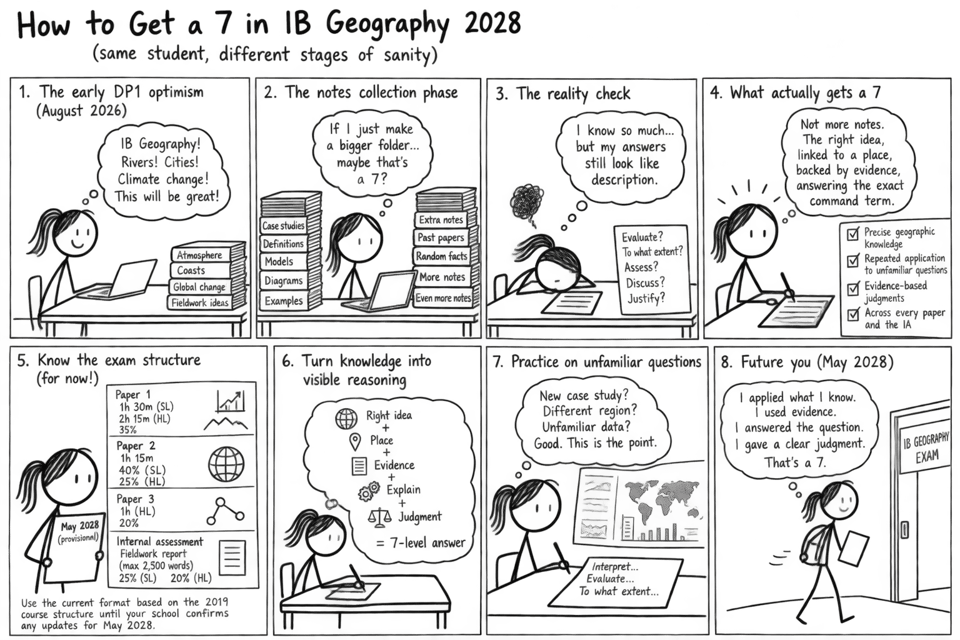
To learn how to get a 7 in IB Geography 2028, focus on three things: precise geographic knowledge, repeated application to unfamiliar questions, and evidence-based judgments across every paper and the IA. For the May 2028 cohort, preparation should currently follow the published IB Geography course structure while treating unannounced examination details as provisional.
A 7 is not earned by collecting the largest folder of notes. It comes from retrieving the right idea, connecting it to a place, interpreting evidence, and answering the exact command term under time pressure. Many students know enough Geography to reach a high grade, but their knowledge appears as description when the question demands evaluation. The goal is to convert what you know into visible, assessable reasoning.
The May 2028 syllabus position
The IB's public Geography page currently links to the subject brief for the course first assessed in 2019. Under that structure, SL students complete Paper 1, Paper 2, and an internal assessment, while HL students also complete Paper 3.
At the time of writing, the IB has not publicly released a separate Geography guide identified specifically as first assessment May 2028. It has not published the detailed May 2028 examination timetable, final questions, or grade boundaries. Boundaries cannot be predicted reliably because they are set after assessment and may vary between sessions.
The current format is therefore the best available planning basis. Your coordinator and Geography teacher should confirm the version shown in official school-facing IB documentation before you make final decisions about content or timing.
| Component | SL | HL | What it tests |
|---|---|---|---|
| Paper 1 | 1 hour 30 minutes, 35% | 2 hours 15 minutes, 35% | Optional geographic themes, stimulus interpretation, knowledge and extended writing |
| Paper 2 | 1 hour 15 minutes, 40% | 1 hour 15 minutes, 25% | Geographic perspectives and global change |
| Paper 3 | Not taken | 1 hour, 20% | Synthesis and evaluation within the HL extension |
| Internal assessment | 25% | 20% | An individual fieldwork report, currently capped at 2,500 words |
Use these details provisionally until your school confirms that no course update applies. The RevisionDojo IB Geography hub can keep your topic review and question practice in one place.
What 7-level Geography performance looks like
A top response usually does several small things well simultaneously. It answers the question immediately, uses geographic vocabulary accurately, selects relevant evidence, explains relationships, acknowledges limitations, and reaches a defensible judgment.
Use this checklist when reviewing your work:
- Have I translated the command term into a clear task?
- Does every paragraph help answer that task?
- Have I used a named place, process, model, or source where appropriate?
- Have I explained why the evidence matters rather than merely inserting it?
- Have I considered scale, stakeholders, time, or uncertainty?
- Does my conclusion decide something using explicit criteria?
A useful mental sequence is claim, evidence, geographic reasoning, qualification, judgment. Not every short response needs all five stages, but longer analytical and evaluative answers usually do.
How to perform across the examination papers
Paper 1: turn optional themes into analytical tools
Paper 1 rewards secure knowledge of your selected optional themes, but knowledge is not the destination. You must interpret maps, photographs, graphs, and written sources before connecting them to geographic processes and examples.
For each theme, build a compact case-study bank. Record the location, scale, process, two or three pieces of usable evidence, stakeholder differences, and one limitation. Do not turn a case study into a memorized speech that you force into every question.
Instead, practise the same example through different commands. Explain why something happened. Discuss contrasting consequences. Evaluate whether a response was effective. RevisionDojo's guidance on why Geography case studies matter and using case studies to improve exam performance develops this approach.
Consider this illustrative prompt:
Evaluate the effectiveness of urban planning in reducing flood vulnerability.
A descriptive response lists barriers, drainage systems, and zoning. A stronger structure would include:
- Judgment: Planning can reduce exposure, but its effectiveness depends on enforcement, maintenance, and inclusion.
- Evidence: Introduce one accurately learned urban example and its planning measures.
- Reasoning: Explain how each measure changes exposure, sensitivity, or adaptive capacity.
- Counterpoint: Show where informal development, extreme events, funding limits, or displaced risk weakens the strategy.
- Final judgment: Decide its effectiveness using criteria such as coverage, durability, equity, and cost.
This is not an official IB mark scheme. It demonstrates how evidence becomes evaluation.
Paper 2: connect the core instead of revising separate boxes
Paper 2 tests geographic perspectives on global change. Strong candidates move between population, climate, resource use, security, and development rather than treating each chapter as isolated.
Suppose a stimulus shows changing water consumption across countries. A limited answer reports the highest and lowest values. A better answer identifies the overall pattern, supports it with accurate figures, notes an anomaly, and proposes a plausible explanation without claiming the graph proves causation.
For extended responses, draw links across scales. A national policy may shape household behavior, while global trade transfers environmental costs elsewhere. Geography becomes powerful when it shows that a local outcome can have a distant cause.
Practise data interpretation alongside essays. RevisionDojo IB Geography Study Notes and question tools support content review, while Flashcards help retrieve definitions, processes, locations, and case-study details. The Questionbank is where that recall becomes application.
Paper 3: make synthesis visible at HL
HL Paper 3 is not simply another opportunity to reproduce the HL extension. It requires you to combine concepts, examples, and perspectives in response to broad questions about global interactions.
Before writing, define the question's central tension. A question about whether global interactions create uniformity, for example, invites comparison of economic, cultural, political, and spatial outcomes. It also requires decisions about scale and exceptions.
Build your plan around three moves:
- establish a qualified overall position;
- test it through contrasting processes, places, and stakeholders;
- refine it into a final judgment.
Avoid arranging the essay as a tour of everything you remember. Select evidence according to the argument. Every paragraph should strengthen, limit, or reshape your thesis.
How to produce a 7-level Geography IA
The current Geography IA is an individual fieldwork report with a maximum of 2,500 words. The published structure uses six criteria totaling 25 marks: fieldwork question and geographic context, methodology, quality and treatment of information, written analysis, conclusion, and evaluation.
A strong investigation begins with a focused question that can be answered using the data collected. The map and geographic context should explain why the location matters. The methodology should justify sampling and data-collection decisions rather than merely narrating what the class did.
Analysis is where many reports lose direction. A graph is not analysis by itself. After every figure or statistical result, explain the pattern, connect it to geographic theory, identify anomalies, and consider whether the evidence supports the fieldwork question.
For example, you might find that environmental quality generally improved with distance from a busy road. The analysis should connect that pattern to traffic intensity, identify any site that departed from it, and consider whether vegetation, land use, or another variable offers a plausible explanation. This interpretation is stronger than claiming that distance alone caused the result.
Your conclusion should answer the fieldwork question directly and in proportion to the evidence. Your evaluation should identify specific limitations, explain their likely effect on reliability or validity, and propose realistic improvements. Saying that more time would help is weaker than identifying which additional sites, collection times, or sampling method would reduce a known bias.
Use the RevisionDojo Geography IA Grader to inspect your report criterion by criterion. AI Grading tools can reveal missing explanation, while the Coursework Library can clarify effective academic structure. They should support your judgment, not replace teacher feedback or authorize copying.
A two-year plan for a 7 in IB Geography
August-December 2026: build accurate foundations
Create concise notes after each topic and begin a case-study ledger immediately. Learn command terms through questions rather than detached definitions. The guide to first-term IB Geography expectations is useful if the course initially feels broader than expected.
Each week, complete one short stimulus response and one planned extended answer. You need not write every essay in full. Planning teaches selection, while occasional timed writing tests whether your reasoning survives contact with the clock.
January-June 2027: improve explanation and prepare fieldwork
Compare your responses with mark guidance and teacher feedback. Track errors under headings such as knowledge, command term, evidence, analysis, timing, and judgment. Patterns matter more than isolated scores.
Before fieldwork, understand the research question, variables, sampling decisions, ethical considerations, and limitations. The discussion of common IB Geography first-term struggles can help diagnose whether your difficulty is recall, interpretation, or writing.
July-August 2027: consolidate without trying to finish everything
Use the break to repair DP1 gaps. Reduce each case study to a flexible one-page record, then retrieve it from memory. RevisionDojo Flashcards and Study Notes can make this systematic, while AI Chat can explain a confusing process or ask follow-up questions.
Do not build revision around unverified predictions. Predicted Papers can become useful when explicitly aligned with the confirmed May 2028 course, but no provider can know the actual examination questions in advance.
September-December 2027: complete the IA and integrate the course
Finish the IA early enough to revise thoughtfully within your school's rules. Check every visual for a title, labeling, source, and purpose. Then read the report as one argument: question, method, evidence, conclusion, and evaluation should align.
Begin mixed-topic examination sessions. Use the RevisionDojo guide to manageable Geography case studies to simplify your evidence bank without sacrificing relevance.
January-May 2028: practise decisions under time pressure
Move from topic practice to complete timed sections and then Mock Exams. The value of a mock is not the number at the top. It is the evidence underneath: where time disappeared, which command was mishandled, and which examples could not be retrieved.
RevisionDojo's guide to IB Geography Mock Exams explains how to use simulation deliberately. The collection of IB resources for May 2028 students can help coordinate Geography with your other subjects. If a weakness persists, Tutors can provide targeted human feedback rather than another round of passive rereading.
Keep checking official information through your coordinator. The May 2028 examination schedule and session-specific administrative instructions were not available in the official results reviewed for this article, so do not build a final calendar around assumed dates.
The quiet advantage of deliberate practice
Getting a 7 in IB Geography is not about sounding certain on every issue. Geography often deals with incomplete evidence, uneven impacts, and outcomes that change with scale. The strongest responses are confident enough to decide, but careful enough to qualify.
RevisionDojo brings that process together through its Questionbank, Study Notes, Flashcards, AI Chat, Grading tools, Predicted Papers, Mock Exams, Coursework Library, and Tutors. These tools shorten the distance between learning an idea and discovering whether you can use it.
Your next step is specific: open the RevisionDojo IB Geography Questionbank, choose one topic studied this week, complete one exam-style question under timed conditions, and rewrite the weakest paragraph using claim, evidence, reasoning, qualification, and judgment.