



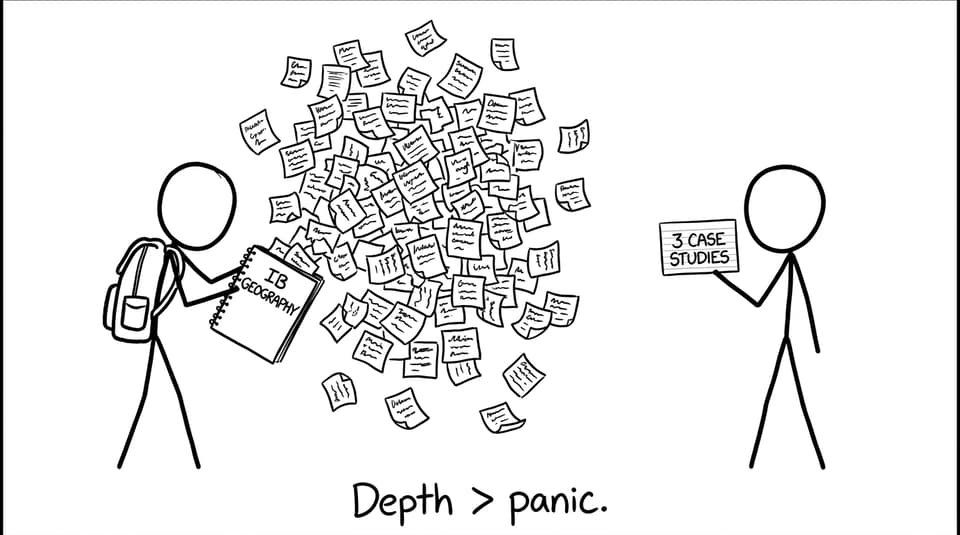
There’s a moment in every revision season where your notes stop feeling like knowledge and start feeling like luggage. You drag them from desk to desk, convinced the weight itself will earn you marks.
For IB Geography, that moment often arrives with case studies. Not because case studies are hard, but because students treat them like trivia collections instead of tools.
The goal of “easy” case studies isn’t to be lazy. It’s to be usable under time pressure: clear causes, clear impacts, clear responses, and a few memorable stats. That’s what gets you over the line in exam essays.
A quick checklist for easy IB Geography case studies
Before you commit a case study to memory for IB Geography, run this five-part test:
-
One-sentence summary: can you describe it in 15 seconds?
-
Cause, Impact, Response: do you have at least 2 points for each?
-
Named place + date: can you anchor it in time and space?
-
Two statistics: not twenty. Two.
-
Evaluation hook: one limitation or criticism (even a small one).
If a case study passes that test, it’s “easy” in the only way that matters for IB exams: it’s retrievable.
To practise applying these quickly, build short timed responses using the IB Geography resources hub and then pressure-test your recall with RevisionDojo Flashcards and Study Notes.
Urban environments case study: Curitiba (Brazil)
Curitiba is a gift to IB Geography students because it’s basically a story about planning choices. You don’t need specialist jargon to explain it. You just need the sequence.
Why Curitiba is one of the easiest IB Geography case studies
-
Context: Curitiba, Brazil.
-
Big idea: planning + public transport can shape growth.
-
What to remember:
-
Bus Rapid Transit (BRT) as a cheaper, flexible mass transit option.
-
Green space and parks used as flood management and liveability improvements.
-
Recycling and waste programs designed to work with community incentives.
-
How to use Curitiba in exam answers
Use it for questions on urban sustainability, transport strategies, and managing rapid urban growth. Add evaluation by noting that replicating Curitiba depends on governance capacity, funding, and local political support.
If you want a broader menu of optional-theme examples, keep the Comprehensive guide to Geography case studies for IB exams open while you build your own shortlist.

Population and migration case study: Mexico to USA migration
Some case studies are easy because they’re famous. This one is easy because the logic is intuitive: people move when staying feels riskier than leaving.
Why this migration case study works well for IB Geography
-
Context: migration flows from Mexico to the United States.
-
What to remember:
-
Push factors: unemployment, poverty, insecurity/crime (plus local opportunity gaps).
-
Pull factors: higher wages, more job opportunities, established migrant networks.
-
Impacts:
-
Destination: labour supply, cultural diversity, political tension and policy debate.
-
Origin: remittances, brain drain in some sectors, social change.
-
-
How to use it in exam answers
Use it to structure essays on push/pull factors, migration impacts, and flows at different scales. Evaluation can include the way policy shifts change routes and risks over time.
For technique, practise writing “because” sentences (cause) followed by “therefore” sentences (impact), then finish with a “however” sentence (evaluation). RevisionDojo’s AI Chat is useful here for turning vague ideas into sharper chains of reasoning, then you can drill similar prompts in the Questionbank.
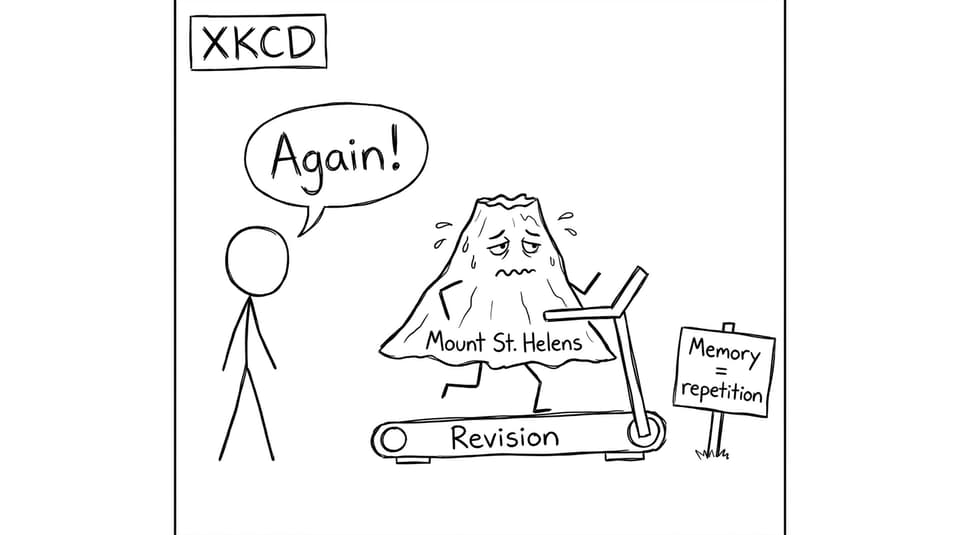
Hazards and disasters case study: Mount St. Helens (1980)
Hazards become easy when the narrative is clear. Mount St. Helens is a classic: a dramatic event, well-documented impacts, and obvious lessons about monitoring and evacuation.
Why Mount St. Helens is easy to memorise for IB Geography
-
Context: Washington State, USA.
-
Date: May 18, 1980.
-
What to remember:
-
Major eruption linked with a large landslide.
-
57 deaths and widespread damage to forests, infrastructure, and local economies.
-
Long-term recovery and improved hazard monitoring.
-
How to use it in exam answers
Use it for volcanic hazard profiles, risk management, and comparing vulnerability in different places.
To go deeper (and pick up extra comparison options like Merapi or Tōhoku), RevisionDojo’s Case studies of geophysical hazards notes are ideal for quick retrieval, and the matching geophysical hazards flashcards help lock in key facts.
Global climate change case study: Kiribati and sea-level rise
Kiribati is “easy” because the link between process and outcome is direct: low-lying islands + sea-level rise = existential risk.
Why Kiribati is a strong, simple IB Geography case study
-
Context: Kiribati, a low-lying island nation in the Pacific.
-
What to remember:
-
Vulnerability: limited elevation, exposure to storm surges, coastal erosion.
-
Impacts: threats to housing, freshwater supplies, agriculture, and livelihoods.
-
Responses: adaptation planning, relocation discussions, international advocacy.
-
How to use it in exam answers
Use it for climate vulnerability, adaptation vs mitigation, and environmental justice. Evaluation can highlight funding limits, sovereignty issues, and the uneven responsibility for emissions.
To strengthen your data-handling for climate questions, pair the case study with How to analyze IB Geography data effectively so your essays don’t become opinion pieces.
Resource management case study: Singapore water management
Singapore is the kind of case study examiners like because it’s a clear example of policy meeting constraint.
Why Singapore is one of the easiest resource management case studies
-
Context: Singapore (limited natural freshwater supply).
-
What to remember:
-
Desalination
-
Water recycling (NEWater)
-
Rainwater capture and demand management through public education
-
Outcome: increased water security and resilience.
-
How to use it in exam answers
Use it for water scarcity, sustainability strategies, and evaluating how wealthy, well-governed states can reduce vulnerability.
If you’re unsure which themes matter most for your paper structure, it helps to clarify your course demands using Understanding the differences between IB Geography SL and HL.
How to revise case studies so they actually appear in your essays
Most students “revise” case studies by rereading. Most marks come from deployment.
A simple routine that works for IB Geography
-
Build one-page summaries in RevisionDojo’s Study Notes style: context, causes, impacts, responses, evaluation.
-
Convert those into 10-12 Flashcards per case study (nothing more).
-
Use the Questionbank to practise the same case study across different command terms (explain, discuss, evaluate).
-
Run one timed essay per week and use RevisionDojo’s Grading tools to spot where your evidence is thin.
-
Two weeks before exams, use Mock Exams and Predicted Papers to practise selecting the right case study fast.
The calm way to win marks with IB Geography case studies
The easiest IB Geography case studies are the ones you can use without thinking: Curitiba, Mexico to USA migration, Mount St. Helens, Kiribati, Singapore. They’re memorable because their logic is clean.
If you want to turn these from “things I read once” into “evidence I can deploy,” build your shortlist inside the IB Geography resources hub, then cycle Study Notes, Flashcards, and the Questionbank until your examples feel automatic. That’s when case studies stop being luggage and start becoming leverage.
Further reading you can use next: