The biggest adjustment shock in IB Geography is simple: knowing the content is no longer enough. Students must select relevant knowledge, apply it to unfamiliar material, support claims with located evidence, and make judgments that answer the exact command term.
That is why many IB Geography first term struggles feel confusing. A student may understand urbanization, revise every definition, and still receive an unexpectedly ordinary mark. The problem is often not effort or memory. It is the conversion of knowledge into geographic analysis.
IB Geography connects physical and human processes, patterns across scales, perspectives, case studies, data interpretation, and evaluation. Adjusting therefore means learning to think with information rather than repeat it.
The first-term adjustment checklist
By the end of your first term, aim to:
- translate command terms into clear answer structures
- explain processes through cause-and-effect chains
- use a small amount of precise case-study evidence
- read graphs, maps, photographs, and tables methodically
- distinguish description from analysis and evaluation
- identify why marks were lost
- complete one short timed response each week
You do not need complete mastery by December. You need a repeatable system that closes the gap between what you know and what you can demonstrate.
The real source of IB Geography first term struggles
Earlier geography courses may reward broad understanding. IB questions can demand another layer: why patterns vary, how processes interact, whether a response was effective, and which stakeholders benefited.
Imagine a student studying flood management. Their notes contain definitions, diagrams, impacts, and several strategies. Then the question asks them to evaluate whether hard engineering is an effective long-term response.
Listing dams, levees, and channelization does not evaluate anything. The student needs criteria such as cost, durability, environmental impact, and social equity. They must apply evidence, recognize limitations, and reach a defensible judgment.
That shift is the shock. Geography stops feeling like a collection of facts and starts behaving like an argument supported by place, scale, process, and evidence.
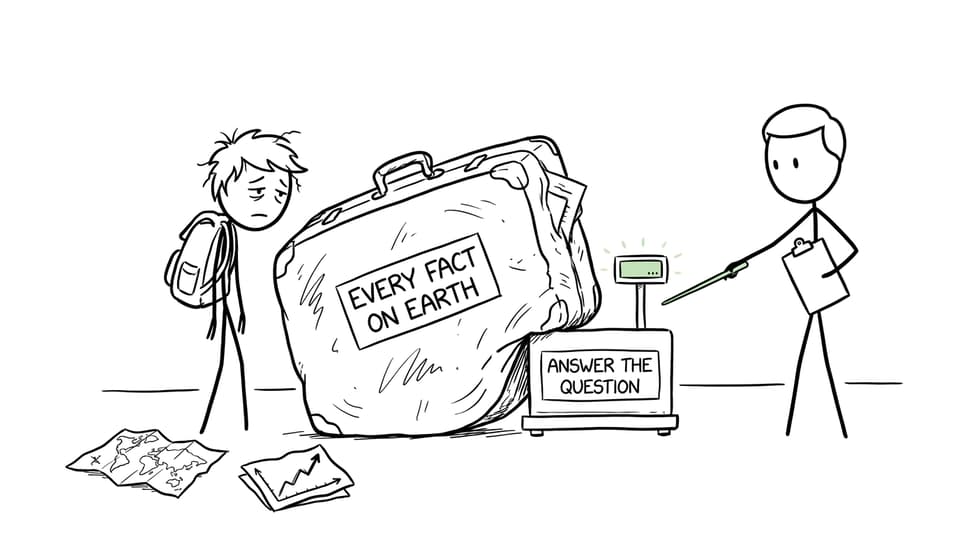
More note-taking can temporarily hide the problem. Familiar pages create fluency, but recognition is not retrieval, and retrieval is not application.
Learn the language inside each question
Command terms reveal what kind of thinking an answer must display:
- Describe: identify an observable pattern accurately.
- Explain: connect a cause to a process and consequence.
- Compare: refer to both examples and identify meaningful similarities or differences.
- Discuss: consider multiple arguments or perspectives before concluding.
- Evaluate: weigh strengths and limitations against explicit criteria.
The RevisionDojo guide to IB command terms explains how these verbs change the expected answer.
Before writing, translate the command term into an instruction. For example, turn evaluate into “criteria, evidence, limitations, judgment.” This brief pause prevents irrelevant writing.
Build case studies for use, not display
A disappointing mark often sends students searching for more case studies. The result can be overloaded notes that are difficult to recall or adapt.
Instead, build each example around six elements:
- named location and relevant period
- geographic scale
- central process or driver
- two or three useful pieces of evidence
- affected stakeholders and responses
- one limitation, trade-off, or judgment
The aim is flexible evidence, not a memorized paragraph. One flood event, migration policy, or urban strategy may support several questions when you understand what it proves.
RevisionDojo's IB Geography case-study guide provides a practical framework. Use IB Geography Flashcards to retrieve locations, processes, statistics, and evaluation points without rereading an entire notebook.
Turn every topic into three layers
Understand the concept
Begin with definitions, models, processes, and relationships. RevisionDojo's IB Geography Study Notes can establish that foundation without turning revision into endless copying.
Close the notes and explain the concept aloud. If you cannot explain why one factor leads to another, return to that precise gap rather than restarting the chapter.
Attach geographic evidence
Add one or two examples showing how the concept operates in a real place. Record only evidence you can explain. A statistic without an argumentative purpose is decoration, not analysis.
Ask, “What claim could this evidence support?” If you cannot answer, the detail probably does not belong in your core revision set.
Practise the assessed action
Finally, answer a question. The IB Geography Question Bank moves you from learning into exam-style application by topic.
This is where understanding becomes visible. RevisionDojo's AI Chat can clarify why a response remained descriptive, while Grading tools can identify missing evidence, weak reasoning, or an unsupported conclusion.
Use a realistic weekly routine
Early progress comes from short cycles of retrieval, application, and correction. Try this structure:
- Monday: review one concept and create five retrieval prompts.
- Tuesday: improve one compact case-study card.
- Wednesday: interpret one graph, map, or table.
- Thursday: write one command-term paragraph.
- Friday: review feedback and label the mistake.
- Weekend: complete one 20-30 minute mixed practice session.
For data work, identify the data type, read the title and units, state a quantified pattern, note an anomaly, and explain the relevant process. The IB Geography data-analysis framework develops this routine further.
Keep an error log with four categories: knowledge, evidence, command term, and structure. This replaces the vague belief that you are “bad at Geography” with a specific next step.
What not to prioritize yet
The first term is not the time to memorize dozens of examples or constantly complete full-paper simulations. Build accurate habits on smaller tasks first.
Predicted Papers and Mock Exams become more useful after you have covered enough content to practise selection, timing, and stamina. The Coursework Library can support your understanding of geographic investigations, while Tutors offer focused human guidance when feedback reveals a persistent weakness.
For now, prioritize understanding the question, choosing relevant knowledge, connecting causes to consequences, and supporting reasoning with evidence. The complete RevisionDojo guide to IB Geography shows how these habits connect across the course.
The first term is calibration, not a verdict
An early mark measures your current response to an unfamiliar academic system. It does not define your eventual level.
Students adjust by noticing what the assessment demands, practising that demand in small doses, and using feedback before mistakes become habits. RevisionDojo brings that loop together: Study Notes and Flashcards build knowledge, the Questionbank turns it into action, and AI Chat and Grading tools reveal weaknesses. Later, Predicted Papers, Mock Exams, the Coursework Library, and Tutors support deeper preparation.
IB Geography becomes manageable when you stop trying to remember the whole world and start making one clear, evidenced geographic argument at a time.