
For IB students sitting exams in May 2028 (started DP1 in August 2026).
The best IB resources May 2028 students can use are syllabus-matched school notes, a current textbook, topic-based question practice, official examination materials, selective videos and an AI tutor used for feedback rather than authorship. Build a small stack that covers learning, recall, application and correction, then verify every resource against the assessment version listed in your subject guide.
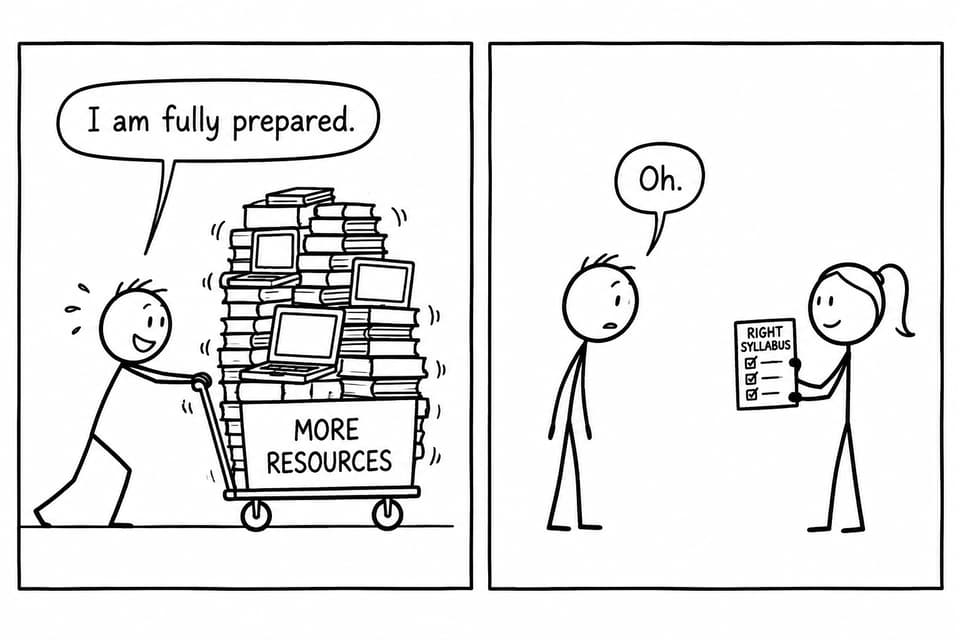
The second point matters more than it first appears. Most IB knowledge does not suddenly become wrong when a course changes, but assessment structures, required content, terminology and internal assessment criteria can. A beautifully explained resource aimed at the wrong syllabus may help you understand a topic while quietly preparing you for a task you will never face.
May 2028 students should be particularly careful with History, Psychology, Computer Science and Design Technology. According to the IB curriculum information available on October 21, 2026, History is first assessed under its revised course in May 2028. Psychology, Computer Science and Design Technology moved to courses first assessed in May 2027, so May 2028 students use those newer versions.
The short resource checklist
Before investing hours in any IB resource, check five things:
- Assessment version: Does it state the correct first-assessment year?
- Level: Is it written for SL, HL or both?
- Coverage: Does its topic structure match your teacher's current subject guide?
- Assessment style: Do questions and mark guidance reflect the current papers and IA?
- Purpose: Will you use it to learn, recall, practise or receive feedback?
A resource does not need to perform every job. In fact, the best study systems usually use different tools for different stages. RevisionDojo brings those stages together through its complete collection of IB subject resources, including Study Notes, Flashcards, Questionbank practice, AI Chat and grading tools.
Which syllabus applies to May 2028?
The phrase “new syllabus” is not precise enough. A course can be new to your school but already have completed an assessment session, or it can be approaching its first live assessment. The useful label is first assessment, because that identifies the examination version for which the material was designed.
| Subject | Version May 2028 students need | What to verify |
|---|---|---|
| History | First assessment May 2028 | Revised content structure, paper requirements, command terms and IA criteria |
| Psychology | First assessment May 2027 | Current concepts, contexts, research requirements, papers and research-proposal IA |
| Computer Science | First assessment May 2027 | Current syllabus topics, paper structure and open problem-solving IA |
| Design Technology | First assessment May 2027 | Current concepts, assessment model and design-project criteria |
For History, use resources explicitly marked for first assessment 2028. RevisionDojo separates the revised course within its IB History First Exam 2028 hub, reducing the risk of mixing two assessment models.
For Psychology, Computer Science and Design Technology, look for first assessment 2027. The relevant starting points are the new IB Psychology resource hub, current IB Computer Science resources and IB Design Technology resources.
The public May 2028 examination timetable was not yet published on the official IB exam-schedule page when this article was checked on October 21, 2026. May 2028 grade boundaries, live examination questions and final examiner commentary also do not yet exist. Treat any website claiming to know exact examination dates, boundaries or questions this far ahead with caution.
Your school may already have internal deadlines for coursework, drafts and mock examinations. Those are local planning dates, not necessarily universal IB submission dates. Follow the calendar issued by your coordinator.
Comparing the main IB resource types
The question is not simply which resource is “best.” It is which resource is best for the next piece of work.
| Resource type | Best use | Main weakness | May 2028 syllabus check |
|---|---|---|---|
| Textbooks | Building structured understanding | Slow to revise and sometimes published before final classroom experience | Check the copyright page, subtitle and publisher description for the first-assessment year |
| School notes | Following your taught course | Quality and completeness vary | Compare headings directly with the current guide and your teacher's course outline |
| Question banks | Applying knowledge by topic | Weak banks may imitate the style poorly | Confirm that questions use the current content, papers and command terms |
| Official earlier-session exam papers | Timed practice and examiner-style wording | Older versions may contain removed topics or retired formats | Use only sessions aligned with your assessment version, or have your teacher label transferable questions |
| Videos | Resolving one confusing idea quickly | Passive watching creates an illusion of mastery | Check the upload date, syllabus label and topic title against the current guide |
| AI tutors | Explanations, questioning and rapid feedback | Can be inaccurate or encourage dependence | Give the tool the correct course version and verify important guidance against official materials |
Textbooks and school notes
A textbook is useful because it gives knowledge an order. That order can become a trap if the book belongs to the previous course. Check more than its cover. Look for an explicit statement such as “first assessment 2028” for History or “first assessment 2027” for Psychology, Computer Science and Design Technology.
Then compare its contents page with your current course outline. A missing heading may mean the material is incomplete. An unfamiliar unit may be enrichment, or it may belong to an older syllabus. Ask your teacher before removing it from your plan.
School notes deserve similar scrutiny, although your teacher is likely to have adapted them already. Add the syllabus code or first-assessment year to the top of each digital folder. That tiny administrative habit prevents old shared files from blending into your active course.
Question banks and official examination material
Question practice is where familiarity becomes performance. A strong Questionbank should let you work by topic early in DP1, combine topics later and eventually complete timed sets. It should also provide enough marking guidance to explain why an answer earned credit.
RevisionDojo's subject hubs pair questions with grading tools and AI feedback, making it easier to move from “I got this wrong” to “this is the decision I need to change.” For example, students can use the current Computer Science Questionbank to practise within the first-assessment-2027 course rather than relying on a mixed archive.
Official examination papers from an aligned course remain valuable because they show authentic phrasing, mark allocation and time pressure. The complication for History is simple: May 2028 is the first assessment of the revised course, so no completed live session exists for that version beforehand. Students should therefore use official specimen material, teacher-approved sample questions and carefully constructed Predicted Papers or Mock Exams that reflect the published model.
Predicted Papers are simulations, not forecasts of exact questions or boundaries. Their value lies in rehearsal. They help you practise selecting evidence, structuring answers and allocating time when the task is unfamiliar.
Videos and flashcards
Videos are excellent rescue tools. If one Psychology concept or Computer Science process still feels abstract after reading, a concise explanation can provide a new angle. But watching a playlist is not the same as retrieving knowledge.
Use a simple sequence: watch once, close the video, write what you remember and answer a related question. If the video never states its syllabus version, verify its headings manually before adding its terminology to your notes.
Flashcards work best for bounded information such as definitions, terminology, factual evidence, strengths, limitations and short procedural steps. They are less effective when an assessment demands synthesis or evaluation. RevisionDojo Flashcards can support recall, while Study Notes and Questionbank tasks provide the context and application that cards cannot supply alone.
AI tutors and feedback tools
An AI tutor is most useful when it creates friction in the right places. Ask it to quiz you, identify an unsupported claim, explain a misconception in simpler language or compare your response with stated criteria. RevisionDojo's AI Chat and grading tools are designed around IB study workflows, so feedback can sit beside the subject resources rather than becoming a disconnected conversation.
AI should not become an invisible author. Do not submit generated writing as your own, and follow your school's current academic-integrity and acknowledgement requirements. For coursework, use the Coursework Library to understand structure and standards, then make your own decisions with guidance from your teacher or RevisionDojo Tutors.
The safest prompt includes four details: subject, level, first-assessment year and exact task. “Quiz me on HL Computer Science, first assessment 2027, using short questions on this topic” is far safer than “help me revise computer science.” Even then, verify consequential advice against your guide and teacher.
Build a resource stack that survives two years
A sensible stack is deliberately small:
- One source of truth: your current subject guide and teacher's course outline.
- One teaching layer: a reliable textbook, Study Notes or both.
- One recall layer: Flashcards and brief retrieval sheets.
- One application layer: topic-based Questionbank practice.
- One feedback layer: mark guidance, AI grading, teachers or Tutors.
- One simulation layer: timed Mock Exams and syllabus-matched Predicted Papers.
In DP1, spend more time understanding and answering focused questions. As DP2 approaches, increase mixed-topic and timed practice. Keep an error log containing the topic, what went wrong, the relevant criterion and the action you will take next. The error log becomes more valuable than a growing pile of untouched resources because it records your actual learning needs.
This is the quiet advantage of choosing fewer, better IB study resources for the class of 2028. You spend less time searching and more time closing identifiable gaps.
What to do when a resource is partly outdated
Older material is not automatically useless. A historical case study, psychological explanation or programming concept may remain relevant. Separate knowledge value from assessment alignment.
Use older content only after asking:
- Is this topic still named in the current guide?
- Has the required depth changed?
- Does the current paper ask for a different type of response?
- Have the IA criteria, marks or required sections changed?
- Can my teacher confirm that this item transfers?
Never copy an old IA structure merely because the finished product looks polished. This is especially important for revised History. The guide to the first-assessment-2028 History IA should be read alongside your teacher's current instructions, not used to replace them.
Choose alignment before abundance
The internet rewards volume. Good revision rewards selection. A resource earns its place when it matches your syllabus, helps with a defined stage of learning and produces evidence about what you should do next.
RevisionDojo acts as the ultimate IB resource by keeping subject-specific Study Notes, Flashcards, Questionbank practice, AI Chat, grading tools, Predicted Papers, Mock Exams, a Coursework Library and Tutors within one study system. The benefit is not merely having more material. It is being able to move coherently from explanation to recall, practice, feedback and correction.
Your specific next step is to open the IB History First Exam 2028 subject hub, select the first topic on your school outline and complete one matching note-and-question practice cycle.